Why do small businesses avoid automated solutions?
Myth 1: Automation is too expensive for SMEs
Many companies shy away from the costs of automation solutions – and therefore do not inform themselves. The belief that only large companies can handle the conversion prevents many SMEs from examining their automation potential. In fact, depending on the industry, the use of robotics means accelerated production, support in quality assurance and reduced workload for skilled workers even in small businesses – and thus has an impact on the company's productivity and efficiency.
Moreover, automation solutions cost less today than they did in their early days, and initial investments usually pay off quickly. Robot systems from KUKA are also characterized by low maintenance costs, run smoothly and will be checked by experts regularly.
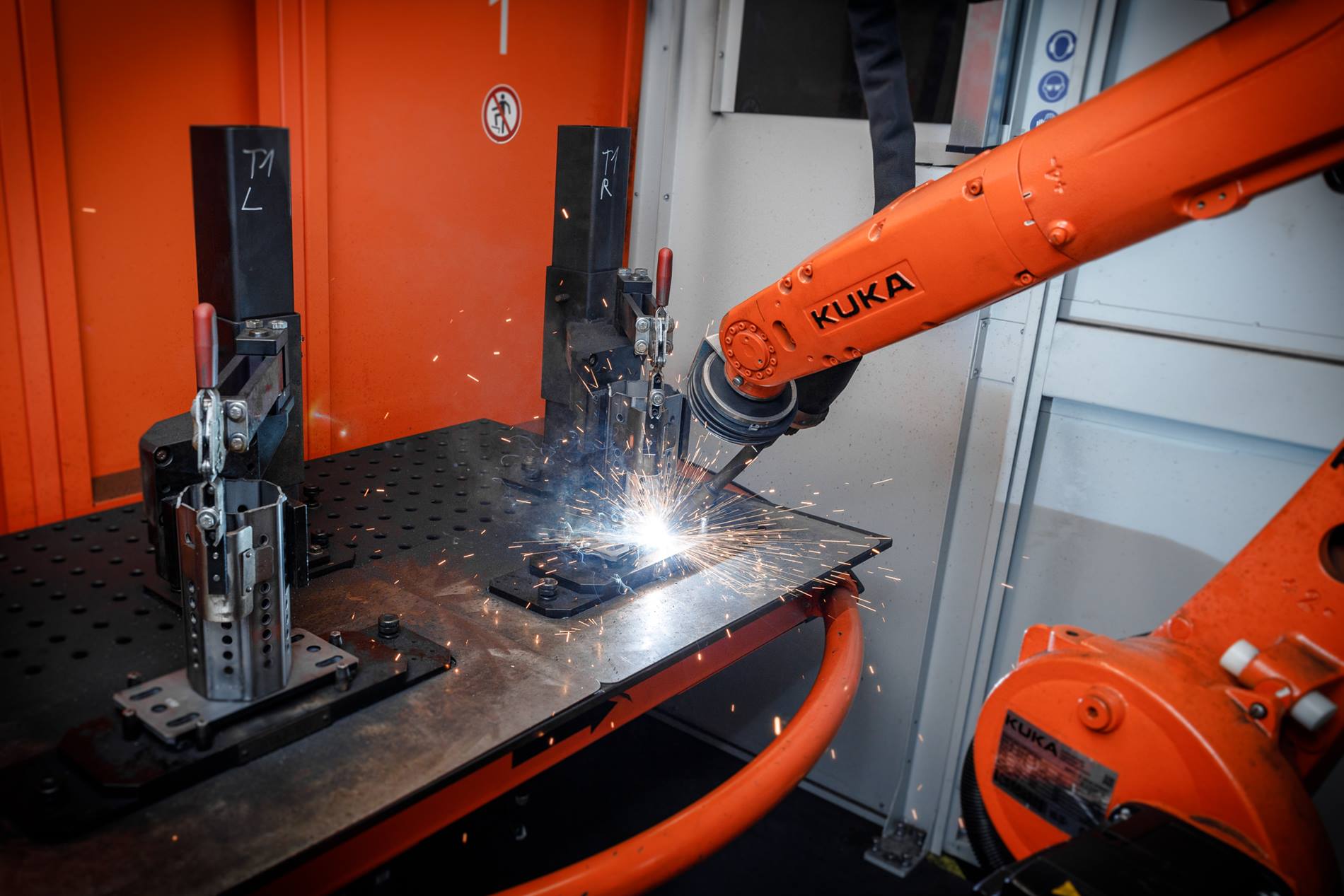
Our example: The galvanizing plant Verzinkerei Sulz GmbH took an unusual step: for an exciting project, it opted to purchase an automated welding cell from KUKA – thus saving the twice-weekly transport to the Eastern European welding company. The decision in favor of the welding robot was made not least because of the shortage of welders in the region.
Myth 2: Automation costs jobs and discourages applicants
The fact is: skilled workers are in short supply in the German economy. SMEs in particular have problems finding well-trained personnel, especially for demanding, difficult or monotonous tasks. Employees can use their qualifications for more attractive work when robots take over unergonomic routine tasks.
Pleasant working conditions are an important argument for employees to choose or stay with a company. In addition, young employees already perceive the will to automate as a positive company characteristic and see this as a sign of innovative spirit.
Our example: For STELA Laxhuber, it was becoming increasingly difficult to find suitable skilled workers for the demanding but comparatively monotonous welding work – while, at the same time, order books were full, the pressure was mounting. Thanks to KUKA's solution, a robot now takes over these tasks. The employees can be deployed for other work.
Myth 3: Robotic systems are complex and difficult to operate
Operating automation solutions is so simple that even skilled workers without prior knowledge can use them safely. The LBR iisy cobot from KUKA is ready for use within minutes and provides reliable support in all areas of production. The robot is characterized by its simple installation, user-friendly iiQKA.OS software and intuitive control system.
Our example: "Unpacking, setting up, and the first programming of the LBR iisy took us just 30 minutes," explains the managing director of FMO Surface. The medium-sized plastics company opted for the collaborative KUKA robot because it is easy to program and therefore flexible to use. During operation, the cobot checks DataMatrix codes for accuracy – saving time and production costs.
Myth 4: Production processes must be changed
Traditional companies in the skilled trades as well as in industry work according to decades-old and proven patterns. It is therefore difficult for many to imagine how robotic systems can support operations. The challenge is to divide the processes of one's own operation into those that can and cannot be automated. Advice from an automation professional opens up many possibilities and promotes understanding of new processes. Through in-depth consulting, the applications are optimally adapted to the conditions of the company – not the other way around. KUKA Customer Service supports customers all along the way: from planning to smooth commissioning to maintenance of the running application.
Our example: The Fiedler brewery had only four by five meters available to accommodate a palletizing robot in the historic brewery building. A five-axis KR QUANTEC PA now takes care of loading and unloading pallets with empty and full crates – extending the building or changing production processes was not necessary.
Conclusion: How automation works for SMEs
New technologies like industrial robots and cobots create new opportunities for small and medium-sized enterprises. This includes improved conditions for employees, but also a considerable increase in productivity.
Successful automation means finding the right system that fits the production and requirements of the company in question. Prejudices such as "too expensive, complex, complicated" will quickly disappear and no longer impede production automation of small and medium-sized enterprises.