You are using Internet Explorer and will not be able to use our website properly. Please change to an up-to-date browser for ideal presentation of the website.
Cost-effective and sustainable: KR FORTEC robots weld battery housings for plug-in hybrid cars
Combine the highest welding quality with green technology, and you have friction stir welding (FSW), the optimal process to use for non-ferrous metals with low melting temperatures and for metallic materials. KUKA applied its expertise in this area to put three friction stir welding cells into production for a major car manufacturer.
The challenge: battery housings for plug-in hybrid vehicles
Instead of cars with internal combustion engines, many consumers now prefer to drive electric vehicles. What's not obvious is that an electric car needs a “feel-good” temperature – or at least its batteries do – because only properly tempered batteries perform optimally and achieve their maximum service life. Therefore, these lithium-ion batteries must be cooled during operation and heated at a low ambient temperature. Particularly in a plug-in hybrid vehicle, this is a task for cooling systems integrated into the base of the battery carriers. These housings are extremely difficult to manufacture, which offers an optimal application for robot-based FSW processes.
Friction stir welding: the welding process for plug-in hybrid vehicles
Robot-based friction stir welding in battery manufacturing: this is how it’s done.
Friction stir welding for electric cars with plug-in hybrid functionality
A major car manufacturer also recognized this problem, and initially used adhesives and screws to manufacture the battery housings. When this process did not provide the desired results, the company scanned the market for a new solution. The demands on the battery housing are extreme: They require level module mounting surfaces and leak-tight end holes, and must pass pressure tests. With robot-based friction stir welding, KUKA offered the carmaker a process-safe and cost-effective method to produce plug-in hybrid electric cars, one that guarantees the safety and functionality of battery housings.
Feasibility studies to weld battery housings
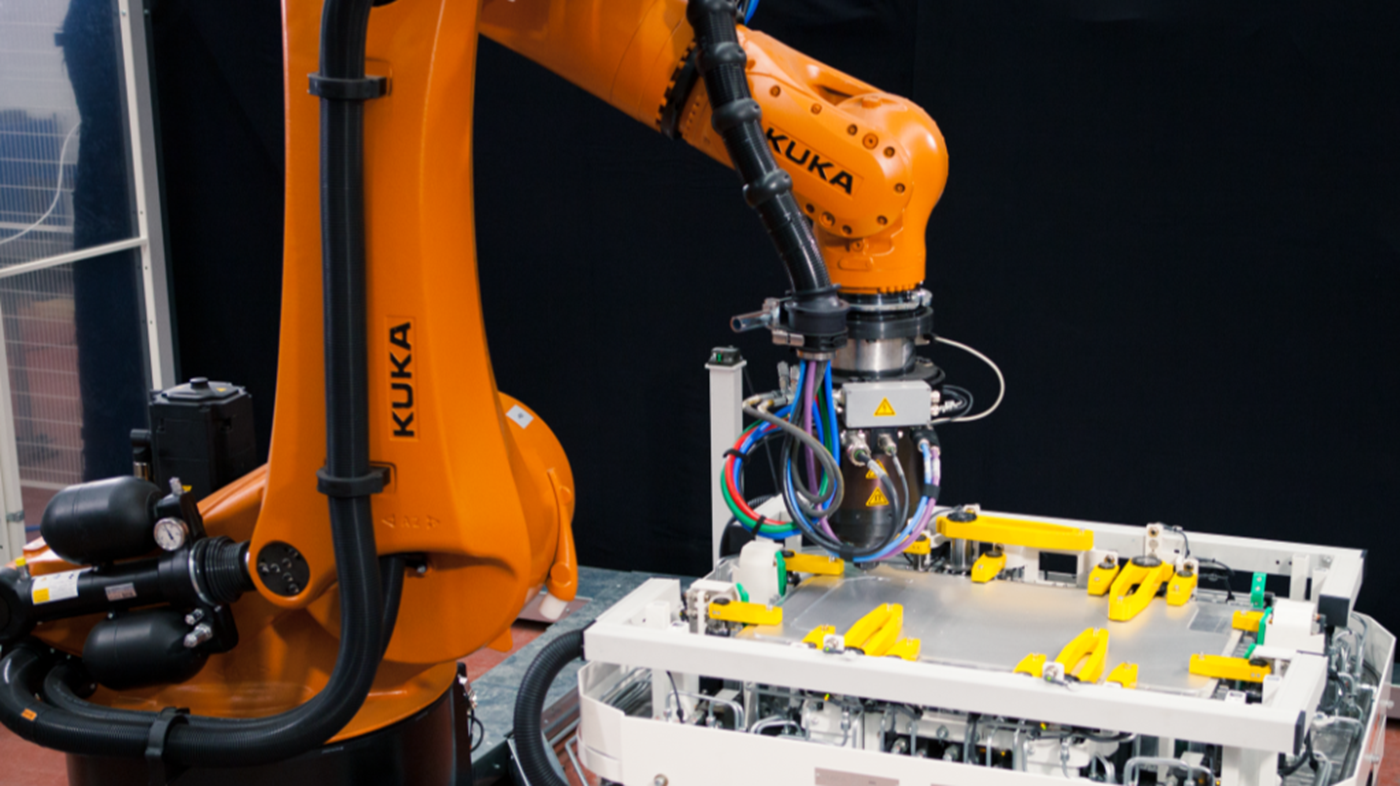
KUKA worked with the customer from the initial idea all the way through to testing and delivery. “We already had developed prototypes and gone through various tests with them. In feasibility studies, we tested metallurgical weldability and performed reachability analyses as well as process simulations. When all test results were more than satisfactory, we installed the system at the customer’s site,” explained Stefan Fröhlke, Senior Manager for Process Solution FSW at KUKA. The KUKA cell4_FSW friction stir welding cell, developed specifically for the growing electromobility market, leverages its modular concept to offer maximum versatility and configuration options in addition to outstanding cost efficiency.
The KUKA cell4_FSW friction stir welding cell uses two workstations to offer maximum process utilization.
In feasibility studies, we tested metallurgical weldability and performed reachability analyses as well as process simulations. When all test results were more than satisfactory, we installed the system at the customer’s site.
The benefits of friction stir welding with the right FSW tool
To seal the cooling system of plug-in hybrids, friction stir welding joins the base plate to the cast housing precisely along the cooling channels. A pressure-tight circuit that can withstand alternating pressure requires a large cross-section bond as well as a well-mixed and tight seam. “Friction stir welding has proven to be a suitable joining technology because the components exhibit minimal distortion from heat input,” noted Stefan Fröhlke in explaining the process. KUKA relies on stationary shoulder friction stir welding (SSFSW). This means that unlike in conventional friction stir welding, only the welding pin rotates in a stationary shoulder. This creates a level, smooth surface along the weld seam during the feed motion, which reduces the effort required for finishing tasks.
Friction stir welding is ideally suited to produce battery housings for electrically powered, plug-in hybrid vehicle.
Industry 4.0: record quality data transparently
Further benefits for the customer with the KUKA cell4_FSW welding cell: The heavy-duty robots of the KUKA KR FORTEC series provide the high level of stiffness and long service life to ensure increased path accuracy on large components. “At the same time, our process control and documentation (PCD) system enable the customer to track all key process parameters and record quality data transparently,” emphasized Portfolio Manager Till Maier. In this way, KUKA has created a way to integrate Industry 4.0. The simple data exchange with KUKA Remote Service also provides for rapid assistance in the event of problems, which prevents longer downtimes.
Environmentally conscious driving: green technology for the electric car
The process is not only cost-effective and of high quality, but also is considered green technology. “Thanks to low energy consumption, friction stir welding is environmentally friendly. Beyond this, no fume extraction or anti-glare measures are required,” explained Stefan Fröhlke. This combination of quality, cost-effectiveness and sustainability convinced the customer.
The FSW process consumes little energy and is thus also sustainable.
Friction stir welding: the success story for electric cars continues
Following a prototype and test phase, the first system was put into production in Germany in 2016 and since has served as a blueprint for the production of battery housings for electrically powered vehicles in the automotive group. As part of the expansion of friction stir welding capacity, the automotive manufacturer has restructured process responsibility and handed it over to its subsidiary in Sweden, which has built a new facility specifically for this purpose. Along the way, the manufacturer ordered two additional friction stir welding cells from KUKA.
New automation concept reduces cycle time by 25%
The first cell went to Sweden in September 2020, and preliminary acceptance of two new KUKA cell4_FSW cells took place in Augsburg in May 2021. Just two months later, in July 2021, the two systems went into operation at the customer’s site. The improvements over the first cell impressed everyone involved. Automation of the complex hydraulic clamping system reduced the total cycle time, including component handling, from 20 minutes down to 15 minutes. At the same time, the optimized clamping system improved product quality (for example, the weld seam).
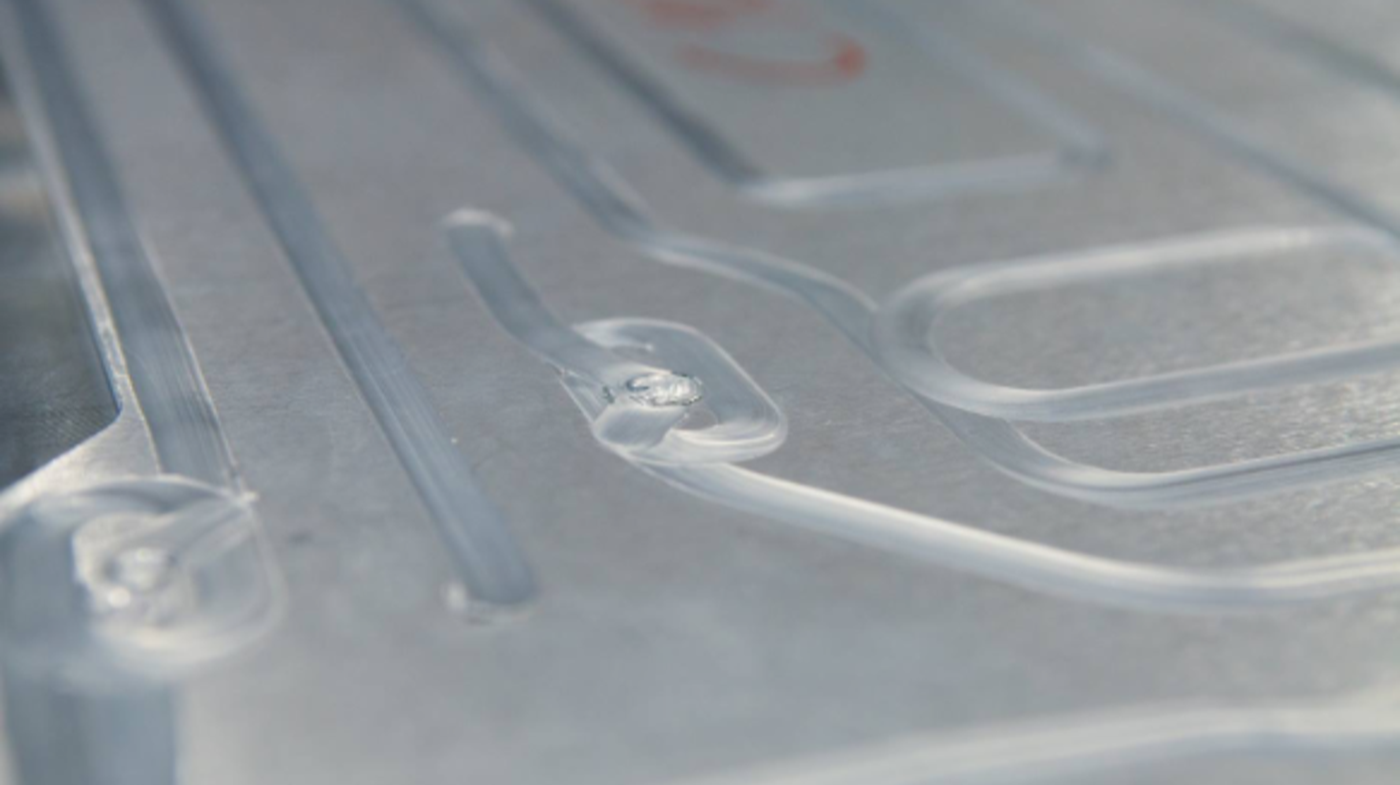
Example of a meander seam to close cooling channels. The weld seam plays an important role in the electric car.
High expectations for the welding of aluminum alloys
In the car, the safety-critical components of the battery housings had to meet stringent requirements. The weld seam had to withstand a very high bursting pressure – and prove it through a strength test. Special clamping devices and the appropriate tool had to be developed, along with the welding parameters. Only FSW technology could implement this process, as different aluminum alloys (wrought alloy and die-cast aluminum) had to be welded together.
Friction stir welding is a cost-effective and ecological process for a car with plug-in technology.
Our cooperation was very open, goal oriented and based on trust, and the customer was surprised at the quick implementation.
Fast implementation led to great customer satisfaction
Rapid delivery – within six months – also was a condition for placing the order, and KUKA’s expertise in this area met all requirements. As a result, the customer expressed the greatest possible satisfaction: “Our cooperation was very open, goal oriented and based on trust,” emphasized Project Manager Adel Ben Hassine (Sales & Proposal Engineering at KUKA). “And the customer was surprised at the quick implementation.” Beyond this, the customer achieved the benefits of sustainability: “The tools were developed further with the customer, which has doubled the service life of the pins.”