You are using Internet Explorer and will not be able to use our website properly. Please change to an up-to-date browser for ideal presentation of the website.
Welding cell welds huge fan blades
Welding is a high art in systems engineering. STELA, a “hidden champion” in drying technology, understands both. At this medium-sized company, an innovative KUKA welding cell takes the welding of large components such as fans to new dimensions.
An example that shows that small and medium-sized enterprises also benefit from robots
Now managed in the third generation by Thomas Laxhuber, the Bavarian family business STELA Laxhuber in Massing, Germany, is a “hidden champion” among system builders. STELA – named after its founder Stefan Laxhuber – and its 235 employees design, weld and manufacture sophisticated drying systems in all conceivable sizes and fields of application for customers worldwide. The purchasers of these products come from all around the globe, including the agricultural industry, wood materials processing, the food, fodder, cellulose material and paper industries as well as the water management sector.
In the video: Robot in the welding shop at STELA welds huge fans
Highly robust components used in STELA systems are welded precisely
Large-scale drying with highly robust components
At the heart of these drying systems are massive fans that activate a stream of warm air to extract moisture from products such as grain, corn, wood or recycled plastic. This makes them durable and creates the basis for them to be processed further. The fan rotors in the dryers can have a diameter of 1.60?meters and weigh half a tonne. When such a colossus is accelerated to up to 3,000?rpm, top craftsmanship in all assembled, highly robust components is an absolute must.
Stefan Laxhuber has high demands when it comes to the quality of his products
STELA produces and welds key components itself
“The special feature at STELA is the high level of vertical integration,” stresses Thomas Laxhuber, who became the third generation in management in 2014. “To continue producing world-leading drying systems, we want to manufacture the key components of our machines ourselves to the fullest extent possible. We see this as a prerequisite for the long service life of the systems.” This is particularly true for highly robust components such as the fan rotors. With their blades, these radial fans suck air in via the motor axis and blow it out again at an angle of 90°.
The steel construction swivels into the cell, where welding can begin
Welding with choreographed accuracy
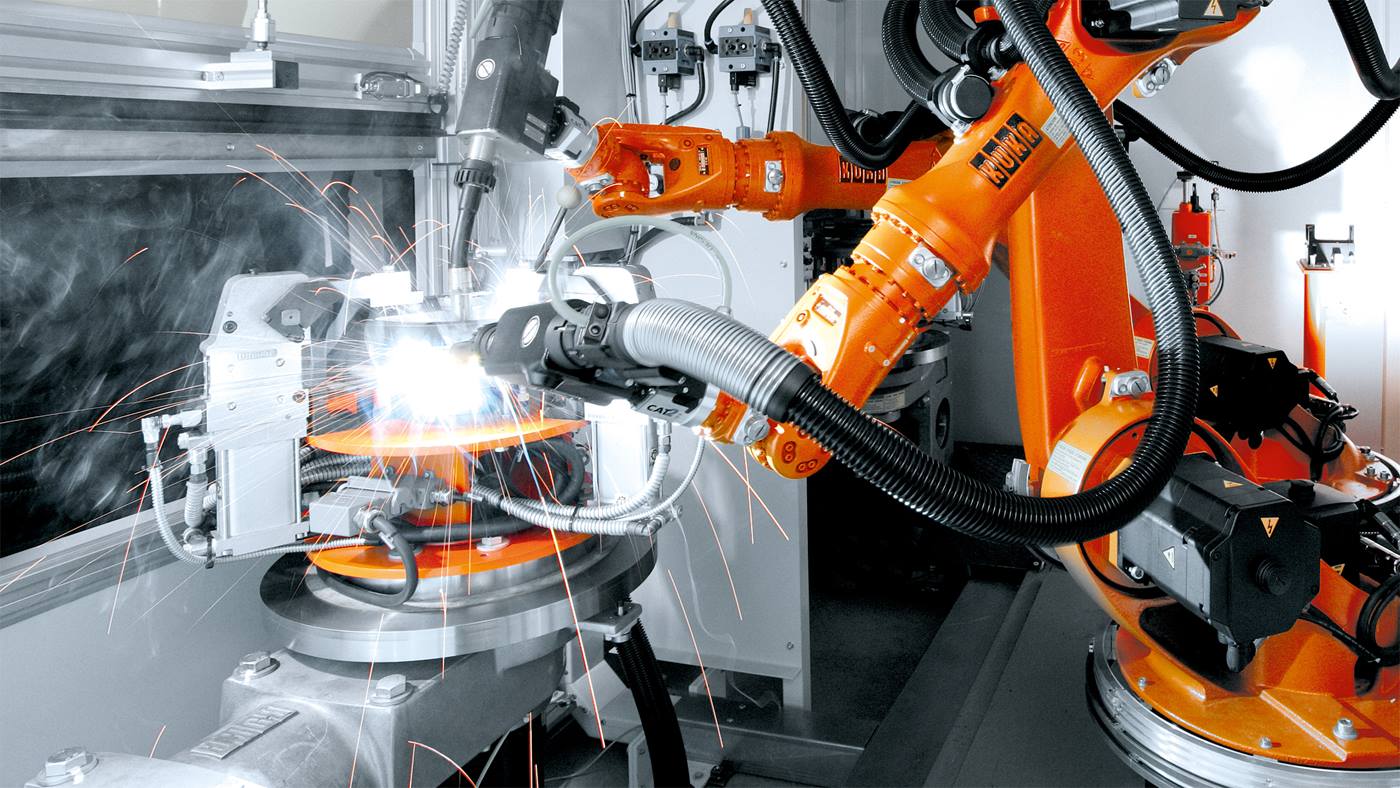
Today, Andreas Utz stands in the middle of the production hall in front of a welding cell of approximately 40 square meters. The production manager for fan construction at STELA is controlling the brand-new cell4_arc robot cell. Inside the cell, the six-axis KUKA KR CYBERTECHrobot welds rhythmically, using its slender orange arm to guide the sensor-controlled torch to the fan drum. Beforehand, Andreas Utz had screwed the steel construction in place on the positioner. Once the positioning unit was swiveled into the interior of the cell, an intelligent line laser initially scanned the component using KUKA.SeamTech Finding and determined the optimal starting point for the torch. Then the critical precision welding could begin. The robot welds seam after seam – always with the same accuracy choreographed by the KUKA.ArcSense software.
Performed manually, the welding took about a day. With the robot cell, it is now completed in around 50 minutes.
In the welding shop, time is money: robotic welding cell increases productivity
In about 50 minutes, the radial fan is welded. As the finished workpiece leaves the cell, the next one is already rotating into the cell, having previously been screwed in place on the other side by Andreas Utz. “Work in progress,” says Utz with a smile. “Performed manually, the welding takes about a day. With the robot cell, we’re in the fast lane of production now. In terms of both time and quality. This is because the seams are welded so perfectly in a short time and in a manner that would be impossible by hand. Now we are welding in quantities we never dreamed possible and have been able to once again manage the volume of orders.”
“The robot welds the seams to a perfection that cannot be achieved manually,” says Andreas Utz
Hard to find suitable personnel to weld by hand
The path to facilitating work in the welding shop in this manner was less straightforward than operating the cell. Sven Pietsch still clearly remembers the dismissive reactions of robot suppliers when STELA’s purchasing manager along with CEO Thomas Laxhuber set out to search for a welding cell. “We were under pressure,” Pietsch recalls. “The order books were full and, at the same time, it was becoming increasingly difficult to find suitable skilled workers for the demanding but also comparatively monotonous welding work.”
A line laser scans the component and determines the optimal starting point for the torch
Perfectly tailored cell configured for welding from standard modules
At various trade shows, the Bavarian-based company sought in vain for appropriate solutions for welding. “Apparently, as an SME, people thought we were too insignificant,” says Sven Pietsch with a grin. “That is, until we met the KUKA experts at EUROBLECH in Hanover. There, we very quickly began discussing a customized solution to weld our large components.” At KUKA’s TechCenter for welding, he says, they soon dove deep into STELA’s production processes, configuring the perfectly tailored cell4_arc robot cell for the welding of fans from various available standard modules – and providing all hardware and software for the welding application. “At all times, we felt that we were dealing with the right people and the right technology,” notes Thomas Laxhuber.?
The robot welds consistently with the same accuracy choreographed by the KUKA.ArcSense software
A perfectly adapted cell that welds quickly and with high quality?
The cell4_arc for STELA also represents a new approach for KUKA, using customized, modular automation steps. “Together with our customers, we can leverage our KUKA cell4_production concept to combine optimally coordinated components and proven standard equipment from the field of arc welding to create ideal solutions for automated welding in each case. With the right application software, the handling and programming of the welding parameters are outstandingly easy and help to meet the highest production demands,” says Mathias Klaus, who is responsible for Solution Sales Modular Cell Business at KUKA. “The robot cell that welds fans at STELA is impressive evidence of this.”
For almost 100 years, it has been part of STELA’s DNA to be guided by quality and to always be one step ahead in terms of technology. Thanks to this automation for welding fans, we can build on this in the future.