You are using Internet Explorer and will not be able to use our website properly. Please change to an up-to-date browser for ideal presentation of the website.
Textile (r)evolution
The trend to move production closer to sales markets saves time, cuts costs and benefits the environment. For the European textile industry, technology powers the partial return from low-cost production facilities in Asia. With KUKA robotics, the automation experts at robotextile have created an efficient, easy-to-handle system solution that could lead textile production into a new era.
Textile turning point
Once a pioneer of the Industrial Revolution, the clothing and textile industry now faces a watershed moment in worldwide restructuring. The introduction of mechanical looms at the turn of the 19th century transformed the industry – as well as entire social orders. Today, the digitalization of living and working environments marks another epochal shift. The textile industry gains additional momentum from the increasingly urgent pursuit of sustainability and the assured social standardsthat legislators require. These trends currently lead to a reconsidered approach to textile production in a worldwide industry that employs approximately 75 million people, primarily in Asia – under often-problematic working conditions.
Michael Fraede, founder and CEO of robotextile, firmly believes that this industry soon faces a turning point of global significance.
Until now, automation has had little to no impact on textile production, but that is changing. Automation creates the decisive prerequisite for textile production to move closer to its respective sales markets and thus become more efficient – and, above all, more sustainable.
KUKA robotics revolutionizes the textile industry
Cost-efficient, sustainable and fast production with small robotics from KUKA
Thinking ahead in textile production
Michael Fraede has been at home in the fields of robotics and automation technology for more than 30 years, and always looks for solutions for various industries. During a collaboration with Michael Müller, the Managing Director of erler GmbH (based in Dormettingen, Germany and specialized in automation technology), the two creative entrepreneurs identified a system solution specially tailored to textile processing, which led to the founding of robotextile. The goal here: maximum flexibility in the so-called secondary processes – in other words, the handling processes that accompany the act of sewing.
Clothing industry sets the pace
The textile industry’s demands have grown rapidly in recent years. Increasingly shorter fashion cycles mean that patterns and models, colors and cuts also change at an ever-faster pace. Additionally, digitalized configuration and ordering processes increase ad hoc production. Nevertheless, Fraede notes that many companies have shied away from automation and the supposedly costly, complex programming and installation work associated with robotics. “We wanted to address those concerns,” he said, “and now we can show that they’re unfounded.”
The fashion industry is highly dynamic and fast moving: trends set its pace
Challenging material
Together with scientists from the Research Institute for Textiles and Clothing Technology at the Niederrhein University of Applied Sciences, Fraede and Müller specifically tackled a problem that automation specialists have been unable to solve convincingly and, above all, cost-effectively: namely, handling non-rigid, easily deformable, flexible textiles and cut pieces.
The textile industry needs to catch up so it can modernize sustainably
“For a robot, this is something quite different from handling solid materials such as wood or steel – a challenge, but not an impossibility,” noted Professor Maike Rabe, who heads the Research Institute for Textiles and Clothing Technology (FTB) at the Niederrhein University of Applied Sciences in Mönchengladbach, Germany. “Nevertheless – and unfortunately – the clothing and textile industry lags significantly behind other sectors in terms of automation and digitalization. There is a great amount of catching up to do in this sector to be able to sustainably modernize this industry and keep it fit for the future.”
Now robotextile offers an answer to this challenge.
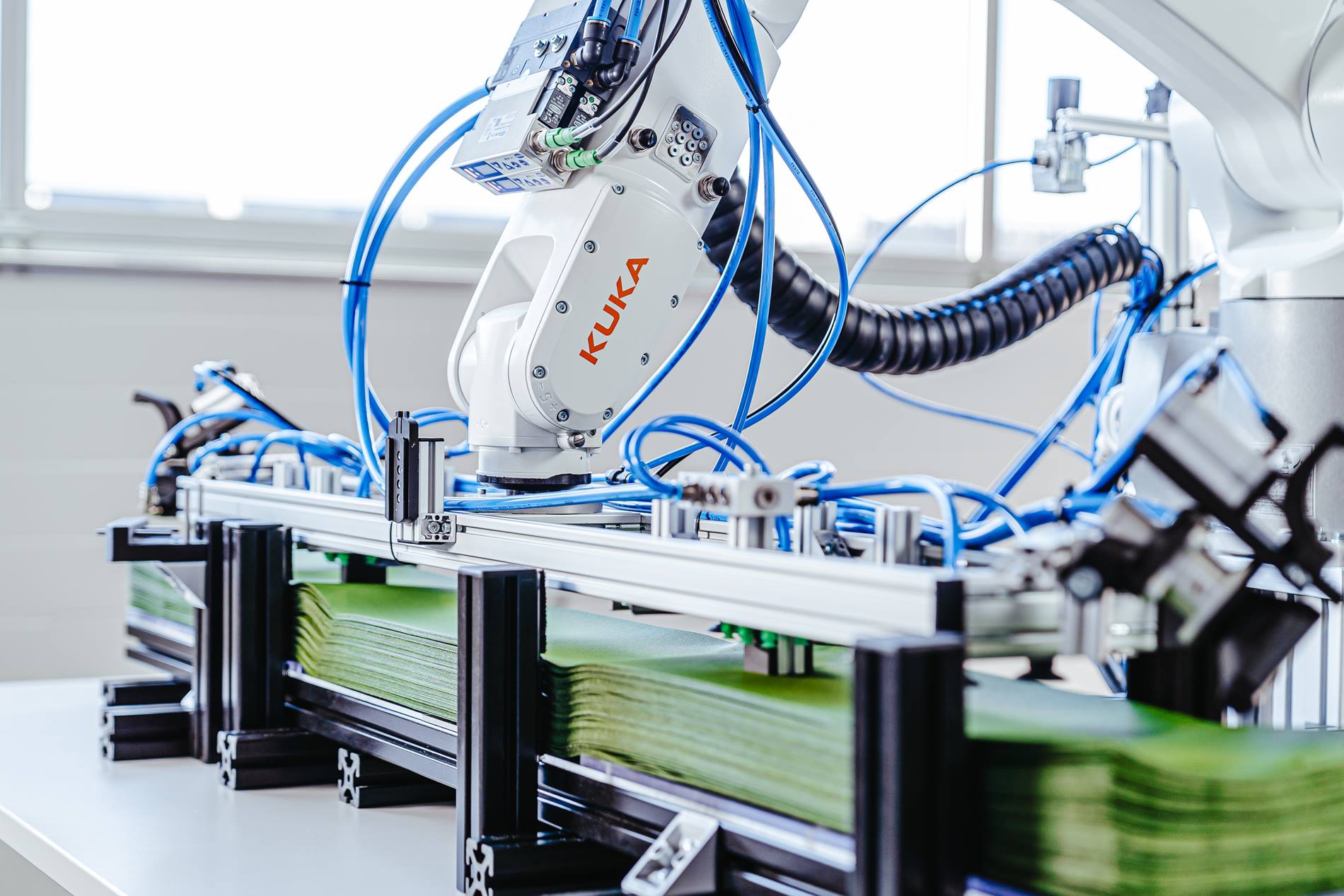
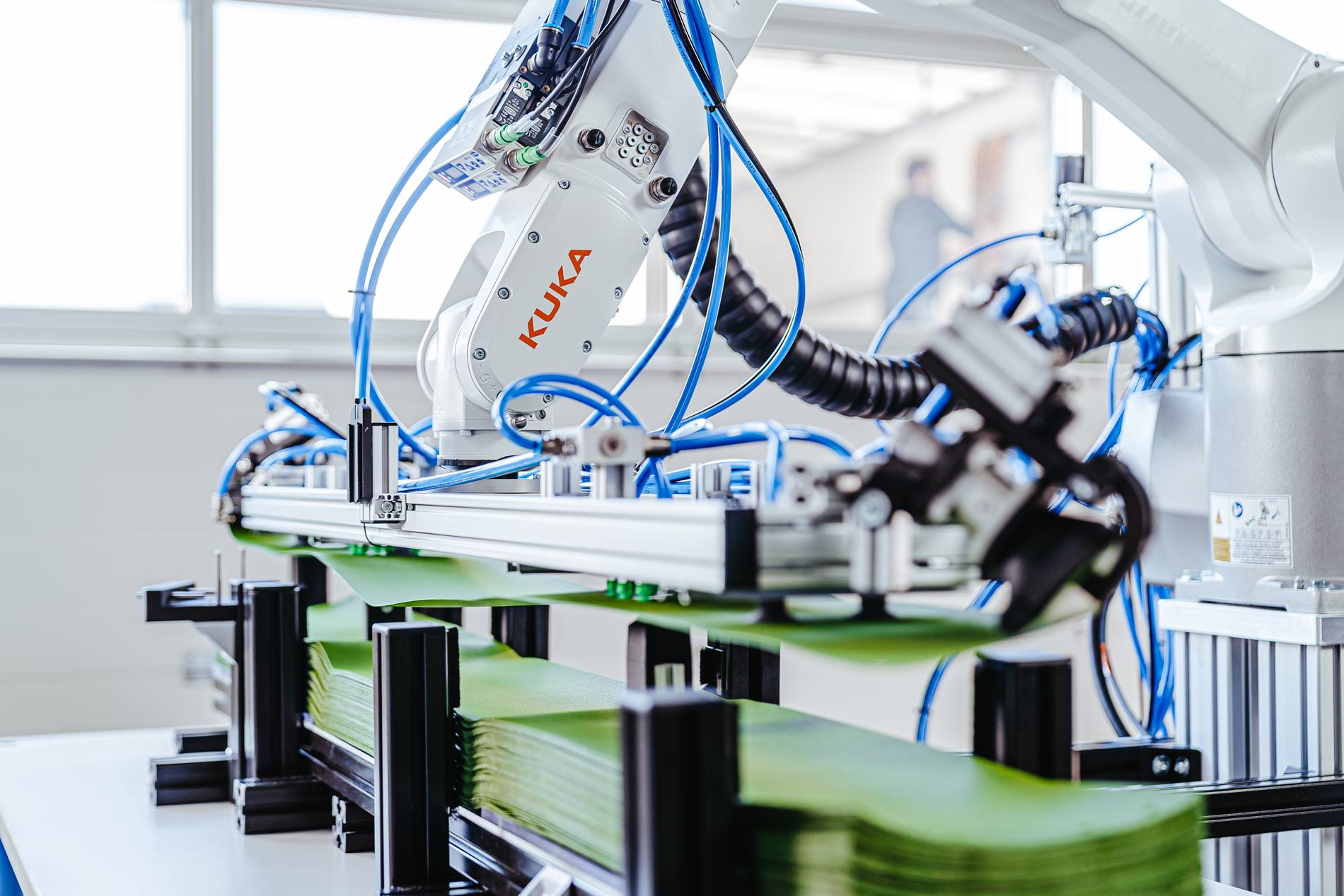
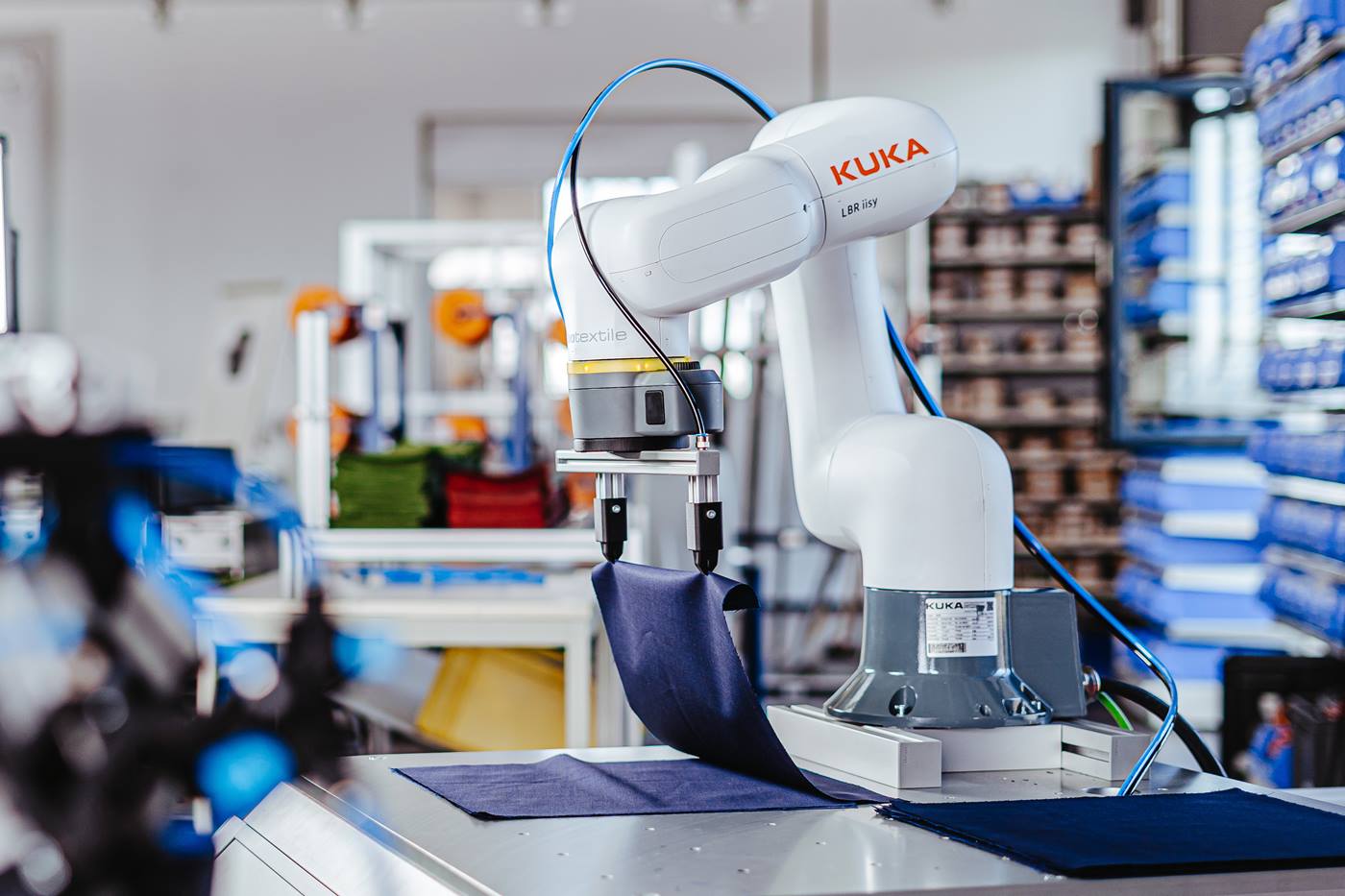
With the extremely agile and highly flexible small robots from the KR AGILUS, KR SCARA and LBR iisy series, as well as specially designed grippers, we can take layers of fabric from a stack of pre-cut pieces and feed them individually to the next production step without picking up the next layer of fabric as well. Nothing previously on the market could accomplish this.
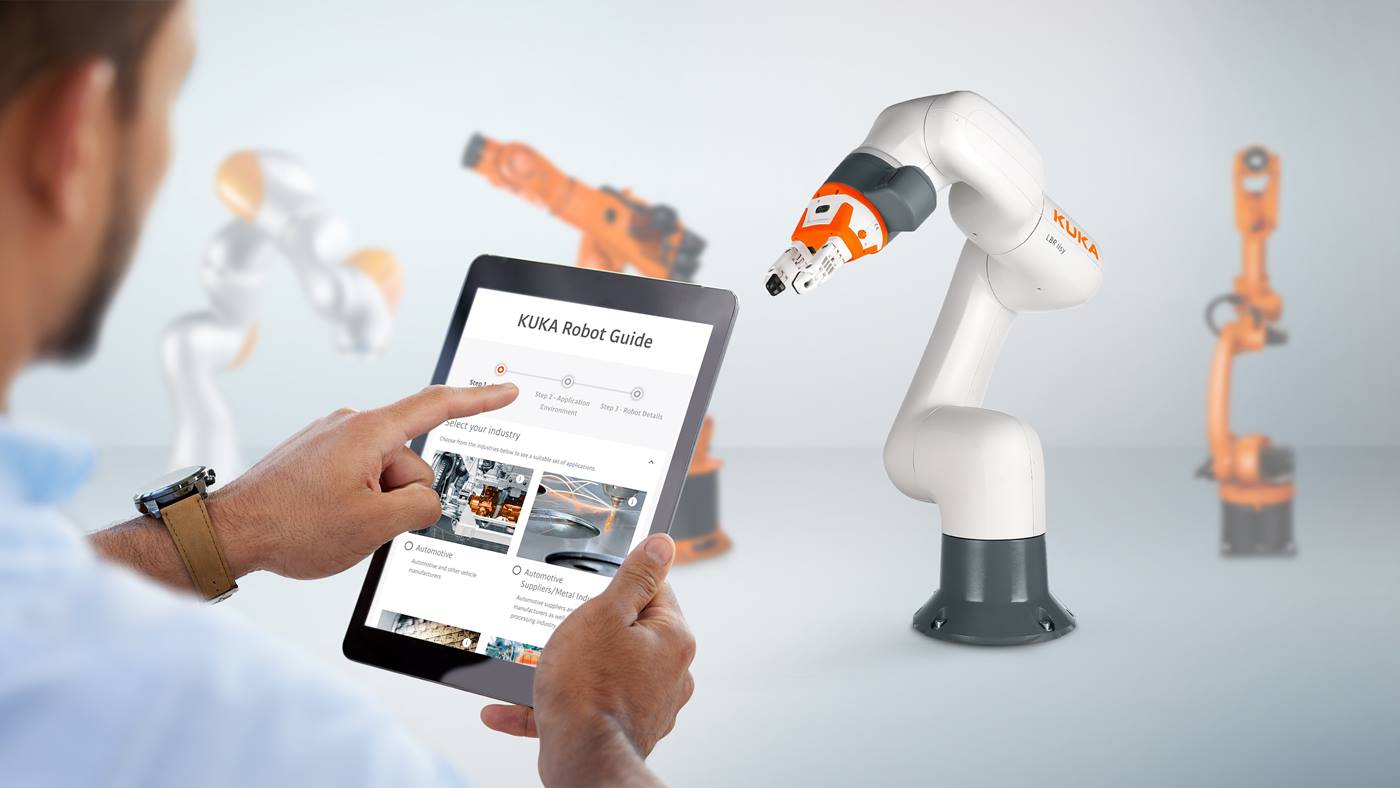
Small robots from KUKA impress with compact design, long reach and precision
Leveraging nearshoring and robotics for reliable quality and competitive costs
The team at robotextile believes that if European textile producers turn to robotics, that will provide an advantage over rivals from low-cost countries in the growing international competition. “In conventional textile manufacturing, extremely simple fabric-handling tasks account for about 40% of personnel costs. These often are highly monotonous, tiring processes – such as placement of trouser pockets or collars prior to actual sewing,” said Michael Fraede. Here, automation opens up new possibilities for companies that want to set up onshore and nearshore production economically with lower personnel requirements. Intelligently implemented robotics pave the way for “reliable, consistent quality with manageable ongoing costs” and enable production methods with true long-term competitiveness and viability.
“The devil is in the details”
With the new robotextile system solution for automated textile production, the two innovative entrepreneurs believe they are on the right track, especially because they have found solutions to those industry challenges where “the devil is in the details.” As Michael Müller noted, “Textiles can change shape during processing, depending on their design or fiber composition. As a result, machines must adapt constantly to these variable fabrics throughout production.”
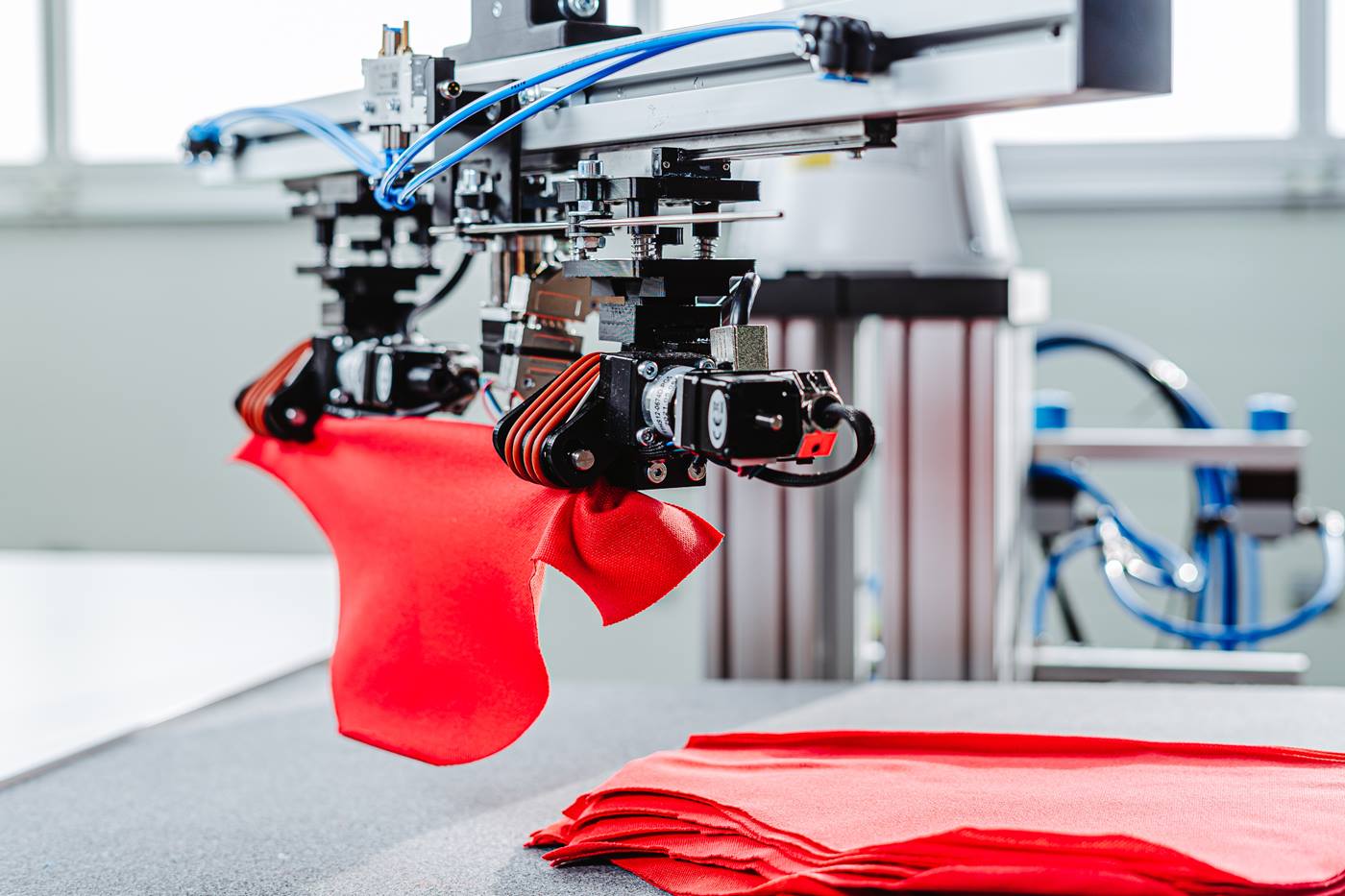
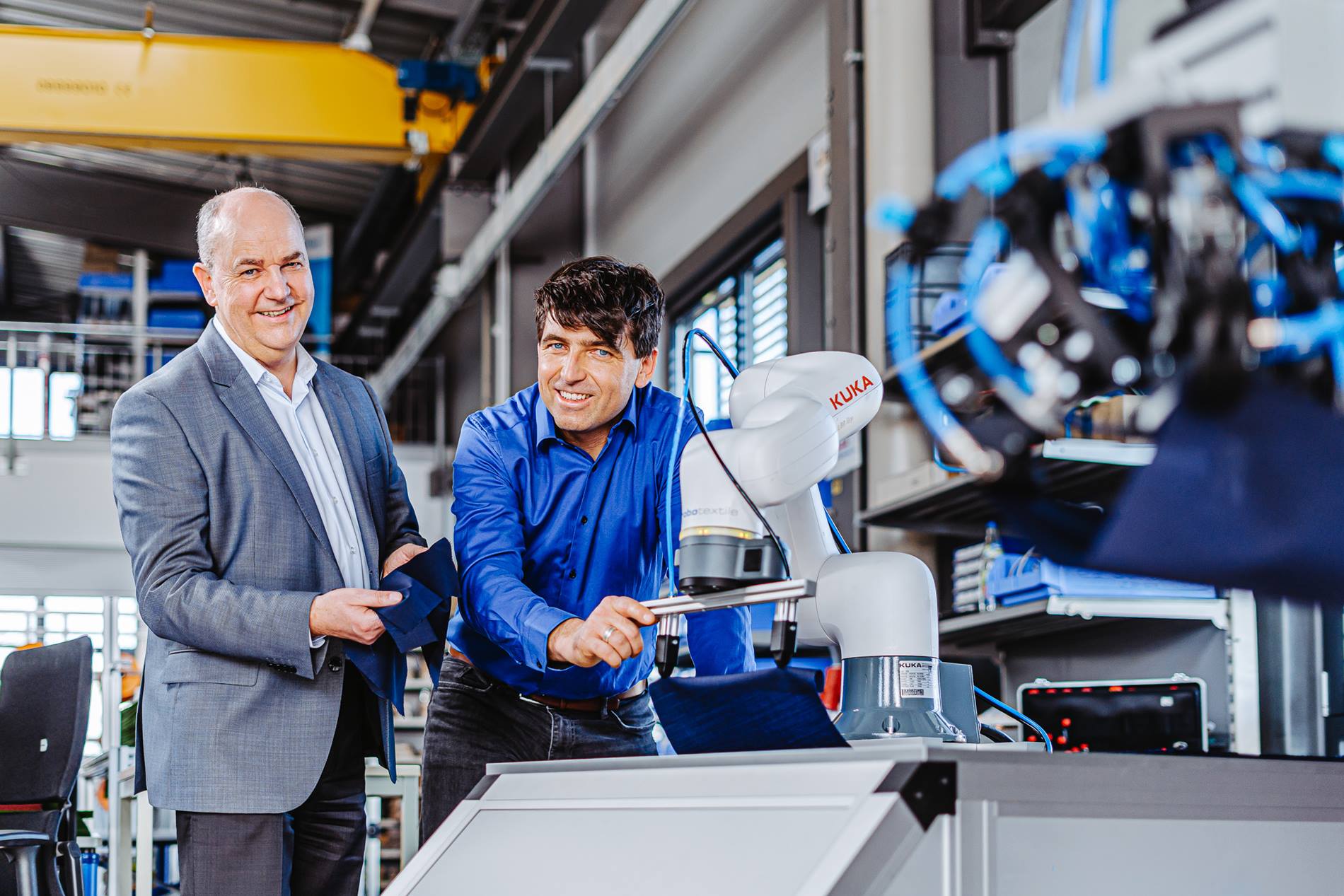
Automation makes it possible: robotics takes over the handling of easily deformable and flexible textiles
Custom-tailored technology
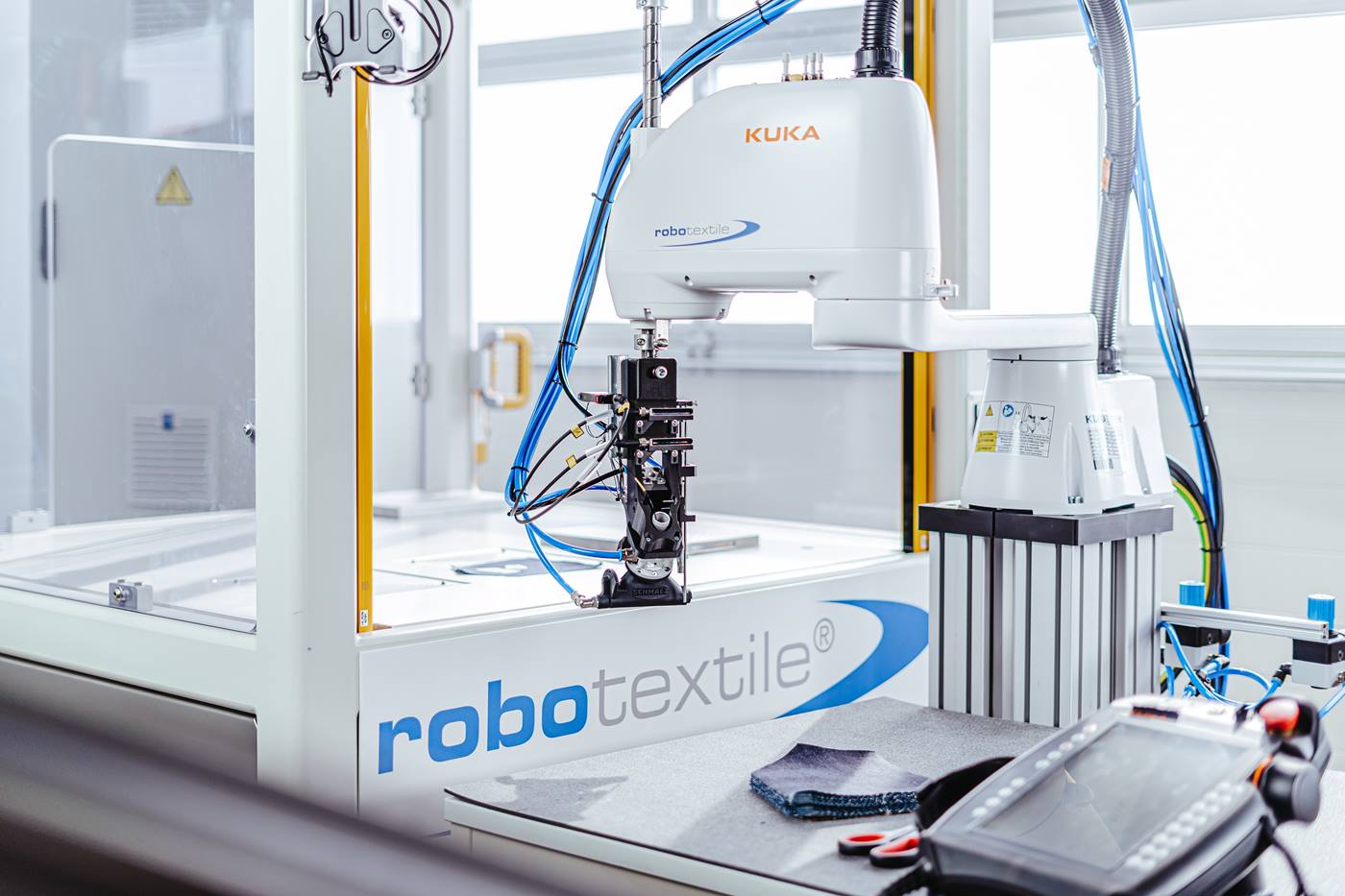
In the development department at erler in Dormettingen, robotextile has collaborated with experienced technology partners to devise dedicated gripper technologies for various production requirements – for example, a flow gripper that uses the so-called Coand? effect – and bring them to market maturity. Here, airflow causes the corners of the fabric to flutter up so the gripper can suck them up individually and grasp them firmly. Another special roller gripper picks up very thin textiles. An appropriately designed rubber parallel gripper handles special-purpose and technical textiles.
Sensitive and fast: the LBR iisy cobot from KUKA would also be perfectly suited to this task
Compact, precise, fast: textile processing robotics from KUKA
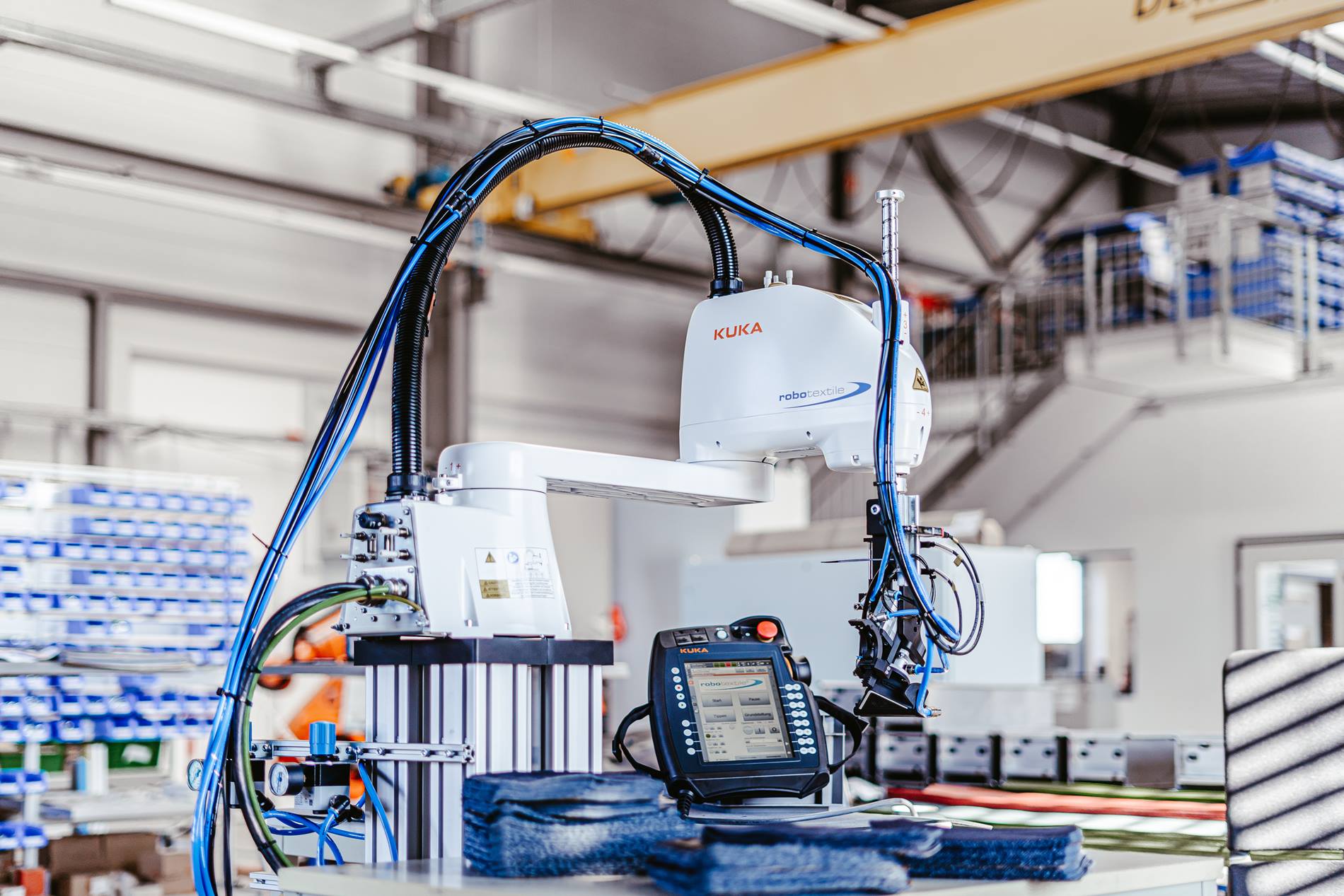
“The KUKA small robots from theKR AGILUS, KR SCARA and LBR iisy sseries are perfect for this system solution,” explained Björn Märtens, Global Business Development Manager at KUKA. “The robots move in the most confined spaces,and thanks to their robust design, they achieve maximum repeatability and continuous precision at extremely high speeds. The small robots thus ensure high manufacturing quality without ever getting out of step.” He also noted that a KR SCARA robot, for example, can achieve a cycle time of four to six seconds per layer of fabric with a payload of five kilograms in a workspace that measures 1.60 meters in diameter. In doing so, the robots use an internally routed media supply for air, power and data.
The KUKA KR SCARA makes automation easier and sustainably more economical in cost-sensitive industries
A milestone in textile production
“With the aid of integrated sensors in the grippers, our small robots can take layers of fabric from the stack of pre-cuts in an extremely ‘sensitive’ manner and feed them individually to the next production step,” said Märtens. He also noted that in recent years, many companies tried and repeatedly failed to achieve the necessary process reliability and cost effectiveness for this step. “We have achieved a real milestone in this,” robotextile co-founder Michael Müller said with conviction.
Looking to the future: automation for more sustainable textile production
C&A: innovation driver and thought leader in the textile industry
According to Professor Rabe, the T7 project seeks to enable a comprehensive reform of the European clothing and textile industry as well as projects for reshoring – the relocation of production facilities to industrialized countries – to play a leading role in the textile industry in the future. Achieving this, however, always requires partners who can transfer such developments from the lab to the production environment.
robotextile’s innovative system solution can bring production back to Europe
Reshoring benefits the environment, prevents overcapacity, strengthens the local economy, creates attractive jobs and takes place under ethically fair conditions – which is becoming increasingly important for manufacturers in the context of the new Supply Chain Act. To this end, we combine highly sustainable production with highly productive processes.
In Mönchengladbach, the German-Dutch clothing company C&A has joined the T7 development project with its “Factory for Innovation in Textiles” (FIT). In conjunction with T7, a C&A pilot project brings some of its jeans production back from Asia to Europe. The company also is building a highly automated manufacturing line with help from robotextile, the Niederrhein University of Applied Sciences and its project partners, among others.
Reacquiring lost production expertise
The fashion company’s “Factory for Innovation in Textiles” (FIT) focuses on innovative technology, carbon-neutral production and more sustainable fashion. For Jürgen Mohs, Authorized Officer and Project Manager of “C&A’s FIT GmbH”, the aim is “to bring back some production to Europe and simultaneously reacquire lost manufacturing expertise to ensure the stability of supply chains for the future.”
“We already have gained highly valuable experience in this area with the University of Applied Sciences in Mönchengladbach and with robotextile,” Mohs observed. Based on this, C&A initially plans to produces 400,000 pairs of jeans per year, with production beginning in 2022 and set to expand up to 800,000 pairs later on. “C&A’s FIT will be more than just a laboratory for prototypes. It’s about large-scale production,” Mohs reported. He also notes that FIT is based on the belief that sustainable fashion should not be a niche product now or in the future.
An advanced development with small robotics from KUKA: KR AGILUS, KR SCARA and LBR iisy
“Onset of a new era”
For Michael Fraede, this is “exactly the right signal for the onset of a new era. With C&A’s FIT initiative, the comprehensive support from science and research and our scalable automation solutions place quality, fair working conditions and transparent processes at the heart of sustainable textile production for the first time on a large scale – irrespective of location. This is encouraging news for the textile industry and its increasingly quality and environmentally conscious customers.” But will this be a technological revolution or merely an evolution? That remains to be seen, but the development represents a definite step forward.