Utiliza?i o versiune veche de Internet Explorer. Actualiza?i browser-ul pentru o prezentare optim? a site-ului web.
Surface processing with a KR QUANTEC and KUKA.CNC
With KUKA.CNC software, SEMATEK GmbH breaks new ground in surface processing.
Since 2007, SEMATEK GmbH, located in Seeg in the Allg?u region, has been developing innovative and complete engineering solutions for modern manufacturing companies in need of manufacturing processes for new products and wanting to optimize or continue developing existing processes. The company has always stood for lowering costs and increasing production output.
KUKA Robotics at Sematek
?Automation of surface processing
The smoothing or finishing of milled dies and molds – such as deep drawing dies for body components, inlay molds for components made of composite materials or injection molds for plastic components – is today still largely carried out by hand. Even at other companies with high levels of automation in production, polishing larger free-form surfaces can take up to 20 man-days. In the development of a new technology for surface processing, the emphasis was placed on making the process as flexible, precise, reliable and cost-effective as possible.
The goal here was to transform metallic surfaces into high-quality functional surfaces through automation. This is now possible through the “Machine Hammer Peening” application; a hammering process in which the surface of the workpiece is smoothed out. In order to automate the machining of complex workpiece surfaces with this process, SEMATEK turns to a KUKA robot with KUKA.CNC software.
KUKA KR QUANTEC guided by KUKA.CNC
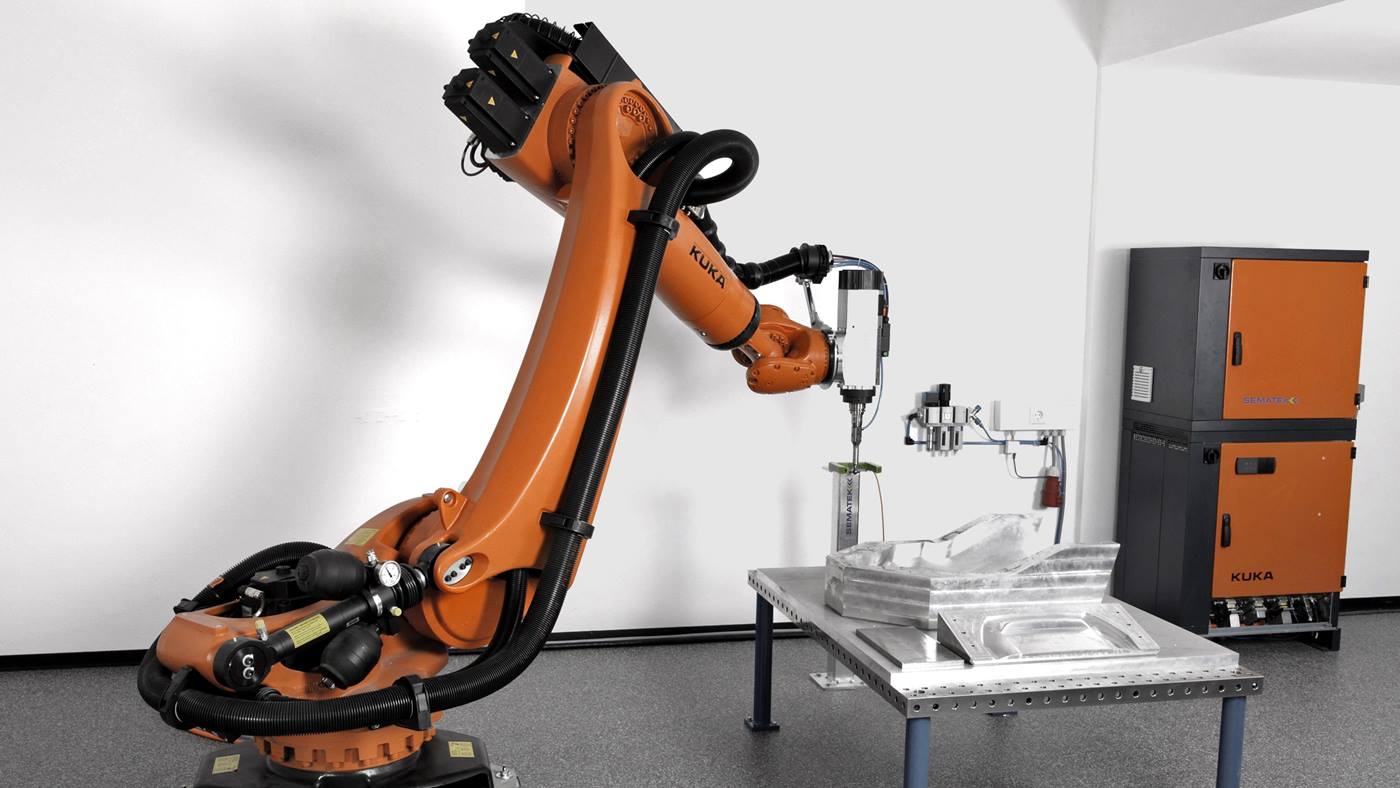
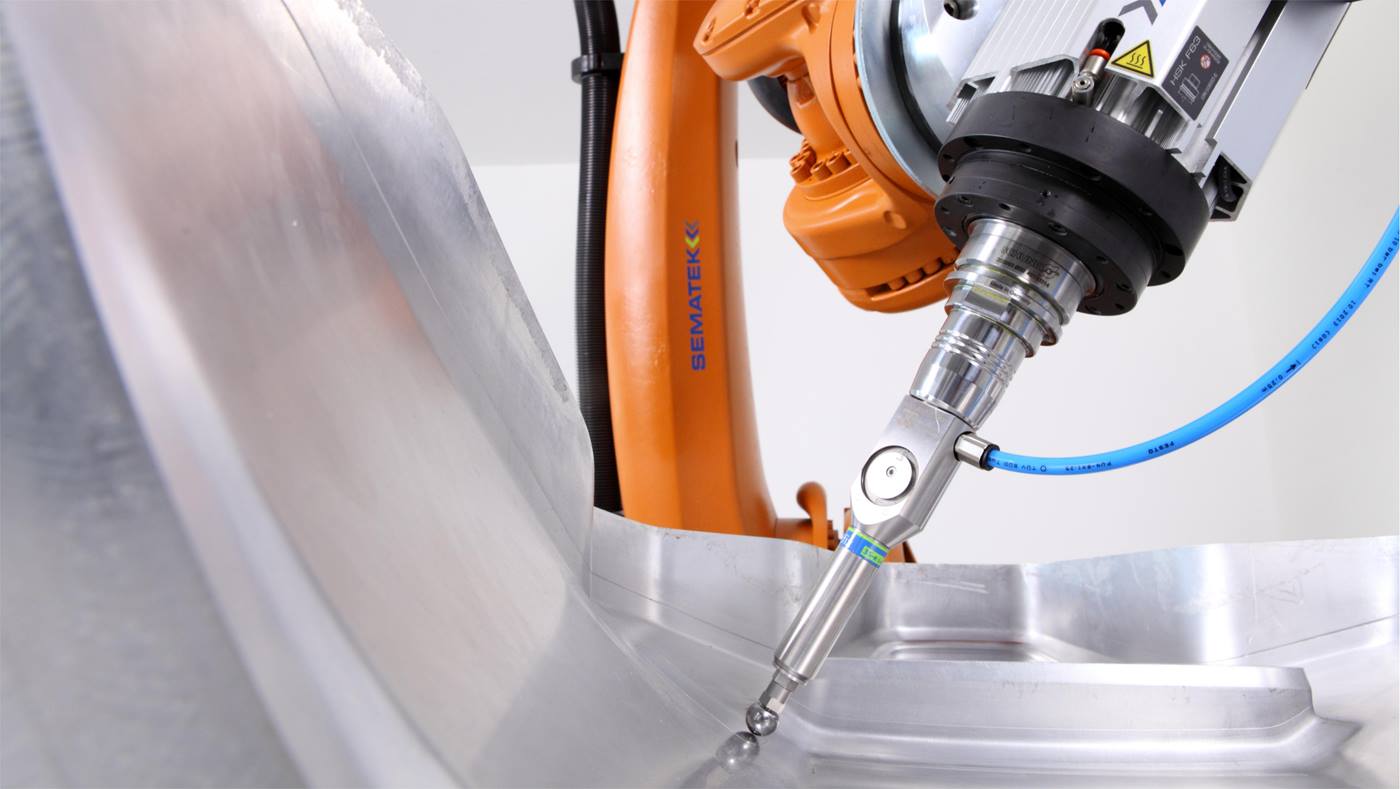
On the flange of the KR QUANTEC series KUKA robot there is a pneumatically operated tool with a linearly oscillating hammer head (FORGEfix from 3S-engineering GmbH) for the machining of the surface. Once the robot has measured the workpiece, the robot guides the hammer head over the surface along the “hammer peening path” using KUKA.CNC software. In doing so, the milling peaks are pressed down into the milling grooves. The sphere diameter, feed rate, path distance, feed motion angle as well as pitch angle between the hammer stroke and the surface must be selected and set to suit the process.
SEMATEK uses a 5D measurement system from LEONI GmbH to measure the processing head. Besides measuring the Tool Center Point (TCP), this procedure primarily ensures that the tool orientation is calibrated as precisely as possible. The tool orientation is a particularly important factor for the processing of 5-axis CNC programs so as to achieve the highest possible process accuracy.
?Complete programming of the robot in G-code
The KUKA KR 240 R2900 stands out for its reach and flexibility. For components requiring a 5-axis machining strategy, the use of the robot presents a clear cost advantage. To simplify setup and programming of the robot, KUKA has implemented a complete CNC kernel on the controller and developed the KUKA.CNC software package.
This software allows programming of the robot motion to be carried out completely in G-code (DIN 66025). Programs can thus be created via the CAD/CAM process chain and used on the controller without further conversion into a special robot program (compilation into the robot language).
The KUKA robot processes the surfaces with a linearly oscillating hammer head as a tool.
This has the added advantage that CNC functions, such as tool radius correction and sister tools, can be used without difficulty. SEMATEK supplements the process chain with a simulation module which also ensures that the overall system is accessible and not at risk for a collision. In this manner, the robot can be used as a full-fledged CNC machine. It can also take advantage of path performance which has been improved further and allows for uniform machining over the entire component.
?Maximum quality in a minimum amount of time
The hammer peening not only smooths the milled surface, but it also strain-hardens it and optimizes the distribution of residual stress. The surface becomes uniform and reproducible. The hammer peening process enables a surface roughness of Ra smaller than 0.1 μm that would not be possible through milling alone. Thanks to strain-hardening, the surface hardness can be increased by up to 30 percent – depending on the material being machined. As a result, additional surface finishing may be completely omitted in some cases.
But above all, the automated hammer peening process eliminates manual grinding and polishing activities. The time for the finishing – and, thus, for the overallmanufacturing process – is significantly shortened, above all due to the reduced finish-machining requirements. Using the KUKA robot, even complex free-form surfaces can be machined. It is often possible to machine the complete component here – thus eliminating the need for costly and time- consuming reclamping. Thanks to extremely precise path planning, the robot can also move at high velocities with minimal overlap. This ensures maximum results in a minimum amount of time.
Since 2007, SEMATEK GmbH, located in Seeg in the Allg?u region, has been developing innovative and complete engineering solutions for modern manufacturing companies in need of manufacturing processes for new products and wanting to optimize or continue developing existing processes. The company has always stood for lowering costs and increasing production output.
KUKA Robotics at Sematek
?Automation of surface processing
The smoothing or finishing of milled dies and molds – such as deep drawing dies for body components, inlay molds for components made of composite materials or injection molds for plastic components – is today still largely carried out by hand. Even at other companies with high levels of automation in production, polishing larger free-form surfaces can take up to 20 man-days. In the development of a new technology for surface processing, the emphasis was placed on making the process as flexible, precise, reliable and cost-effective as possible.
The goal here was to transform metallic surfaces into high-quality functional surfaces through automation. This is now possible through the “Machine Hammer Peening” application; a hammering process in which the surface of the workpiece is smoothed out. In order to automate the machining of complex workpiece surfaces with this process, SEMATEK turns to a KUKA robot with KUKA.CNC software.
KUKA KR QUANTEC guided by KUKA.CNC
On the flange of the KR QUANTEC series KUKA robot there is a pneumatically operated tool with a linearly oscillating hammer head (FORGEfix from 3S-engineering GmbH) for the machining of the surface. Once the robot has measured the workpiece, the robot guides the hammer head over the surface along the “hammer peening path” using KUKA.CNC software. In doing so, the milling peaks are pressed down into the milling grooves. The sphere diameter, feed rate, path distance, feed motion angle as well as pitch angle between the hammer stroke and the surface must be selected and set to suit the process.
SEMATEK uses a 5D measurement system from LEONI GmbH to measure the processing head. Besides measuring the Tool Center Point (TCP), this procedure primarily ensures that the tool orientation is calibrated as precisely as possible. The tool orientation is a particularly important factor for the processing of 5-axis CNC programs so as to achieve the highest possible process accuracy.
?Complete programming of the robot in G-code
The KUKA KR 240 R2900 stands out for its reach and flexibility. For components requiring a 5-axis machining strategy, the use of the robot presents a clear cost advantage. To simplify setup and programming of the robot, KUKA has implemented a complete CNC kernel on the controller and developed the KUKA.CNC software package.
This software allows programming of the robot motion to be carried out completely in G-code (DIN 66025). Programs can thus be created via the CAD/CAM process chain and used on the controller without further conversion into a special robot program (compilation into the robot language).
The KUKA robot processes the surfaces with a linearly oscillating hammer head as a tool.
This has the added advantage that CNC functions, such as tool radius correction and sister tools, can be used without difficulty. SEMATEK supplements the process chain with a simulation module which also ensures that the overall system is accessible and not at risk for a collision. In this manner, the robot can be used as a full-fledged CNC machine. It can also take advantage of path performance which has been improved further and allows for uniform machining over the entire component.
?Maximum quality in a minimum amount of time
The hammer peening not only smooths the milled surface, but it also strain-hardens it and optimizes the distribution of residual stress. The surface becomes uniform and reproducible. The hammer peening process enables a surface roughness of Ra smaller than 0.1 μm that would not be possible through milling alone. Thanks to strain-hardening, the surface hardness can be increased by up to 30 percent – depending on the material being machined. As a result, additional surface finishing may be completely omitted in some cases.
But above all, the automated hammer peening process eliminates manual grinding and polishing activities. The time for the finishing – and, thus, for the overallmanufacturing process – is significantly shortened, above all due to the reduced finish-machining requirements. Using the KUKA robot, even complex free-form surfaces can be machined. It is often possible to machine the complete component here – thus eliminating the need for costly and time- consuming reclamping. Thanks to extremely precise path planning, the robot can also move at high velocities with minimal overlap. This ensures maximum results in a minimum amount of time.