You are using Internet Explorer and will not be able to use our website properly. Please change to an up-to-date browser for ideal presentation of the website.
“Robin” aims to take robotic knee surgery to a new level
The Italian-based medical technology company Orthokey developed its robotic system “Robin” in order to support orthopedic surgeons in the operating room. Based on the LBR Med from KUKA, the system enables precise robotic-assisted surgery for total knee arthroplasty due to its navigation system.
More precision in knee surgery thanks to "Robin"
The success of an operation often depends on the surgeon's experience and skill – the more complex the procedure, the more important the surgeon. If they work manually, they use mechanical devices, which is time-consuming and potentially error-prone. With “Robin”, Orthokey is opening the door to advanced computer-assisted orthopedic surgery. Robin is an intraoperative robotic system that supports the surgeonin planning and positioning orthopedic implants andperforming precise bony resections. To do this, it uses the individual patient profile as well as specific kinematic and anatomical characteristics. "We position several trackers on the patient, which can be seen by a camera with an accuracy of less than 1 millimeter. This allows the surgeon to plan the right positioning of the implant for each individual patient before performing a resection," says Simone Bignozzi, Product Manager at Orthokey, explaining the principle behind “Robin”.
All the interfaces of the system simplify complex processes for users and make robotic knee surgery more intuitive.
Functionality and experience decide
Dr. Domenico Alesi, orthopedic surgeon at the Istituto Ortopedico Rizzoli in Bologna, praises the ease of use of the system in particular: "’Robin’ is intuitive and visually appealing. All the interfaces simplify complex processes for users and make their work easier." “Robin” is also based on a modular approach that takes into account different implant manufacturers and hospital concepts. Last but not least, Orthokey relies on high-quality components for its operating room solution, including KUKA’s sensitive lightweight robot LBR Med.
The engineers at Orthokey compared various robots and also considered developing their own. But then the LBR Med from KUKA came into play, which convinced them for three reasons, as Maria Pasquini, CTO of the “Robin” project at Orthokey, says: "Firstly, the robotic arm is already certified for an easy and fast integration into medical devices, which facilitated the certification of the overall system and enabled it to be ready for the market more quickly. The second factor is the seven degrees of freedom and the sensors in each joint, which can increase the robot's accuracy and dexterity in the operating room. And thirdly, the LRB Med is a mature and established solution with reliable software, so we were able to work quickly and effectively right from the start."
Joint development
From the outset, the idea was to design the system to be simpler and smaller than comparable solutions. Orthokey developed the first prototype in collaboration with the University of Verona. "The proof of concept was ready after eight months, nine months later the development of hardware and software was completed. The first release was ready and documentation was sent to the notified body for product certification," says Bignozzi, describing “Robin's” rocky road to the OR.
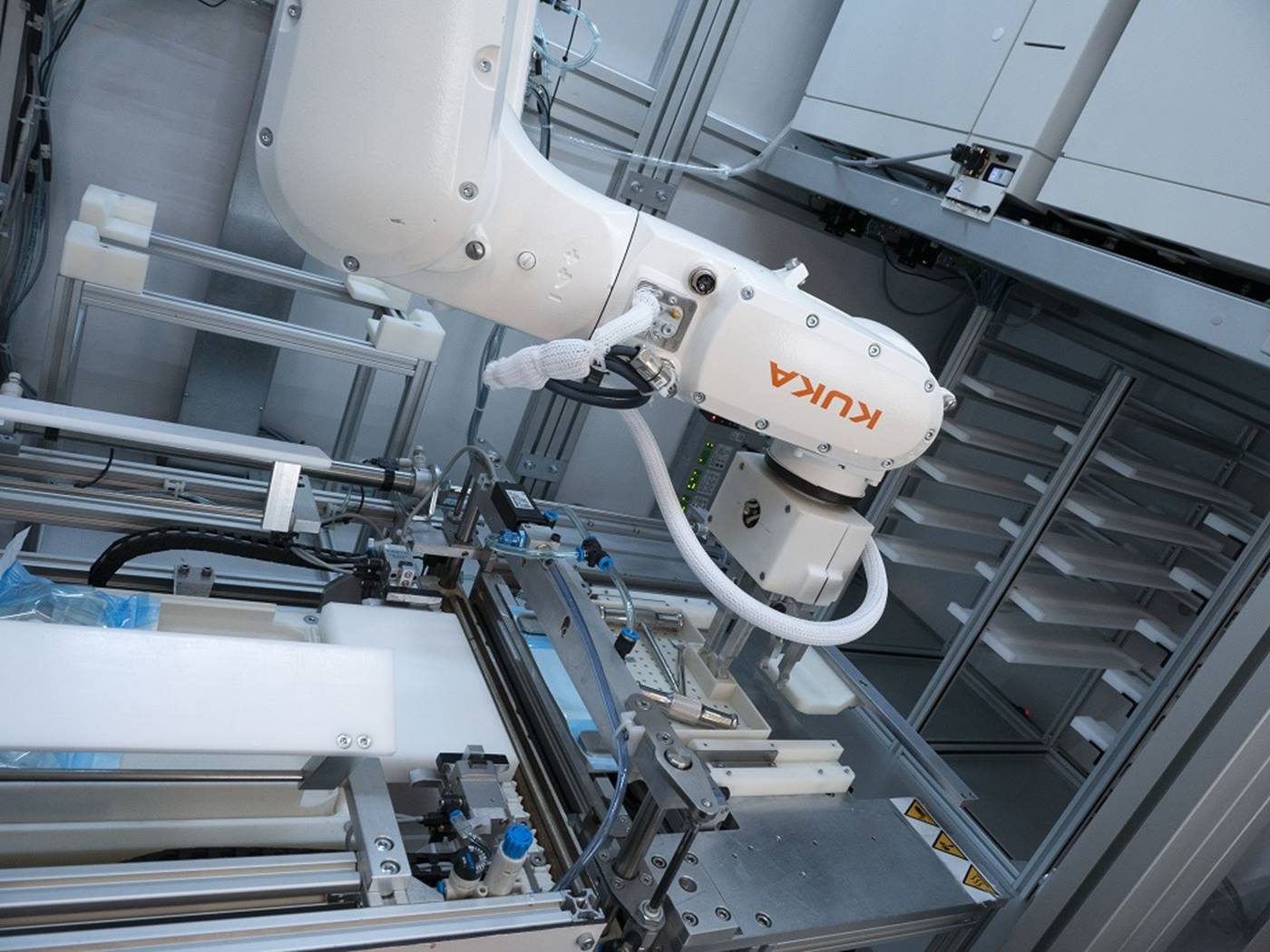
First, the instruments are attached to the robotic system.
Throughout the entire process, the team worked closely with KUKA's research and development team and benefited greatly from their experience. "It was clear that KUKA is an extremely well-established robotics company in medical applications and can draw on the knowledge gained from numerous projects. The strong commitment of each individual team member has helped to make ‘Robin’ a success," emphasizes Pasquini.
High precision human-robot collaboration
So how does an intervention with “Robin” work? Before the procedure begins, the OR staff meticulously prepares the operating field to ensure smooth interaction between humans and the robotic system.Correct positioning of the robotic system is crucial, enabling seamless integration with the surgical team and efficient maneuverability in the operating room. Precise positioning of the devices and careful calibration of the robotic system are crucial for a smooth, trouble-free workflow throughout the procedure.
"Robin" is intuitive and visually appealing.
During the operation, the surgeon uses infrared markers to map the patient's anatomy on the robotic system. These markers make the patient "visible" to the device. The system can then track the patient's anatomy and position in real time, ensuring accurate alignment and guidance during the surgical process.
As the patient's anatomy is registered and visualised on the screen, the surgeon can now precisely plan the strategy for the bone resections.
As the patient's anatomy is registered and visualised on the screen, the surgeon can nowprecisely plan the strategy for the bone resections. The detailed visualisation of the patient's characteristics enables him to develop a suitable approach for the procedure. Once the plan has been finalised, the robotic arm comes into play. "First, it works in automatic mode and approaches the patient precisely. Once it has reached the intended area, the procedure moves into a collaborative phase. In this mode, the surgeon can manually adjust the cutting guide held by ’Robin’ to the target plane, with the robotic arm maintaining exceptional accuracy and ensuring that the cutting guide remains precisely positioned throughout the process. This collaborative approach is repeated for each step of the bone resection to ensure consistent precision," says Dr. Alesi, describing the collaboration between physician and medical robot.
Once all the necessary bone resections have been completed, the surgeon positions the orthopedic implant on the patient. During this final phase, he closely monitors the leg kinematics and the overall result on the screen of the robotic system. "This comprehensive monitoring ensures that the implant is placed accurately and that the desired surgical result is achieved. Once the surgeon has confirmed the success of the procedure, the operation is complete and the patient is transferred to post-operative care," says Dr. Alesi.
Partner in the operating room
“Robin” is ready for the market. Certification in accordance with the Medical Device Regulation (MDR) is currently underway, after which Orthokey intends to apply for further approvals in various countries – next year, for example, with the Food and Drug Administration (FDA) in the USA. "To achieve this and continuously improve our system, we are working with several reference centers around the world. The feedback has been consistently positive. Users appreciate the dimensions and weight of ’Robin’ as well as the simplicity of the surgical workflow," says Simone Bignozzi.
It is important to the developers that the medical robot is not seen as a competitor to the surgeon, but as an assistant in the operating room. It can be a great advantage for young surgeons in particular, as they might have a steeper learning curve than in conventional surgery. "’Robin’ will not restrict work opportunities, but will increase the skills of those involved. OR staff, including surgeons, will learn how to interact seamlessly with the additional device. The surgeon will benefit from patient-centered surgery and outliers can be reduced, especially for surgeons with a low number of operations. There will be an impact on the operating room set-up, but this impact will be minimal. Better training of residents and fellows, a better understanding of knee surgery procedures, the collection of more reliable data and a promotion of the further development of surgical practice can be additional benefits of the system," emphasizes Maria Pasquini.
The robot system allows the surgeon to plan the right positioning of the implant for each individual patient before performing a resection.
Robotic knee surgery at a new level
Dr. Domenico Alesi is also certain that “Robin” will take surgical procedures to a new level. "The solution aims to improve the accuracy of the procedure in the short term, to reduce the number of surgical gestures, to reduce variability between surgeons and to lead to reproducible and more precise results. All of this could be reflected in a better surgical outcome. In the medium term, this will allow us to further develop surgical procedures and the detection of the most important influencing factors," says the surgeon.
"Robin" is ready for the market.
The accuracy of the system is amazing and it is suitable not only for highly specialised surgeons, but for a wide range of doctors.
It is important to the developers that the medical robot is not seen as a competitor to the surgeon, but as an assistant in the operating room.
Frédéric Piasek, Business Development Manager Medical at KUKA, is looking forward to it: „We have an extremely good and open partnership with Orthokey. Thanks to the constant dialogue about technical challenges, we have been able to make gradual progress with the solution. Also, we are in regular contact regarding potential developments. I’m curious to see what the future of our collaboration with Orthokey has in store for us.“