Przeczytasz ten artyku? w: 4 minut
One million users: where telephone and computers took several decades, ChatGPT took just five days. AI is racing down the acceleration lane and into our lives.
But what is artificial intelligence?
As yet, there is no single definition. Ask an AI directly and the answer is as follows: “Artificial intelligence means a system developed by humans that is capable of independently solving tasks or making decisions.” Unlike data processing, AI looks to the future. It can retrieve and analyze millions of data records within milliseconds, enabling it to calculate probabilities and offer proposals.
Is AI changing our daily lives?
“All industries can benefit massively from artificial intelligence and will change greatly,” says Matthias Peissner, head of the research department Human-Technology Interaction at the Fraunhofer Institute for Industrial Engineering (IAO), talking to RedaktionsNetzwerk Deutschland. If you want to stay on the ball, you have to get to grips with AI. Many companies are already doing that. By 2027, approximately three-quarters of companies aim to use relevant technologies. This was the finding of the World Economic Forum’s “Future of Jobs Report 2023”.
What action will be taken by KUKA?
Two aspects are of decisive importance for KUKA. One: How is AI used in everyday work? Secondly: How does KUKA use AI in its own products and solutions?
Let us start by looking at the future of work at KUKA.
“AI tools influence every job. From Software Development, Customer Service, Sales and Marketing, and Legal to IT, Operations and Finance. When it comes to AI, the question is not ‘if’, but ‘when and how’,” explains Christian Schwaiger, Head of Corporate EAM & Enterprise Architect at KUKA. Together with a team of decision makers and experts from various departments, he is implementing KUKA’s AI strategy.
The vision: Increase productivity in all business units by deploying AI. This is to be facilitated by generative AI tools such as Microsoft Copilot – a language model that is used to create texts, generate summaries or perform analyses. There are many application scenarios.
It is basically about democratizing knowledge. This is the same goal that KUKA is also pursuing towards its customers and partners with the 2030 Mission. AI tools are a building block. This brings us to the second aspect.
How does KUKA use AI in its own solutions?
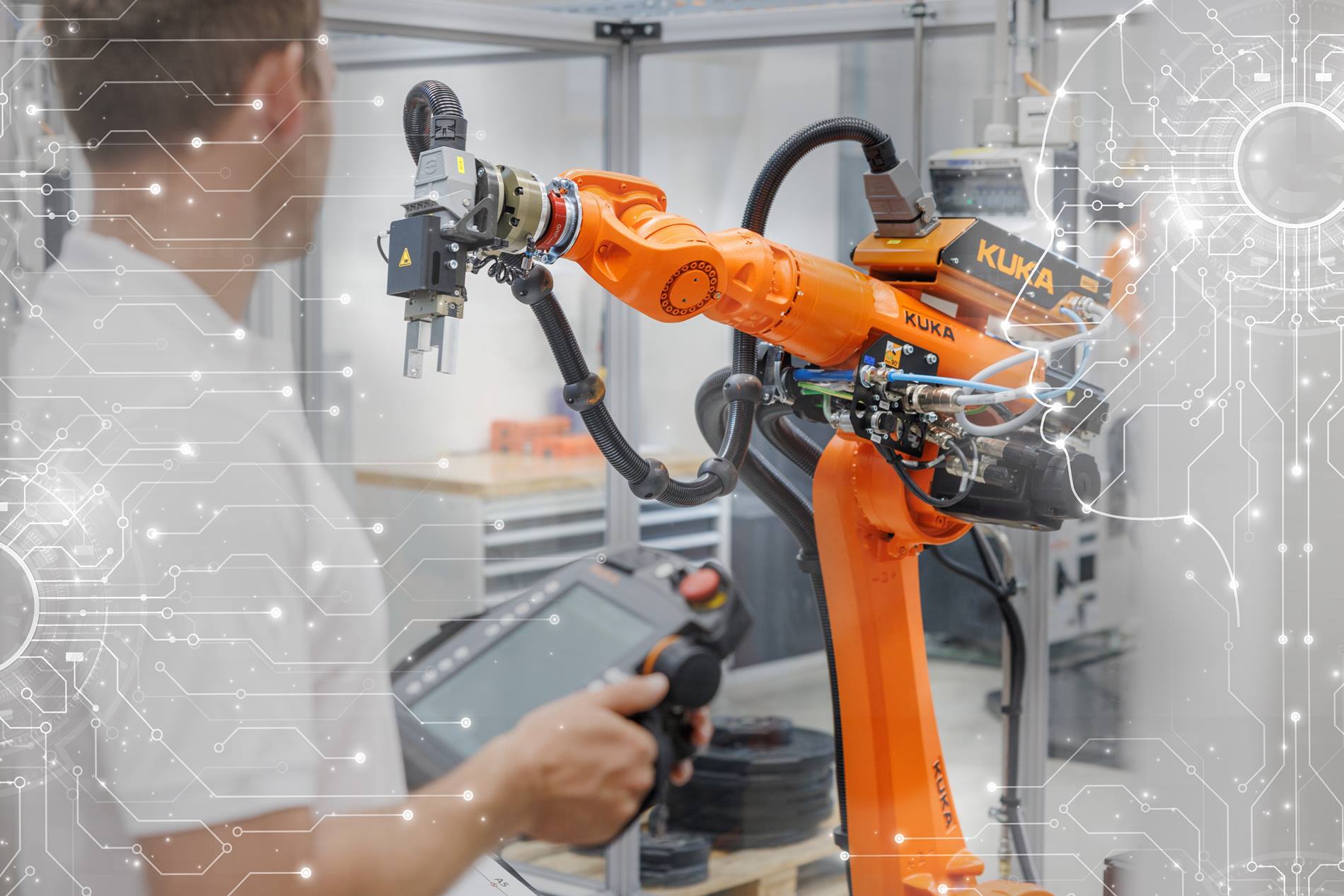
KUKA offers intelligent machines that relieve people of arduous tasks. The focus is on open standards for collecting and interpreting data.
Another application in which AI functions have been integrated: the intelligent KMReS control system. Another use case in which AI functions have been integrated: the KUKA.AMR software family. It controls driverless transport vehicles in a system.
One thing applies to all applications: The precise extent to which AI offers added value in the specific case is questioned. This also applies to projects of the Technology & Innovation Center (TIC).
Dominik Joho, Chief Research & Technology Manager at KUKA explains: “AI technologies can make systems more flexible, enabling them to respond to changes in their environment.” One project, for example, is involved in planning collision-free robot paths more quickly with the aid of deep learning. Jonas Schwinn, Principal Developer at KUKA, adds: “Compared with conventional methods, AI models are less robust and predictable. One important aspect of our development work is therefore to integrate AI models into our processes in such a way that they meet the high safety requirements of industrial robotics.” Then AI delivers real added value.