<sub id="for6y"><s id="for6y"><form id="for6y"></form></s></sub>

    <cite id="for6y"></cite>

        <s id="for6y"></s>
        亚洲一品道一区二区三区,国产无套粉嫩白浆在线,51妺嘿嘿午夜福利,人人妻人人澡人人爽人人精品av,欧美一区二区三区欧美日韩亚洲,欧美一本大道香蕉综合视频 ,884aa四虎影成人精品,国产精品久久久久久福利69堂

        Select your location:

        Location

        Solderen

        Selective soldering of parts with KUKA KR AGILUS robots

        Robotic precision supports zero-error production of the ALNEA-ZEUS control system


        Reduction of production time by 50 per cent

        Warsaw-based ALNEA Sp. z.o.o. designs and manufactures semi- and fully-automatic mechanical, electrical and pneumatic production and testing devices for specific customer requirements. The Polish company has specialized in the selective soldering process. The ALNEA-ZEUS controller developed some years ago by ALNEA was meanwhile in need of a major update to ensure that it could continue to meet the standards set in the future by the international association of the printed circuit and electronics industries (IPC).

        The new version of the soldering controller had to be able to access all process parameters, such as the provision of relevant materials for the soldering process, their exact positioning and the prevention of solder spatter outside the work area. ALNEA implemented the new development in close cooperation with KUKA Robotics in Augsburg. Using a KUKA KR AGILUS robot, it was possible to achieve considerable improvement in the precision of the soldering process, eliminate error sources and reduce the production time by 50 percent. 

        The soldering process used in so-called through-hole technology (THT) requires the utmost precision. The variable parameters, such as flux quantity, pre-heating time and temperature, wetting time or solder temperature, have a decisive influence on the quality. Furthermore, material-related influences must also be taken into consideration. The small structures and the close proximity of components that must not be wetted leave no room for error.

        With THT, repair processes are time- and cost-intensive, often not reproducible and in some cases not even allowed. The goal of the electronics industry is thus the zero-error process. “A reliably controlled selective soldering process is the decisive first step on the path to zero-error production for our customers,” says Krzysztof Kamiński, President of the Board of ALNEA Sp. Z.o.o. 

        Avoidance of errors by means of process monitoring and correction

        One major cause of errors in the selective soldering process is solder bridges. These occur in lead-free soldering, for example, due to the lower weight of the solder alloy or insufficient application of flux. All associated process steps should thus be monitored reliably. Incorrectly or imprecisely positioned modules can also cause problems in the selective soldering process. Monitoring and possible correction of their positions is also of decisive importance.

        Only a modern robot can guarantee the precision required for this soldering process

        Krzysztof Kamiński, President of the Board of ALNEA Sp. Z.o.o.
        For these reasons, in addition to the further development of the controller, it was also necessary for ALNEA to install a robot that could perform the soldering operation and precisely position the components. When searching for the suitable model, ALNEA opted to work together with KUKA.?“What swung it for us was the favorable price/performance ratio and the excellent technical support from the KUKA team,” explains the President. Moreover, the KUKA KR C4 controller also met ALNEA’s requirement that the process had to be controlled via a simple teach pendant. The open architecture of this controller supports effortless technical integration into existing machine environments.

        Small, fast and precise: the KUKA KR 6 R900

        ALNEA decided in favor of a KR 6 R900 robot from the KR AGILUS series as a prototype. The outstanding characteristics of this series include extremely high speeds combined with high repeatability and precision. Thanks to their symmetrical design, KR AGILUS robots take full advantage of their work envelope. To enable their extremely streamlined contours for operation in confined spaces, KUKA has routed the energy supply system internally.

        The KR 6 R900 not only guarantees utmost precision and high working speed in a space-saving design, with a payload of just 6 kg and a maximum reach of 900 mm, the robot also achieves a repeatability of less than ±0.03 mm and is thus ideally suited to the requirements of the soldering process. Essentially, however, other KUKA robot models can also be combined with the new ALNEA-ZEUS control system in addition to the KR 6 R900

        Compact soldering cell with KR AGILUS.

        Commands directly via the teach pendant

        “During integration of the robotic automation solution, the communication between the soldering controller and the robot controller had to be coordinated,” explains Kamiński, recalling one of the challenges. For this, a software package for controlling the parameters of the selective soldering process was loaded, in a manner of speaking, into the robot’s memory. In this way, ALNEA’s customers can control the robot directly in the production process using the KUKA smartPAD teach pendant.

        Commands are transferred to the ALNEA-ZEUS controller via Ethernet communication. The controller then executes the command on the basis of the customer-specific hardware and software. The solution dispenses with a PLC or HMI panel and requires no additional interfaces. 

        The result: 50 percent shorter process time and minimization of errors

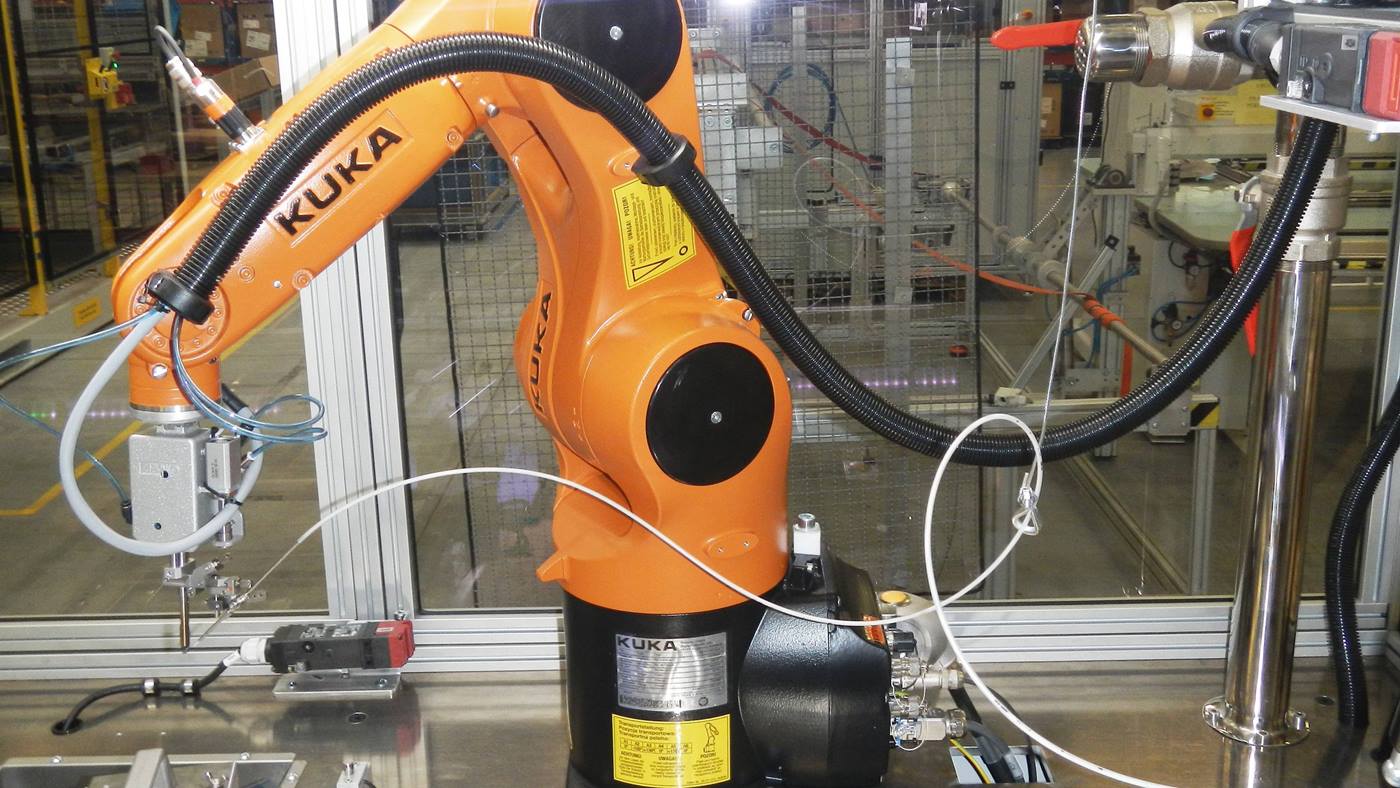
        The KUKA KR 6 R900 precisely meets the requirements placed on it by the selective soldering process. It controls the motions of the soldering iron and also holds the board in a fixed position. Thanks to the robotic automation solution developed by ALNEA, all parameters of the selective soldering process can now be monitored reliably via the teach pendant. Furthermore, all data provided by the KUKA robot are fed into the system and used.

        This includes, among other things, monitoring of the feeding and positioning of components and controlling of other external equipment. This has led not only to a noticeable reduction of errors, but also to a significant increase in productivity. “With the new solution, we have shortened the process time by 50 percent,” stresses Kamiński.

        Thanks to the ability to monitor the process via the teach pendant, the training requirements for customer employees are also kept to a modest level. There is no more need to engage three different people: process, robots and controllers specialists. Now, after a short training, even the direct worker can manage the process and the soldering robot.

        The robot holds the board in a fixed position and at the same time controls the motions of the soldering iron.
        World map of KUKA locations

        Find KUKA system partners in your area

        Find the right partner for your industry or specific challenge here.

        Reduction of production time by 50 per cent

        Warsaw-based ALNEA Sp. z.o.o. designs and manufactures semi- and fully-automatic mechanical, electrical and pneumatic production and testing devices for specific customer requirements. The Polish company has specialized in the selective soldering process. The ALNEA-ZEUS controller developed some years ago by ALNEA was meanwhile in need of a major update to ensure that it could continue to meet the standards set in the future by the international association of the printed circuit and electronics industries (IPC).

        The new version of the soldering controller had to be able to access all process parameters, such as the provision of relevant materials for the soldering process, their exact positioning and the prevention of solder spatter outside the work area. ALNEA implemented the new development in close cooperation with KUKA Robotics in Augsburg. Using a KUKA KR AGILUS robot, it was possible to achieve considerable improvement in the precision of the soldering process, eliminate error sources and reduce the production time by 50 percent. 

        The soldering process used in so-called through-hole technology (THT) requires the utmost precision. The variable parameters, such as flux quantity, pre-heating time and temperature, wetting time or solder temperature, have a decisive influence on the quality. Furthermore, material-related influences must also be taken into consideration. The small structures and the close proximity of components that must not be wetted leave no room for error.

        With THT, repair processes are time- and cost-intensive, often not reproducible and in some cases not even allowed. The goal of the electronics industry is thus the zero-error process. “A reliably controlled selective soldering process is the decisive first step on the path to zero-error production for our customers,” says Krzysztof Kamiński, President of the Board of ALNEA Sp. Z.o.o. 

        Avoidance of errors by means of process monitoring and correction

        One major cause of errors in the selective soldering process is solder bridges. These occur in lead-free soldering, for example, due to the lower weight of the solder alloy or insufficient application of flux. All associated process steps should thus be monitored reliably. Incorrectly or imprecisely positioned modules can also cause problems in the selective soldering process. Monitoring and possible correction of their positions is also of decisive importance.


        Only a modern robot can guarantee the precision required for this soldering process

        Krzysztof Kamiński, President of the Board of ALNEA Sp. Z.o.o.
        For these reasons, in addition to the further development of the controller, it was also necessary for ALNEA to install a robot that could perform the soldering operation and precisely position the components. When searching for the suitable model, ALNEA opted to work together with KUKA.?“What swung it for us was the favorable price/performance ratio and the excellent technical support from the KUKA team,” explains the President. Moreover, the KUKA KR C4 controller also met ALNEA’s requirement that the process had to be controlled via a simple teach pendant. The open architecture of this controller supports effortless technical integration into existing machine environments.

        Small, fast and precise: the KUKA KR 6 R900

        ALNEA decided in favor of a KR 6 R900 robot from the KR AGILUS series as a prototype. The outstanding characteristics of this series include extremely high speeds combined with high repeatability and precision. Thanks to their symmetrical design, KR AGILUS robots take full advantage of their work envelope. To enable their extremely streamlined contours for operation in confined spaces, KUKA has routed the energy supply system internally.

        The KR 6 R900 not only guarantees utmost precision and high working speed in a space-saving design, with a payload of just 6 kg and a maximum reach of 900 mm, the robot also achieves a repeatability of less than ±0.03 mm and is thus ideally suited to the requirements of the soldering process. Essentially, however, other KUKA robot models can also be combined with the new ALNEA-ZEUS control system in addition to the KR 6 R900

        Compact soldering cell with KR AGILUS.

        Commands directly via the teach pendant

        “During integration of the robotic automation solution, the communication between the soldering controller and the robot controller had to be coordinated,” explains Kamiński, recalling one of the challenges. For this, a software package for controlling the parameters of the selective soldering process was loaded, in a manner of speaking, into the robot’s memory. In this way, ALNEA’s customers can control the robot directly in the production process using the KUKA smartPAD teach pendant.

        Commands are transferred to the ALNEA-ZEUS controller via Ethernet communication. The controller then executes the command on the basis of the customer-specific hardware and software. The solution dispenses with a PLC or HMI panel and requires no additional interfaces. 

        The result: 50 percent shorter process time and minimization of errors

        The KUKA KR 6 R900 precisely meets the requirements placed on it by the selective soldering process. It controls the motions of the soldering iron and also holds the board in a fixed position. Thanks to the robotic automation solution developed by ALNEA, all parameters of the selective soldering process can now be monitored reliably via the teach pendant. Furthermore, all data provided by the KUKA robot are fed into the system and used.

        This includes, among other things, monitoring of the feeding and positioning of components and controlling of other external equipment. This has led not only to a noticeable reduction of errors, but also to a significant increase in productivity. “With the new solution, we have shortened the process time by 50 percent,” stresses Kamiński.

        Thanks to the ability to monitor the process via the teach pendant, the training requirements for customer employees are also kept to a modest level. There is no more need to engage three different people: process, robots and controllers specialists. Now, after a short training, even the direct worker can manage the process and the soldering robot.

        The robot holds the board in a fixed position and at the same time controls the motions of the soldering iron.
        主站蜘蛛池模板: 欧美日韩a| 无码中文AⅤ在线观看| 国产一区二区不卡视频在线| 免费观看污视频网站| 日韩av无码一区二区色| 亚洲产在线精品亚洲第一站一| 亚洲第一香蕉视频啪啪爽| 农夫在线精品视频导航| 米奇7777狠狠狠狠视频影院| 国产成年人在线观看| 国产一级小视频| 亚洲av成人无码精品电影在线| 国内精品久久久久影院一蜜桃| 日本欧美国产精品第一页久久| 国产又色又爽又刺激在线观看| 中文字幕日韩精品东京热| 久久人妻网站| 国产精品无码AV一区二区三区| 免费高潮了好湿h视频| 免费AV片在线观看网址| 国产免费久久精品44| 狠狠操狠狠撸| 亚洲精品久久久久国色天香| 亚洲成av人片无码天堂下载| 色欲狠狠躁天天躁无码中文字幕 | 99久久99久久久精品久久| 日本人又色又爽的视频| 国产色无码专区在线观看| 久久se精品一区二区三区| 亚洲精品一区二区国产精华液| 美女一级毛片免费观看97| 国产精品久久久一区二区三区| 国产精品一区在线蜜臀| 株洲市| 国产av不卡一区二区| 久久精品国产亚洲av高| www污| 艳妇乳肉豪av无码福利| 久久婷婷国产精品香蕉| 国产午夜精品福利在线观看| 国产一区二区三区乱码在线观看|