<sub id="for6y"><s id="for6y"><form id="for6y"></form></s></sub>

    <cite id="for6y"></cite>

        <s id="for6y"></s>
        亚洲一品道一区二区三区,国产无套粉嫩白浆在线,51妺嘿嘿午夜福利,人人妻人人澡人人爽人人精品av,欧美一区二区三区欧美日韩亚洲,欧美一本大道香蕉综合视频 ,884aa四虎影成人精品,国产精品久久久久久福利69堂

        Select your location:

        Location

        AI-based process monitoring for automated friction stir welding

        AI-based process monitoring for friction stir welding

        Whether it's the side walls of high-speed trains, the battery containers of electric cars or the tank structures of launch vehicles: Various industries have special requirements for weld seams. Friction stir welding has established itself as a particularly innovative joining technique. In order to monitor the quality of the weld seams during the process and thus reduce the time and costs of the subsequent inspection, KUKA is working on an AI-based process monitoring system together with other partners in the KI-Produktionsnetzwerk Augsburg.


        Carolin Hort
        May 2, 2024
        Imagine
        Reading Time: 3 min.

        "Friction stir welding is a comparatively new and pioneering joining process: In addition to many other advantages, it is extremely energy-efficient, ensures high strength weld seams and even materials that are difficult to weld can be joined together," says Dr. Thomas Schlech. He is in charge of the project at the University of Augsburg and is responsible for the research focus "Learning manufacturing processes" in the AI production network there. On the other hand, the process is physically very complex, and process anomalies and defects cannot be ruled out, especially if the welding speed is to be optimized. "Deviations in the material or the shape of the joining partners or sub-optimal process control can lead to defects in the joint. This is why companies often check the weld seams retrospectively in complex, sometimes manual processes," explains Schlech. This is time-consuming and cost-intensive. This is why the experts in the KI-Produktionsnetzwerk are now researching a reliable approach to monitoring the process online and in real time.

        Sensor data provides deep insights into the process

        To monitor the process, the research partners rely on the use of various sensors that record the forces, temperatures and vibrations that occur during welding and allow conclusions to be drawn about the process. The main focus is on analyzing signals in the ultrasonic range, which are generated during friction stir welding (FSW) and propagate through the system to the sensors.

        AI-based process monitoring for automated friction stir welding
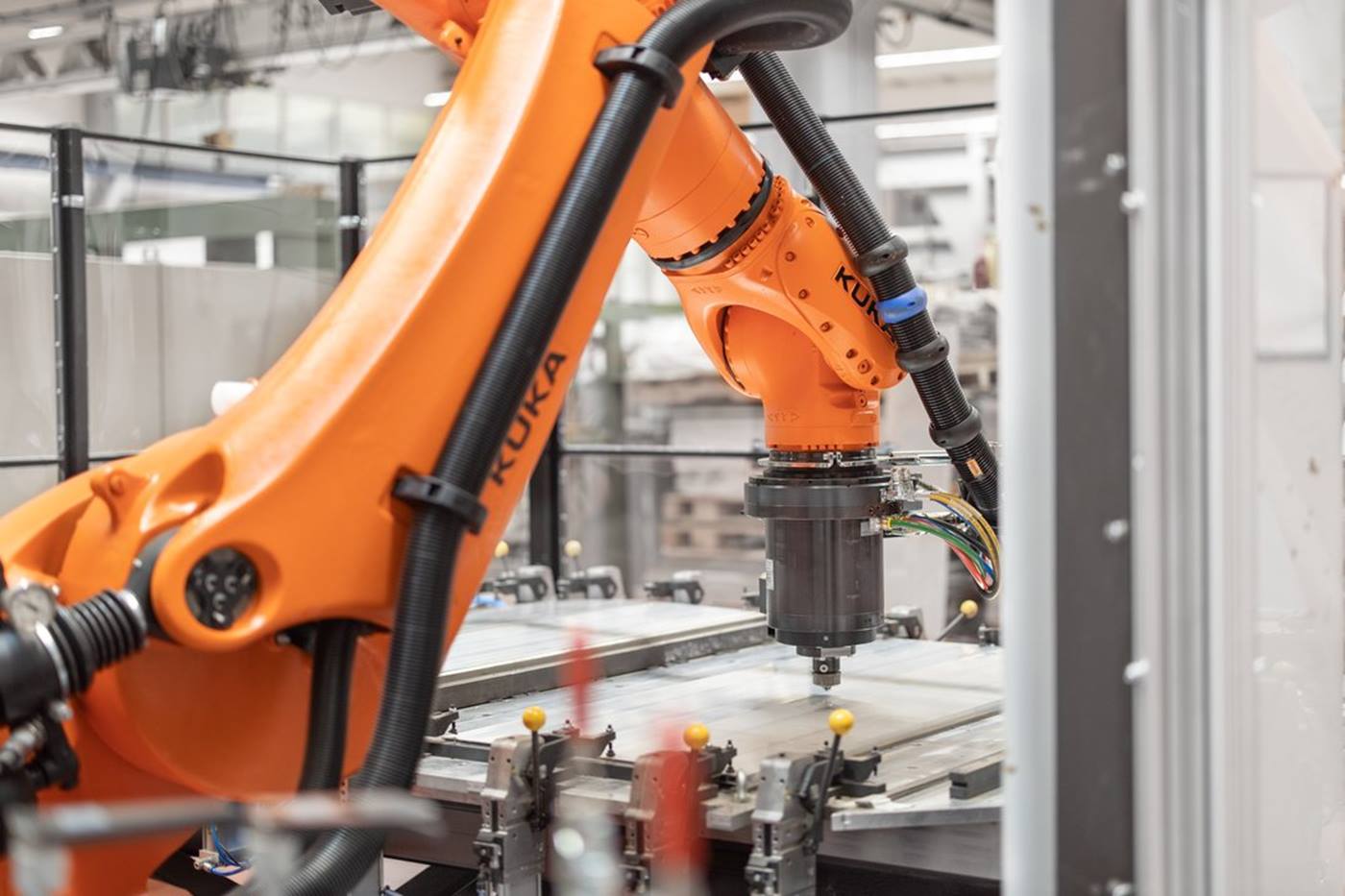
        KUKA is working with partners on AI-based process monitoring for robot-based friction stir welding. 

        "We want to close a research gap with this project: there is still no system for the FSW that can independently detect and classify the smallest errors and deviations and assess how serious such an error can be in the application. The advantages are obvious: fewer subsequent checks save time and money. The data can also be used for process optimization," explains Prof. Dr. Markus Sause, head of the Mechanical Engineering teaching and research unit, where the project is being researched at the university.

        From complex data to process information

        Artificial intelligence or supervised machine learning comes into play in the project when it comes to interpreting the extensive sensor data that is generated on industrial-scale processes both at the industrial partners' systems and at those of the KI-Produktionsnetzwerk at the University of Augsburg. The researchers evaluate the data and assign it to processes in the welding process. Certain patterns in the sensor data can then indicate that a weld seam has not been executed properly. Schlech: "Like a teacher, we use our data to teach our system the meaning of certain signal combinations. The monitoring system thus learns the relationship between sensor signals and the occurrence of deviations in weld seams. As soon as the training is complete, the model can make statements about the seam quality based solely on the sensor signals. If the signals are passed to the system during the process, a defect can be detected, located and classified immediately." An inspector then only has to examine these critical points more closely after the process, if at all, and not the entire weld seam.

        High-ranking visitors to the KI-Produktionsnetzwerk: In addition to the Bavarian Prime Minster Markus Söder, Eva Weber, Lord Mayor of the City of Augsburg, and Minister of State Markus Blume were among those who were impressed by AI for robotics © University of Augsburg

        "The planned project reflects exactly what we want to achieve with the AI production network. We can contribute our research expertise in the field of AI in production in a targeted industrial context in order to strengthen companies from the region. In return, the industrial cooperation and networking with our partners opens up an interesting field of research that goes beyond the project," summarizes Sause.

        KUKA supplies friction stir welding cell

        To realise the project called Artifical Intelligence for Friction Stir Welding - AI4FSW for short - directly on site, a new cell4_FSW midsize single KR was integrated into the hall of the AI production network. Till Maier, Portfolio Manager AWS at KUKA Germany, explains: "In order to evaluate the sensor selection on the robot at an early stage, the friction stir welding cell was set up and put into operation within a very short time. This was only possible thanks to close and cooperative collaboration in the project. The early integration of the welding cell minimises project risks and reduces additional development loops."

        The project was approved by the Bayerisches Staatsministerium für Wirtschaft, Landesentwicklung und Energie as part of the F?rderlinie Digitalisierung Bayern (VDI/VDE-IT). 

        About the KI-Produktionsnetzwerk Augsburg

        The KI-Produktionsnetzwerk Augsburg is an association of the University of Augsburg, the Fraunhofer Institute for Casting, Composite and Processing Technology IGCV, the Center for Lightweight Production Technology (ZLP) of the Deutsches Zentrum für Luft- und Raumfahrt (DLR) in Augsburg and the Augsburg University of Applied Sciences. Regional industrial partners are also involved. The aim is to conduct joint research into AI-based production technologies at the interface between materials, manufacturing technologies, data-based modeling and digital business models. The KI-Produktionsnetzwerk Augsburg is being funded with 92 million euros from the Bavarian state government's High-Tech Agenda.

        About the author
        Next article
        主站蜘蛛池模板: 色综合激情丁香七月色综合| 成人无遮挡裸免费视频在线观看| 亚洲天堂三区| 婷婷综合另类小说色区| 免费中文字幕一级毛片| 成人免费乱码大片a毛片| 富蕴县| 国产主播AV福利精品一区| 无码天堂亚洲国产av麻豆| av超碰| 白丝精品一区二区三区| 人妻综合专区第一页| 中文字幕日韩精品人妻| 午夜成人性爽爽免费视频| 啊av在线| 激情亚洲天堂| 国产精品尤物铁牛tv| 国语偷拍视频一区二区三区| www.yw尤物| 精品国产自在现线看久久| 亚洲成精品动漫久久精久| 久久综合亚洲色一区二区三区| 男人天堂一区| 中文无码网| 国产精品亚洲A∨天堂不卡| 日韩成人A级毛片| 亚洲中文字幕无码中字| 国产欧美久久一区二区| a免费在线| 一区二区三区无效卡| 精品美女少妇内射毛片| 少妇无套内谢免费视频| 中文字幕av久久爽Av| 亚洲一区二区三区在线| 精品一区二区三区自拍图片区| 成人麻豆日韩在无码视频| 亚洲综合一区二区精品导航| 久久精品成人免费国产| 日本网站不卡一区二区| 超碰人人骑| 亚洲国产欧美一区二区好看电影|