You are using Internet Explorer and will not be able to use our website properly. Please change to an up-to-date browser for ideal presentation of the website.
A firm grip on non-rigid parts: KR CYBERTECH automates battery pack assembly
Production of batteries for electric vehicles presents hazards because of the enormous voltage produced when battery modules make electrical contact. Together with KOSTAL Kontakt Systeme GmbH and KUKA, Liebherr-Verzahntechnik GmbH has used two KR CYBERTECH nano series robots to connect high-voltage battery modules safely and efficiently.
Automation provides a tailwind for e-mobility
They are quiet, increasingly use electricity from renewable energy sources, cause fewer CO2 emissions and entail lower costs for repair and maintenance. Electric vehicles are the future. It is estimated that more than 27 million plug-in hybrids and e-cars are currently driving around the world. And when numerous major states put the brakes on the registration of internal combustion vehicles between 2030 and 2035, this number will rise significantly. KUKA recognized the potential of e-mobility early on. Since 2014, the automation specialist from Augsburg has been optimizing its product portfolio to meet the special requirements that have to be met in the production of electronic components for the automotive industry.Liebherr-Verzahntechnik GmbH in Kempten is now also benefiting from this. There, with the help of KUKA robots, an application has been created that can offer manufacturers of electric vehicles and their suppliers greater safety and higher productivity. After all, what would an electric car be without its core component, the battery?
Secure connection of high-voltage battery modules using a robotic solution
Two KR CYBERTECH nano ARC HW robots connect the modules of the high-voltage battery and take the safety and efficiency of battery production to a whole new level.
Robot-based assembly ensures greater safety in high-voltage battery production
The high-voltage battery contains an enormous amount of energy and is crucial for the vehicle's range and charging time. The HV battery consists of several modules that are electrically contacted with each other and connected to form a battery pack. After electrical contacting, these battery systems reach output voltages of between 400 and 800 volts DC. However, the busbar connections often used for this purpose pose a high safety risk to employees due to the exposed contact surfaces.
At the same time, both robots move down to the battery modules with the plug-in module connectors.
The use of pluggable modular connectors offers an alternative. Together with KOSTAL Kontakt Systeme GmbH and with the help of KUKA robots, the company from the Allg?u region has developed an innovative process for the automated assembly of pluggable modular connectors with flexible cables. Plug-in, insulated and flexible module connectors from KOSTAL prevent unintentional contact with live parts and can be plugged in automatically despite their high elasticity – with the required flexibility and cycle time.
To produce these batteries economically in large quantities, automation plays a key role.
E-mobility: A real innovation with hollow wrist robots and special software
Two KR CYBERTECH nano ARC HW robots per cell are responsible for the insertion process itself. These hollow wrist robots are otherwise used primarily for arc welding. However, their compact design and long reach, as well as the possibility of routing cables through the manual axis, also made them the perfect choice for this application. In addition, the Liebherr-Verzahntechnik GmbH selected the KUKA.RoboTeam software package. It enables synchronized cooperation between two or more robots. The program and motion are synchronized in real time, so that even complex processes – such as the joining of flexible parts – work out successfully. A real innovation in the field of electromobility.
In one cell, two KR CYBERTECH nano ARC HW are plugging the electronic connections.
Both robot arms work synchronously in the production of HV-batteries, controlled by the KUKA.RoboTeam software package.
Skills shortage drives automation forward
Most process steps in battery production are already automated today in order to meet the requirements of the automotive industry in terms of cycle times, quantities, quality and production costs, among others. The shortage of skilled workers is also driving the strong trend toward automation. Fewer and fewer skilled workers can be found who are willing to take on such a monotonous, physically stressful and at the same time demanding task. The company KOSTAL Kontakt Systeme GmbH from Lüdenscheid, which has been producing and selling connectors for the automotive industry since 1938, recognized a gap in the market here. It developed a connector suitable for both manual mating and automation. Martin Wolter, Group Manager for Development at KOSTAL Kontakt Systeme, reports: “Safety plays a very important role here – since these are high-voltage contacts, they must be touch-proof. This is comparable to a socket outlet; here the electrical contacts are also protected against accidental contact with fingers. The difference is that the plug connection in the vehicle is exposed to vibration and both high and low temperatures. Our system is very robust and reliably transmits power throughout its service life under varying loads.”
Our system is very robust and reliably transmits power throughout its service life under varying loads.
The slim design of the KR CYBERTECH nano ARC HW allows two robots to fit into one compact cell.
A milestone for electromobility in battery pack assembly
KOSTAL then looked for an automation specialist to make the new product suitable for series production. KOSTAL found what it was looking for at Liebherr-Verzahntechnik GmbH in Kempten. The Allgäu-based company has been supplying innovative solutions to numerous automotive manufacturers and suppliers, as well as customers from the plant engineering, aerospace and construction machinery sectors since 1969.
Viktor Bayrhof in front of the innovative cell that could be presented at the Battery Show after only 1.5 years.
Viktor Bayrhof, Product Manager for Automation Systems at Liebherr, reports: “It was a win-win situation. We, as a relatively new player in the battery assembly business field, found a unique selling point and KOSTAL found someone to automate their product.” The Allgäu company has been cooperating closely with KUKA for more than ten years. Together, the three companies set to work and after just one and a half years, the newly developed robotic cell could be exhibited at the Battery Show in Stuttgart.
Assembly: robots plug flexible cables
They attracted a lot of attention there. This is because the pluggable module connectorswith flexible cables offer other advantages in contrast to screw connections with bus bars: they are easier to install, as only the plug and the counterpart need to be connected, and they can compensate for vibrations during vehicle operation, so that becomes less likely to lose the electrical contact due to wear. Their design also brings advantages when the battery modules are replaced at a later date, for example for second-life applications or recycling of the modules in the battery pack. The only catch is that they are flexible and therefore deform even under low force and torque loads.
And the connection fits – an enormously important step in the expansion of e-mobility.
Processing of flexible parts requires optimal solution
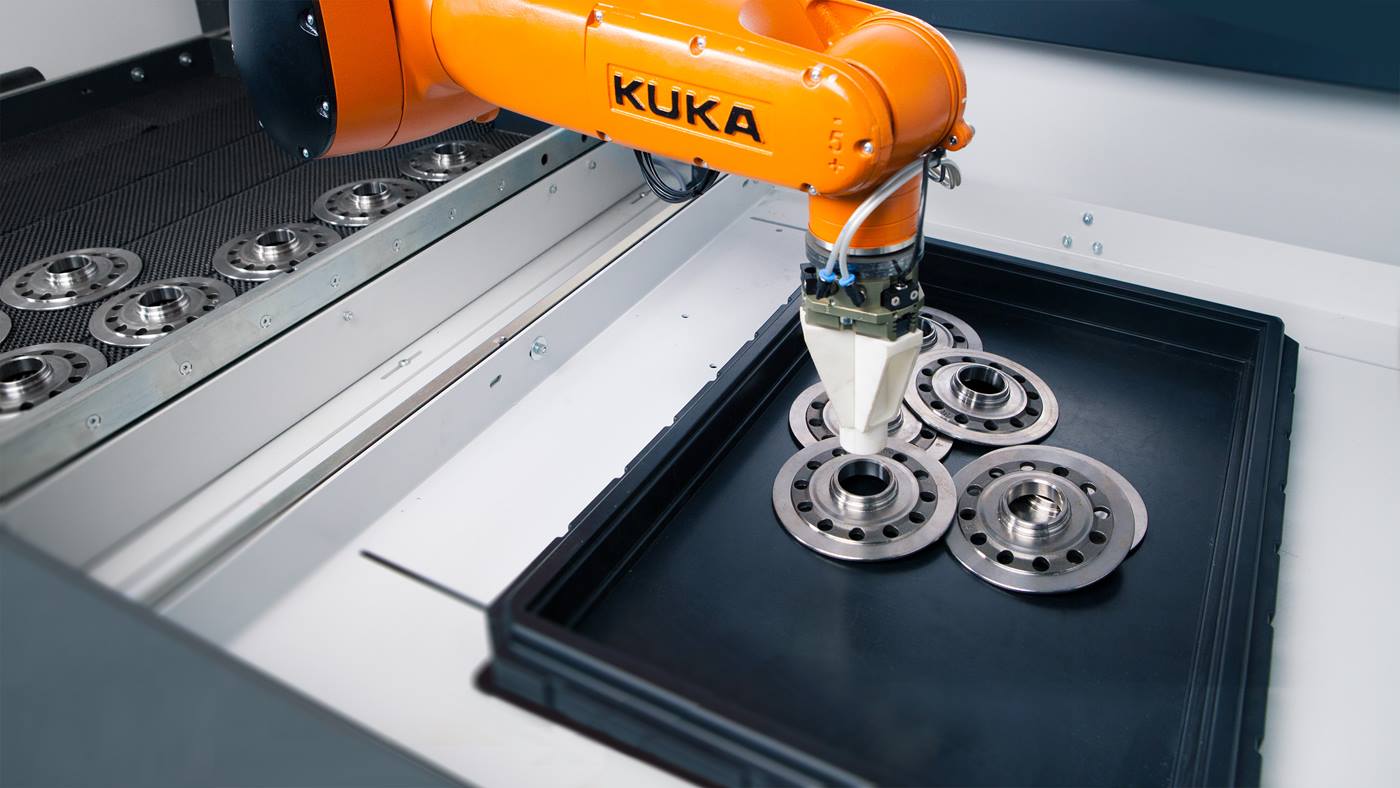
Automating the handling of flexible parts by machines is still a major challenge: for example, elastic cables, which can twist in any direction, are difficult for robots to grip. Based on the KR CYBERTECH nano ARC HW, the company from Kempten has developed a special gripper that removes the cables from a blister. Since the cable is not pre-positioned with sufficient accuracy inside the blister, a 2D camera is used: it helps to determine the exact gripping positions on the flexible cable and to position the module connector at the end of the cable precisely over the connector counterpart.
With the aid of a 2D camera, the robots can precisely grip and insert the flexible parts of the high-voltage battery.
With spring assemblies for exactly the right use of force
Because the connector must be handled with care, the mating process has been decoupled for smooth operation. A spring assembly controls the force applied to the connector and the connector position assurance (CPA). A pneumatic cylinder then presses the connector into the counterpart. This spring assembly compresses until the force torque of 70 newton meters is reached and the end position sensor is triggered. At the same time, the spring-loaded locking pin presses the CPA down. This locks the CPA, the plug is inserted in a process-safe manner and the gripper can move upwards again. In contrast to other automation experts, Liebherr deliberately does not solve the plugging process of the flexible cables via trial-and-error processes. Every grip must fit. The reason for this is that the technology must be suitable for series production and must be able to meet strict cycle times. This has worked even better than good: Instead of the prescribed 17 seconds, the system achieved a cycle time of eleven seconds.
Best performance thanks to the right combination of robots and software
The KR CYBERTECH nano ARC HW is used for the automation process. The flexible, cost-effective industrial robot specializes in working with small components and can also reach plug-in positions that are difficult to access. Its protection against uncontrolled electrostatic buildup or discharge (ESD) makes it ideal for handling sensitive electronic components. In order to be used in compact robot cells, the slimly designed robot can make optimum use of small spaces.
Every step in battery production can be tracked and controlled via the KUKA smartPAD control panel.
The KUKA.RoboTeam software enables Liebherr to have the two grippers work cooperatively in master-slave mode, optimally imitating human arms. This allows the robots to handle different cable lengths and plug positions, as well as compensate for position tolerances. The integrated image recognition system helps to determine the real positions of the slots. Finally, this solution can be applied not only to electrical contacting, but also to other elastic components in battery production – for example, in automating the plugging process of data cables between the Battery Management System (BMS) and the Cell Management Controller (CMC).
High quality standards: Perfectly equipped for the automotive industry
According to Martin Klaus, Global Business Development Manager Electronics at KUKA, many companies in the automotive industry will only be able to remain competitive in the future with the help of automation. “The trend of battery-powered electric cars and the increasing technical progress in vehicles will significantly increase the quantity and variety of complex electronic components in cars,” emphasizes Klaus, who is responsible for the Automotive Electronics division at KUKA. According to Klaus, these components, including inverters, electric motors, displays, cameras and control units, “can only be produced in the required quality and quantity with a high degree of automation.
The interaction of hard- and software makes the individual components highly controllable.
Robotics can be used to implement a large number of the processes required in elec-tronics manufacturing.
New partnership in battery pack assembly fit for the future
The automation specialist from Augsburg is prepared for this and the company’s portfolio includes ESD-protected robots as well as robots certified for cleanrooms and dry rooms. Viktor Bayrhof of Liebherr sees it in the same way. “High-voltage battery systems are the most expensive component of an electric vehicle,” says Bayrhof. “To produce these batteries economically in large quantities, automation plays a key role.” The solution developed by Liebherr, KOSTAL and KUKA can ensure companies' competitiveness even in turbulent times. It gives them permanent control over their production – including the flexible parts.
Expand your knowledge of rotational friction welding, agitation friction welding, and magnetic arc welding. Learn through practical examples, applications, and specific automation solutions for your production.