<sub id="for6y"><s id="for6y"><form id="for6y"></form></s></sub>

    <cite id="for6y"></cite>

        <s id="for6y"></s>
        亚洲一品道一区二区三区,国产无套粉嫩白浆在线,51妺嘿嘿午夜福利,人人妻人人澡人人爽人人精品av,欧美一区二区三区欧美日韩亚洲,欧美一本大道香蕉综合视频 ,884aa四虎影成人精品,国产精品久久久久久福利69堂

        Select your location:

        Location

        Optimized material flow through autonomous mobile robots

        Two concepts, one goal: Using mobile robotics to optimize material flow in production

        KRONE implements automation solutions with KUKA in both brownfield and greenfield sites. In Werlte, Germany, stationary and autonomous mobile robots optimize existing operational processes, while a smart factory has been built on a greenfield site in Ibbenbüren. What both projects have in common is the desire to fulfill customer requirements, secure jobs, and rethink production in a new and future-proof way.


        Intelligent automation in all operational processes

        The autonomous transport platform keeps to itself, making its way through the production hall almost silently. The autonomous mobile robot (AMR) delivers a 100-liter compressed air boiler to a welding station with centimeter precision. A KUKA handling robot is already waiting there to pick it up from the platform and weld it to other components in the processing cell.
        What sounds like a pipe dream for the assembly of truck components has long been everyday reality at the KRONE Group, one of the largest manufacturers of agricultural machinery and commercial vehicles. In partnership with KUKA, KRONE relies on intelligent automation – both in an existing factory (brownfield) and in a new, smart production facility (greenfield). The results are more efficient processes, higher added value, reduced workload for employees, and competitive production “made in Germany.”

        Autonomous intralogistics for maximum efficiency

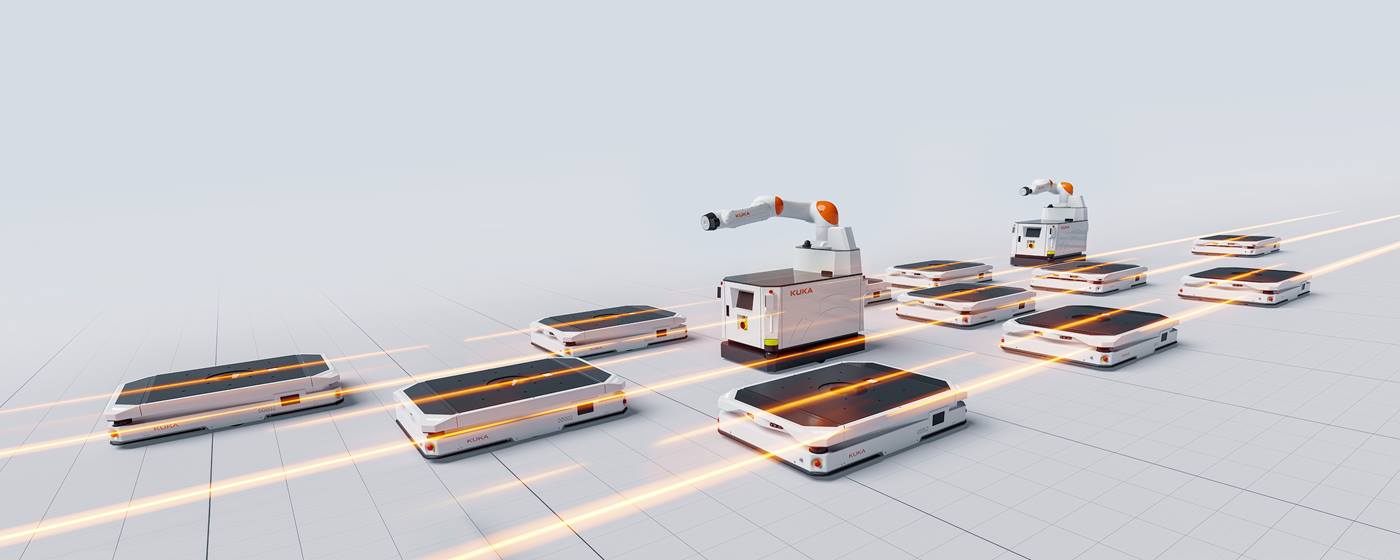
        Mobile platforms from KUKA ensure optimal material flow at KRONE.

        The key to the smart factory: autonomous mobile robots

        The company relies on KUKA as its technology partner and is consistently pursuing automation in both an existing plant in Werlte and the latest greenfield factory built by GTS Green Teuto Systemtechnik GmbH in Ibbenbüren, using manufacturing robots in conjunction with driverless transport systems. This is where KRONE sees great potential. KUKA.AMR Fleet, our AMR fleet management system, is the key to the transformation to a smart factory,” says Nikita Daubert, AMR Business Development Manager for the DACH region at KUKA.

        KUKA's AMR fleet management is compatible with all common control systems.

        KUKA's AMR fleet management can be flexibly linked to in-house control systems such as MES/ERP. This enables us to support customers like KRONE with all their automation concepts in a needs-based and future-oriented manner.

        Nikita Daubert, AMR Business Development Manager for the DACH region at KUKA

        AMR: Mobile robots for inventory management in Werlte

        KRONE operates a truck trailer production facility with established structures in Werlte, Lower Saxony. With the support of Silver Robotics, a KRONE subsidiary that implements innovative and customized robotics and machine construction solutions at KRONE itself as well as for external customers, a fully automated cell has now been set up here. Six-axis KUKA handling and welding robots perform their tasks digitally networked with autonomous mobile robots such as the KMP 1500P.

        Heavy loads, such as the air tanks at the KRONE factory in Werlte, are no problem for the KMP 1500P.

        The compact AMR can carry up to 1.5 tons and moves independently in production thanks to its differential drive technology. Integrated 3D cameras and laser scanners ensure flexibility and safety in a working environment with people. The inductive charging concept keeps the platform operational around the clock.
        “We had previously reviewed all our existing processes and converted them to new processes and working methods such as modular construction,” explains René Mecklenburg, Managing Director of Silver Robotics GmbH. “And we immediately started thinking ahead in terms of intralogistics and optimized material flow. Because we want to offer our customers our products faster – and at even higher quality and at economical, marketable prices.”

        From welding curtains to smart cells

        The welding robots are now supplied autonomously, and forklifts are to be phased out of production as far as possible. Instead, the transport platform automatically brings materials such as compressed air tanks or door elements to the cell. There, a handling robot places them in the welding system. The finished assemblies are also transported away automatically from there. “The mobile robots help us to link together many processes that are very extensive here. This has enabled us to dispense with a lot of conveyor technology and at the same time significantly increase efficiency in production and intralogistics processes,” says René Mecklenburg. At KRONE, humans and machines work hand in hand: “The employees take care of preparing the parts and quality control, while robots do the physically demanding welding work. This relieves our employees of heavy, monotonous tasks, creates more order, and increases safety,” Mecklenburg continues. Volker Perk, Production Director at KRONE Commercial Vehicle Group, sees robotics as a key factor in securing the company's future location: "We want to continue producing truck trailers such as the ‘Profi Liner’ in Germany in the future. To do this, however, we need to automate processes because we simply cannot find skilled workers for many of the tasks required. Robotics gives us the opportunity to introduce our employees to more efficient or value-adding activities."

        At KRONE in Werlte, forklifts are to be replaced by mobile robotics, improving safety.

        Intelligently linking assembly and logistics

        Jochen Roling, Managing Director at GTS, describes how automation and the smart factory were introduced at KRONE based on his own experience: “At first, we only automated the process behind the welding curtain. At some point, it became clear that in order to operate the plant efficiently and economically, material flow and operation also had to be robot-based.” This is where KUKA’s mobile robots came into play. While Werlte continuously modernized existing processes “on the fly,” so to speak, a completely new factory for agricultural machinery production was built in just twelve months in Ibbenbüren, Westphalia, with Green Teuto Systemtechnik, GTS, also a subsidiary of the KRONE Group – as a greenfield solution, literally on a “green field.” Here, robots manufacture welded assemblies that are later painted and then installed in agricultural machinery.

        KRONE implemented automated production in Ibbenbüren on a greenfield site.

        Material flow planning without barriers

        “Why a smart factory? Why a new factory?” asks Jochen Roling, before immediately providing the answer: “At KRONE, we intend to specialize our plants in the end product. For us, ‘smart’ means using digitalization and automation to manufacture with maximum efficiency and scalability.” The advantage of the greenfield approach was that it allowed planning without restrictions and without existing structures. “With the support of KUKA, we are focusing on state-of-the-art, smart, and sustainable manufacturing concepts and processes. That's why we made automated supply and integrated data processing of the production and assembly lines a priority from the very beginning,” says Roling.

        State-of-the-art, smart, and sustainable manufacturing concepts are made possible by KUKA robots at KRONE.

        The entire production architecture of the smart factory was designed from the ground up to be data-driven and scalable – a milestone in the history of KRONE.

        Jochen Roling, Managing Director at GTS

        Real-time data in IT forms the basis

        The basis of the smart factory in Ibbenbüren is an IT architecture that collects real-time data and processes it on an event-driven basis. Every machine, every robot, and every transport vehicle is digitally networked. "This allows production to react immediately to tolerance violations or malfunctions. That's why we no longer talk about control loops, but rather regulation loops,“ says Perk. ”The systems are adaptable; they learn and correct themselves independently." This change also affects communication between development and production. “In the past, production adapted to product changes. Today, it's the other way around. All requirements from production are already incorporated into the next development,” says Roling.

        Digital networking allows all data to be recorded in real time.

        Three steps to full automation

        KRONE is following a three-stage implementation concept on its path to automation. The first step involves developing a holistic perspective on process automation. Building on this, the focus then shifts to solutions for material transport using AMR. Stage three is automated parts handling.

        Autonomous mobile robots with a load capacity of up to six tons

        KRONE designed its plant in Ibbenbüren according to this principle. Today, nine welding and handling robots are used synchronously with two machining centers and an automatic measuring cell in a single production island. This has virtually eliminated downtime, as robots and transport platforms remain in sync around the clock. Production can be ramped up or down without personnel bottlenecks, which are now almost impossible to resolve, becoming a limiting factor. “This scalability of the production architecturefrom small cells to complex networked lines – is a core objective of the new smart factory,” says Roling. The first KMP 3000P robots are now also being tested in Ibbenbüren. They can move up to three tons in the production halls, twice as much in tandem, and move omnidirectionally with the highest precision even in the tightest of spaces.

        Downtime has been virtually eliminated thanks to the optimal coordination of welding, handling, and autonomous mobile robots.

        “We make work more attractive”

        One thing is particularly important to KRONE's factory planners: automation does not mean the end of human labor, but rather its enhancement. “Operating highly automated cells has gained in value. Employees see this as a job of the future,” says Roling. Mecklenburg adds: “We are seeing colleagues actively applying for these positions internally.” Ergonomics also plays a role: “The new workplaces are safer and less physically demanding. That makes them attractive – especially for younger generations,” says Perk.

        Robotics helps us keep our locations competitive even in the face of demographic change.

        Volker Perk, Production Manager of the KRONE Commercial Vehicle Group

        Repetitive, monotonous tasks, handling heavy loads, and the dangers of welding itself – from toxic gases and fumes to the risk of burns and electric shocks are not attractive on the job market. “We simply can't find people for these jobs anymore. Robotics helps us keep our locations competitive even in the face of demographic change,” emphasizes Perk. The automotive industry, with its high production volumes, has led the way: “In series production, automation is economically unavoidable. Today, this also applies to smaller production volumes, such as those involved in the manufacture of individually configured agricultural machinery.” On the way there, KRONE considers its collaboration with KUKA to be strategically important. “KUKA not only supplies technology, but also brings system thinking to the table. We learn together and develop together,” says Perk.

        Looking ahead: assembly, variant production, and AI

        René Mecklenburg sees further potential in assembly automation for the future: “Especially with highly varied products, we need to automate without losing flexibility.” The rapid progress of digitalization and artificial intelligence is opening up completely new potential in this area. “The systems are learning to recognize errors and optimize themselves,” says Volker Perk. “We can build on that.”

        There is still great potential for self-optimization of the systems.
        This thought immediately brings to mind an image from the office of owner Bernard Krone: “A quote from Dante: One waits for time to change, the other seizes it and acts.” They still have a lot of plans for the future at KRONE.

        Further information on autonomous mobile robots:

        Here you will find an overview of all autonomous mobile robots (AMR) from KUKA.

        Find KUKA system partners in your area

        Find the right partner for your industry or specific challenge here.

        主站蜘蛛池模板: 亚洲熟妇无码爱v在线观看| 欧美a在线| 福利一区二区不卡国产| 茄子视频毛片免费观看| 欧美性爱电影网站| av在线播放国产一区| 日日碰狠狠添天天爽五月婷| 湟源县| 亚洲高清美女一区二区三区| 亚洲欧美日韩综合区| 久久亚洲精品无码播放| 人妻少妇被猛烈进入中文字幕| 蜜臀av一区二区| 成人免费A级毛片无码网站入口 | 国内精品一区二区不卡| 色综合久久久久综合体桃花网| 九九久久精品国产| 国产自产V一区二区三区C| 无码少妇一区二区性色av| 日韩欧美人妻一区二区三区| 日韩亚洲视频一区二区三区| 国产丝袜精品在线| 久久综合噜噜激激的五月天| 久久精品国产成人av| 亚洲嫩模喷白浆在线观看自拍| 一卡二卡三卡在线观看| 国产亚洲精品AA片在线爽| 免费观看欧美猛交视频黑人| 美女视频在线永久免费观看| 宁津县| 综合一区二区三区| 亚洲2022国产成人精品无码区 | 久久99精品久久久久久国产人妖| 另类图片亚洲人妻中文无码| 无码人妻斩一区二区三区| 亚洲人妻中文字幕| 乱人伦人妻中文字幕无码久久网 | 亚洲av色吊丝无码| 中文字幕国产精品日韩| 精品无码老熟妇magnet| 国产精品毛片大码女人|