You are using Internet Explorer and will not be able to use our website properly. Please change to an up-to-date browser for ideal presentation of the website.
Food palletizing: Robots stack insects
In Denmark, larva farming and technology are merging into a sustainable solution for the global food supply: ENORM Biofactory uses the precision of KUKA Hygienic Oil robots when palletizing insect crates in order to produce a climate-friendly source of protein.
New type of food production
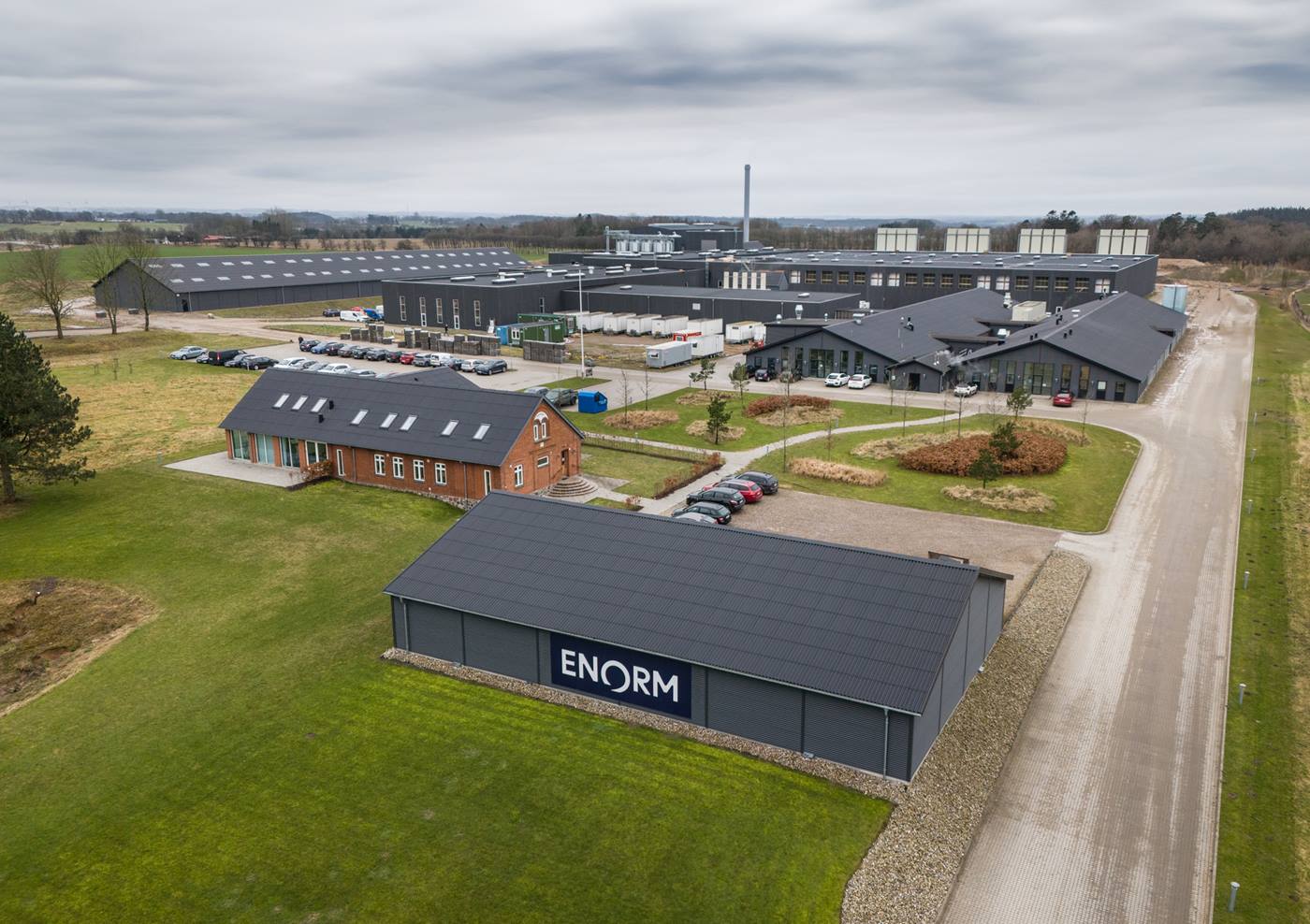
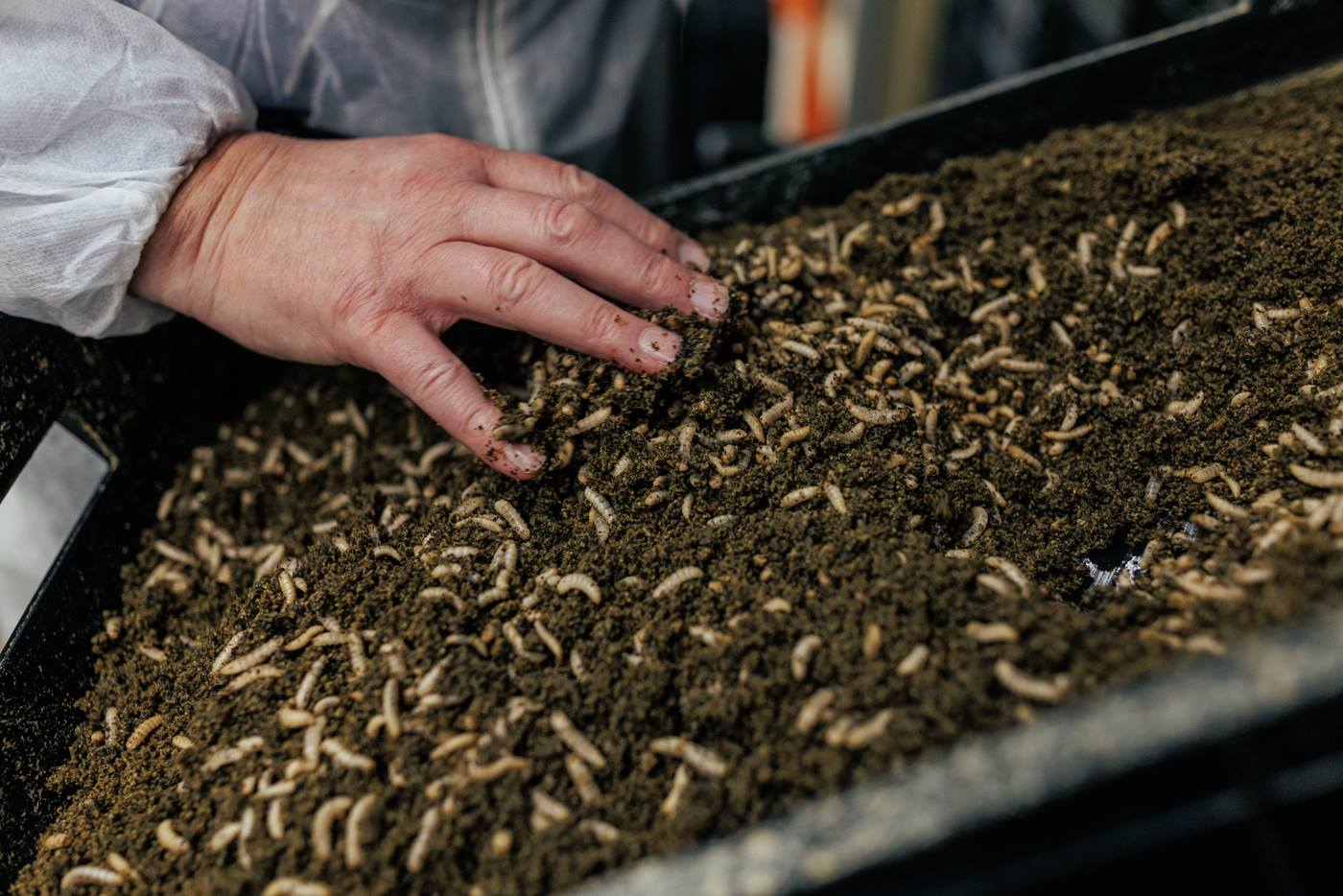
In a factory building near the heart of Denmark, 50 kilometers southwest of Aarhus, a moving spectacle – in the most literal sense – can be seen around the clock, day after day. In countless crates, millions of fly larvae munch their way through their food, while the containers are continuously moved, palletized, emptied and filled by quietly-whirring KUKA Hygienic Oil (HO) variant robots. Welcome to ENORM Biofactory, the largest and first-ever commercial insect farm in Scandinavia!
Perhaps factories like this will soon be everywhere. After all, many experts believe that insects are the protein source of the future. The United Nations estimates that the world’s population will grow to around 9.7 billion by 2050. Moreover, as average incomes rise in many developing countries, a sharp increase is expected in protein demand and meat consumption.
Hygienic Oil robots palletize foodstuffs
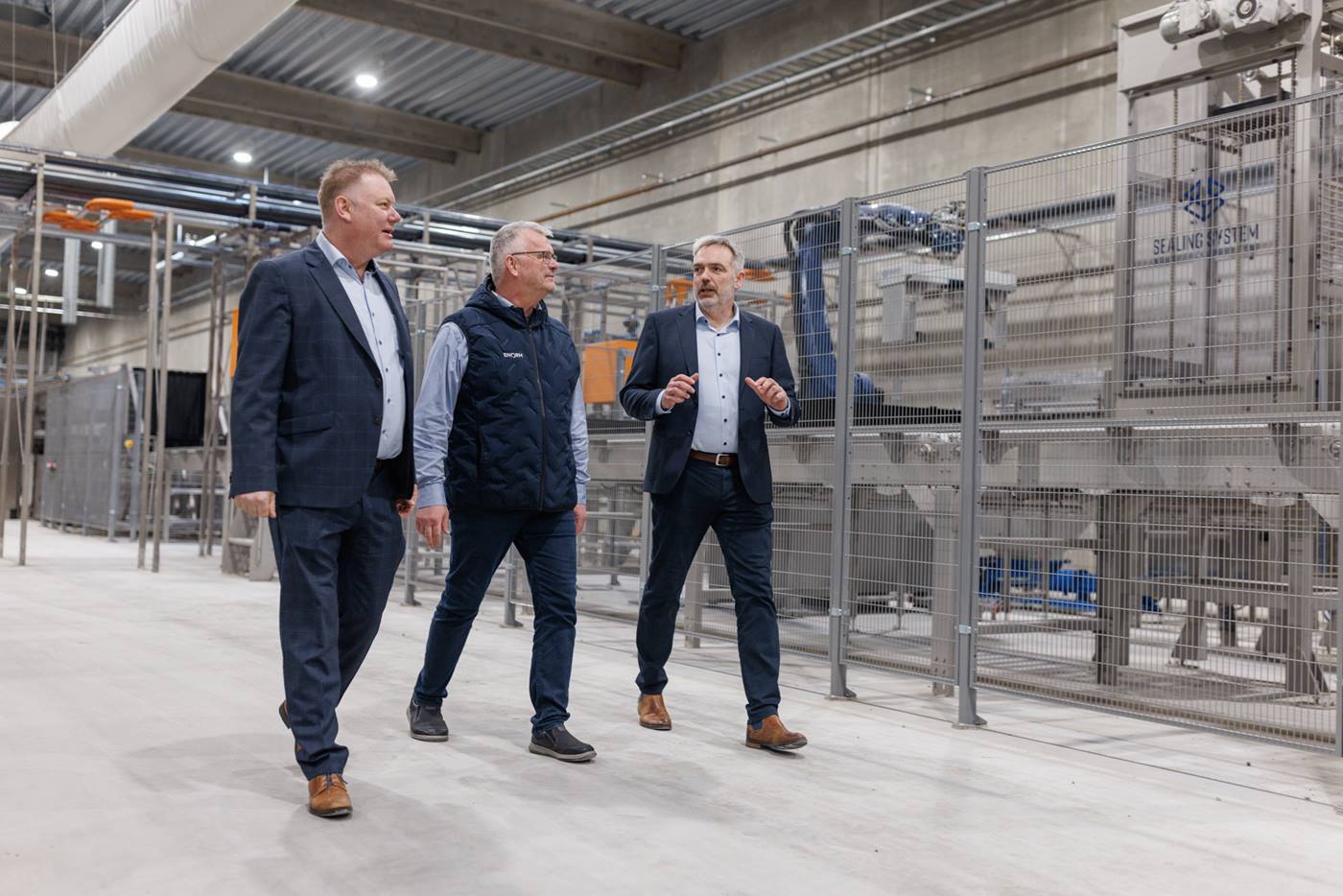
Visiting the ENORM Biofactory on Scandinavia’s largest insect farm.
Larvae: critical for an effective circular economy
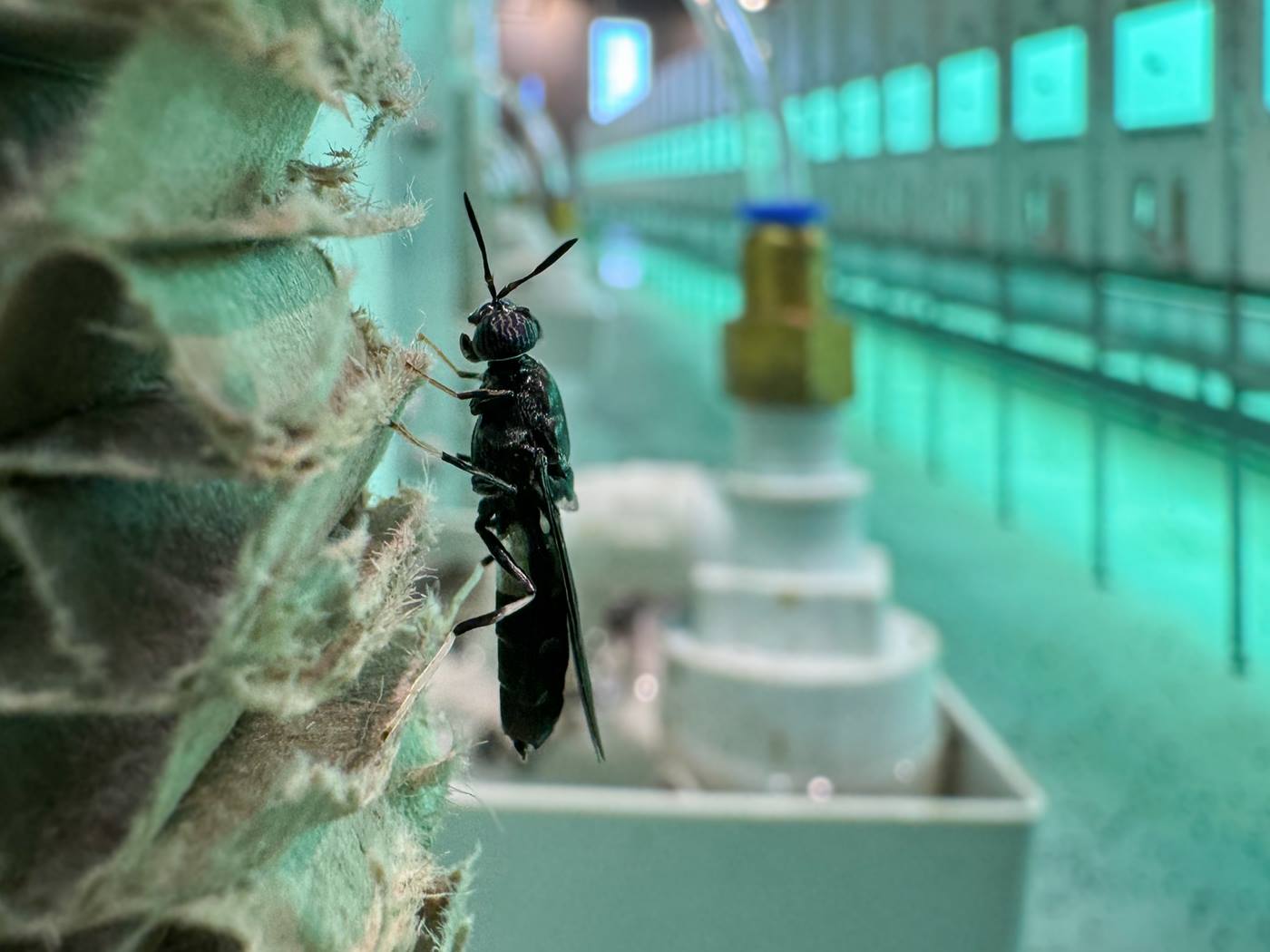
In light of climate change and increasingly scarce resources, it is clear that an effective circular economy and sustainable food production are more important than ever, and the black soldier fly could play a critical role in this. In ENORM’s operations everything revolves around it. “Just one gram of black soldier fly eggs is equivalent to 30,000 larvae,” says Carsten Lind Pedersen, CEO of ENORM. “And they gain weight so quickly that 25 kilos of eggs become 100 tons of larvae in just twelve days. No other animal can do that.”
The ENORM Biofactory insect farm in Denmark.
Jane Lind Sam, COO of ENORM, also stresses the insect’s huge potential in sustainable protein production. “The larvae of the fly can feed on almost all organic matter," Sam explains. "We can therefore feed them with waste products from the Danish food industry that would otherwise have been disposed of, and then turn them into high-quality feed protein for livestock farming.”
This type of insect production protects the climate
In specific terms, ENORM produces two products from the fast-growing larvae: insect meal as a substitute for highly digestible protein feed for fish, poultry, pigs and pets, as well as immunostimulant insect oil, which is also suitable as a food supplement for various animals. “Black soldier fly larvae based ingredients that are produced responsibly boast a significantly smaller carbon footprint compared to other animal-based protein sources,” says Pedersen.
The black soldier fly: the protein source of the future.
He also notes that insect production is a prime example of a sustainable circular economy, with little impact on the environment and climate: “During further processing, the larvae are simply dried. The only thing we have left over is water,” Pedersen notes. "Beyond that, some of the larvae are used to produce new eggs – a perfect cycle!"
The larvae of the fly can feed on almost all organic matter. We can therefore feed them with waste products from the Danish food industry, and turn them into high-quality feed protein for livestock farming.
Palletizing in a humid environment: no problem for robots
Since it is highly efficient, the form of the production process itself is also sustainable. According to Pedersen, this entails two major challenges. On the one hand, a complex ventilation system is required in the factory since a very high amount of heat is generated automatically in the process. “Above all, however, we have to fill, empty and stack containers very quickly, some of which are extremely heavy,” says Pedersen.
Rolf Tange, CTO of Sealing System Group and his team had the task of finding the best palletizing solutions for the process. Sealing System Group is one of the leading suppliers for packaging and palletizing solutions, and Tange has relied on KUKA’s innovative and reliable technologies for decades. “We knew that KUKA’s flexible Hygienic Oil robots would be perfect for ENORM’s insect farm,” Tange states.
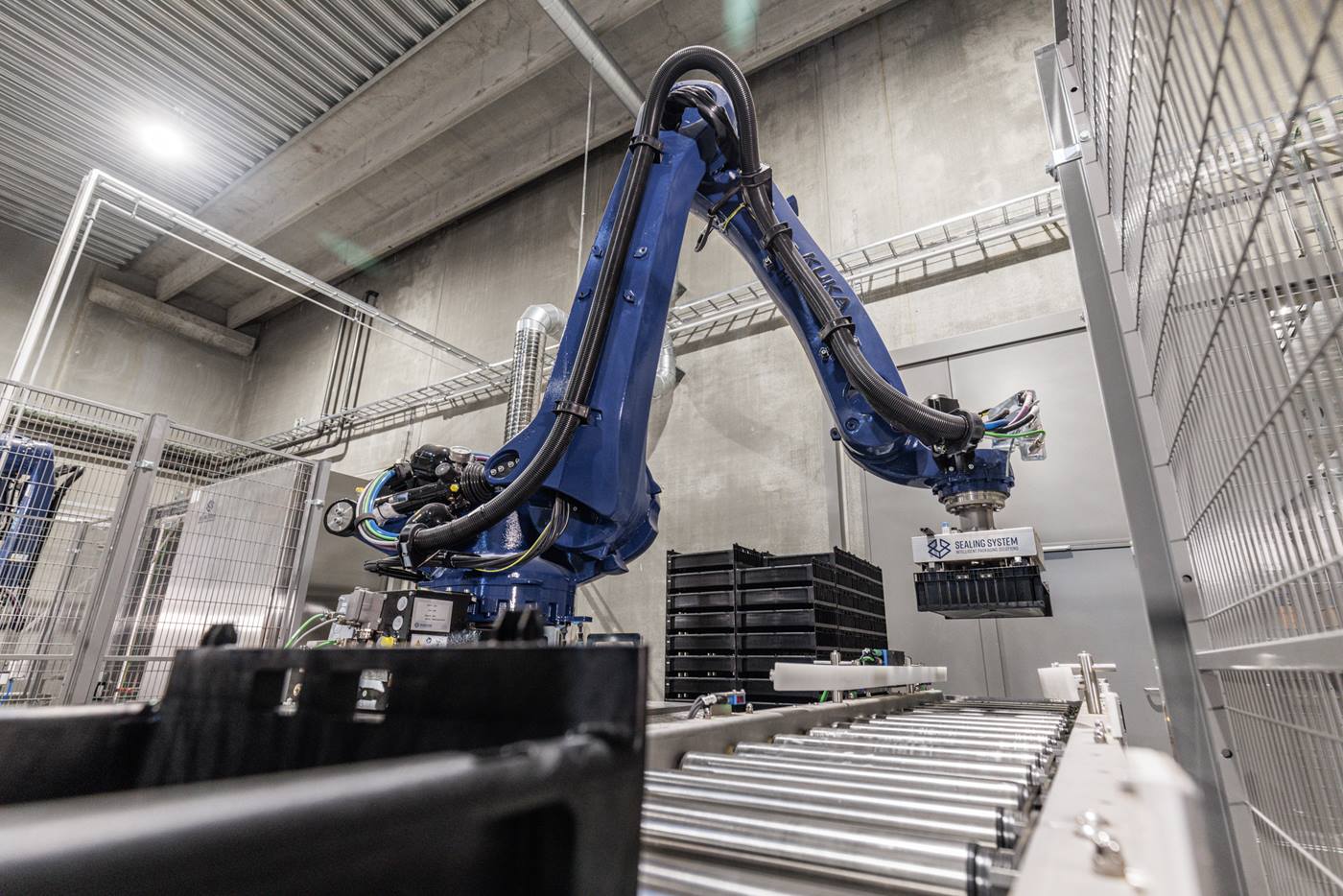
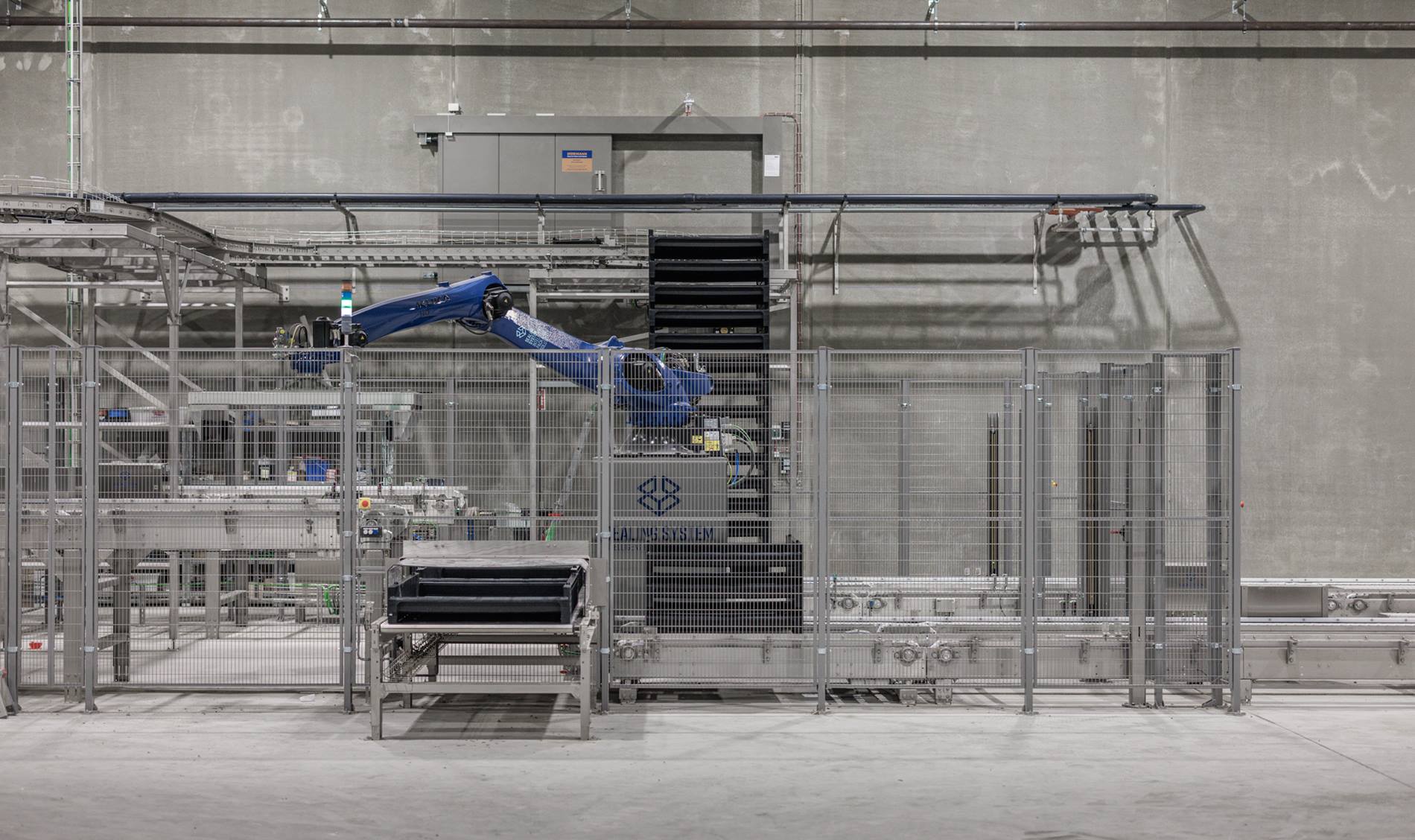
The Hygienic Oil robots fill, empty and stack containers that are sometimes extremely heavy.
“In the first stage, the larvae grow in smaller, 30 to 40 centimeter boxes,” he notes in describing the sequence. After seven days, they are then transferred to larger crates measuring more than a square meter. It's at the last stage, during the handling of the crates, that KUKA Hygienic Oil robots prove themselves an indispensable help to the process: “There are 50 kilograms of liquid mixture inside, then 70,000 larvae are tipped on top,” says Tange. “Not even the fittest worker could manage that weight.”
However, the palletizing is no problem, for the six KR QUANTEC PA HO KUKA robots: Every seven seconds, they fill a new crate, 500 larvae per hour for 20 hours a day. In the remaining four hours, instead of palletizing, the system is cleaned out. “Our production would not be possible without the robots from KUKA,” says Carsten Pedersen, "particularly since the entire sequence is programmed with down to the minute accuracy: “If there was a problem with one of the robots, we would only have two to three minutes to solve it – otherwise the entire process would grind to a halt. But fortunately, that has not happened yet,” he explains.
A portion of the larvae are used to produce new fly eggs.
Modern production runs automatically
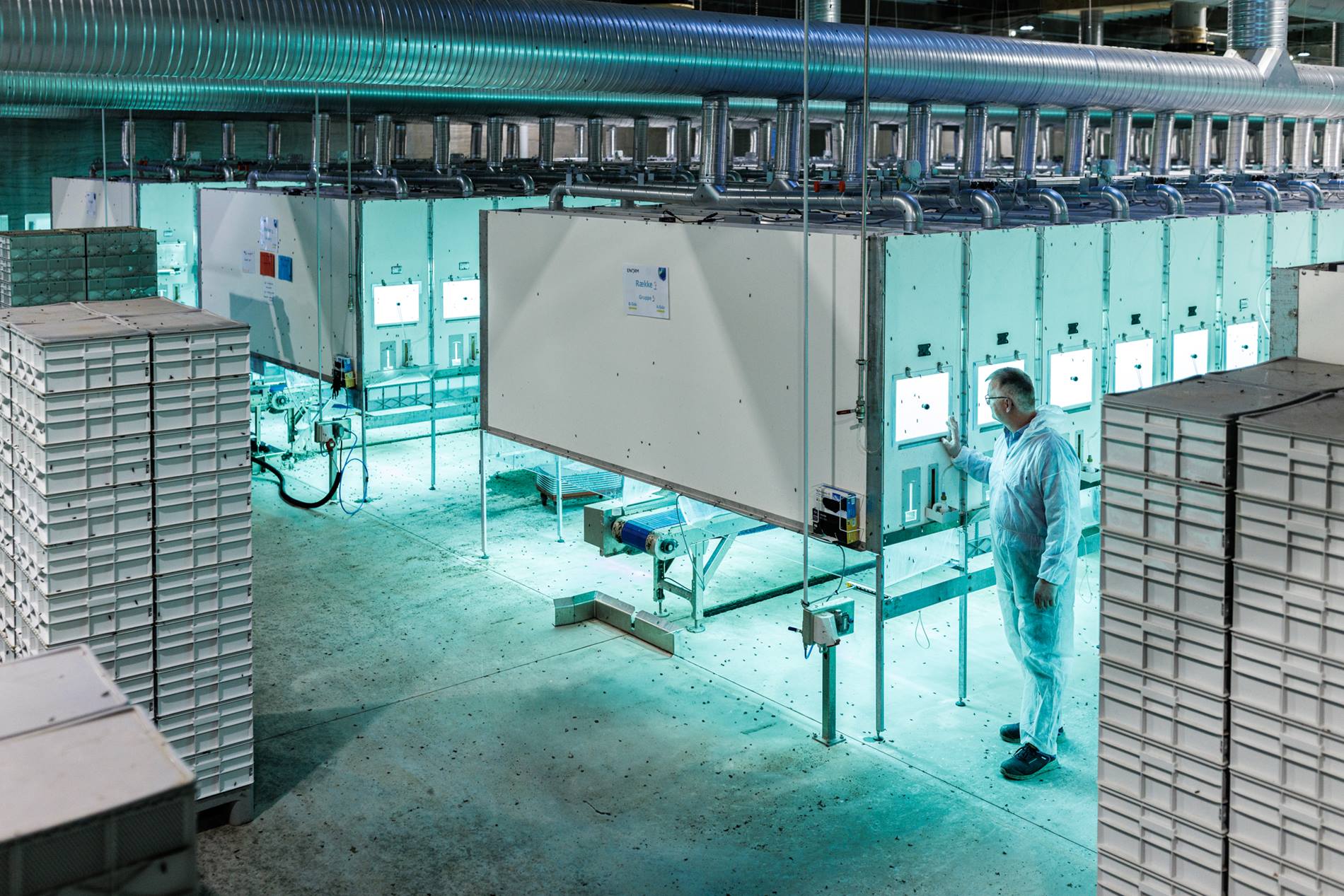
"Handling and palletizing the crates happens on its own," Pedersen notes, "because the entire process is completely automated. “In fact, we only need two employees to control everything.” Pedersen says the employees' role is largely limited to manual control of the systems.
The reliability of the system is also due to the expertise of their system partner Sealing System. “We have often worked successfully with KUKA technologies for the food industry,” says Kim Kildahl Poulsen, Sales Manager at XIO - Intelligent Farming, Sealing System Group. He particularly appreciates KUKA’s large portfolio in the Hygienic Oil robot segment, which is unparalleled worldwide. With their special H1 lubricants in all axes, they meet the high hygienic requirements of the food industry throughout the entire process chain. If the lubricants come into contact with food, it is absolutely harmless for humans and animals, and that is exactly how it is at ENORM.
We have to fill, empty and stack containers very quickly, some of which are extremely heavy. Our production would not be possible without the robots from KUKA.
Despite extensive experience in the food industry, Poulsen admits the structure of the system at ENORM was uncharted territory for Sealing System as well. “With an insect farm, we are dealing with living matter. We've never done that before," Poulsen said. Since the food for the larvae consists of 70 percent water, operations, for example, occur in an extremely humid environment, which is no problem for the specially-designed KUKA robots.
Larval food is mostly water.
The entire process is completely automated. Only two employees oversee the systems.
Software solution helped with design and planning
?
For Poulsen, it was no surprise that everything worked so optimally in the end. After all, he and his team had been able to test important processes in advancebyusing Visual Components. The Finnish company acquired by KUKA specializes in software solutions for the 3D simulation of production planning processes. “With the software from Visual Components, we were able to simulate the speed and rhythm at which the robots and conveyor systems must move. That helped a lot,” Poulsen notes. The KUKA.AppTech programming concept proved to be equally as suitable, enabling efficient and simple programming in the shortest possible time.
The team tested important processes in advance.
And so, in the heart of Denmark, the larvae crawl and the robots palletize eagerly and reliably, day in and day out, ensuring more sustainable food production with the help of KUKA’s innovative technology.
Further information about the Hygienic Oil robots: