<sub id="for6y"><s id="for6y"><form id="for6y"></form></s></sub>

    <cite id="for6y"></cite>

        <s id="for6y"></s>
        亚洲一品道一区二区三区,国产无套粉嫩白浆在线,51妺嘿嘿午夜福利,人人妻人人澡人人爽人人精品av,欧美一区二区三区欧美日韩亚洲,欧美一本大道香蕉综合视频 ,884aa四虎影成人精品,国产精品久久久久久福利69堂

        Select your location:

        Location

        KR AGILUS provides clear insights in endoscopy production

        In the summer of 2021, KARL STORZ implemented an automated process to produce eyecups for endoscopes. Since then, a KR AGILUS has provided relief to the team in Widnau, Switzerland – and accelerated production in a Swabian-Swiss success story.


        Why automate? “We had a welding machine that was getting on in years and unfortunately no longer worked very reliably.” Sarah Mühleck, Site Manager of the KARL STORZ branch in Widnau, Switzerland, described why in late 2020, her team set out to find an efficient, innovative automation solution.

        Founded in 1945, KARL STORZ is known for endoscopes, medical instruments and devices of the highest quality. Globally, its 8,300 employees develop, produce, sell and service the company's 15,000 products at company headquarters in Tuttlingen, Germany, and production facilities in the United States, Estonia and Switzerland. Not far from Lake Constance, the facility in Widnau produces optical components, such as eyepieces, for endoscopes. Because these medical devices enable a view inside the body, they need an extremely tight seal in a sanitizable design.

        Pick and place: a KR AGILUS is part of endoscope production in Widnau, Switzerland. It loads blanks and removes finished workpieces © Stefan Hobmaier, TRUMPF

        From monotonous manual labor to a laser welding system

        The new welding system had to join a stainless steel sleeve to the cover glass set inside a stainless steel ring, part of the eyecup of the endoscope that gives surgeons an unobstructed view inside hollow organs or body cavities. This joining operation always had relied on manual labor. Over and over again, employees placed the components into the machine and removed them after welding. “Gradually, we are relieving our employees of such monotonous, repetitive, stressful tasks,” noted Sarah Mühleck.

        Positioning the cover glass on the sleeve as well as pick-and-place operations require a sensitive touch from the robot – making them ideal tasks for the KR AGILUS © Stefan Hobmaier, TRUMPF

        Step one toward automation: find a welding system

        The team in Widnau conducted a targeted search for an automation solution. They already had chosen the system for the actual welding process. KARL STORZ had already been testing the TRUMPF TruLaser Station 7000 3D laser welding system for several months and was very satisfied with the resultsFounded in 1923 and headquartered in Ditzingen, Germany, TRUMPF has enjoyed international success with its laser and system technology and now with automatable solutions as well, some with a focus on laser cutting, welding and marking. TRUMPF has collaborated with KARL STORZ for almost 30 years.
        The team at KARL STORZ in Widnau quickly got used to working with the new 3D laser welding system © Stefan Hobmaier, TRUMPF

        TRUMPF Laser welding - success story of our customer Storz

        A strong team for pick and place in medical technology: TruLaser Station 7000 and KR AGILUS produce endoscopes at KARL STORZ

        Step two: a neighborhood recommendation

        When talk of automating the TruLaser Station 7000 began, the TRUMPF team recommended a nearby integrator, wbt automation in Gosheim, Germany. The Managing Director of wbt, Joachim Burkert, was quickly taken with the idea of partially automating the production of eyecups. “The name wbt stands for ‘Wir bewegen Teile’ (German for ‘We move parts’), so we were happy to be involved, even though the requirements were high,” he said.
        Joachim Burkert, Managing Director of wbt automation. His company favors KUKA robots © wbt

        Step three: clarify technology details of the laser welding system

        Joachim Burkert described the automation challenges: “We had to accommodate a very large number of workpieces in a confined space with a small robot in a compact cell. Then we had to position and set them down precisely in the welding unit. Because we wanted to grip two workpieces and join them with each motion, we also had to coordinate exactly how the robot would transport the parts.”

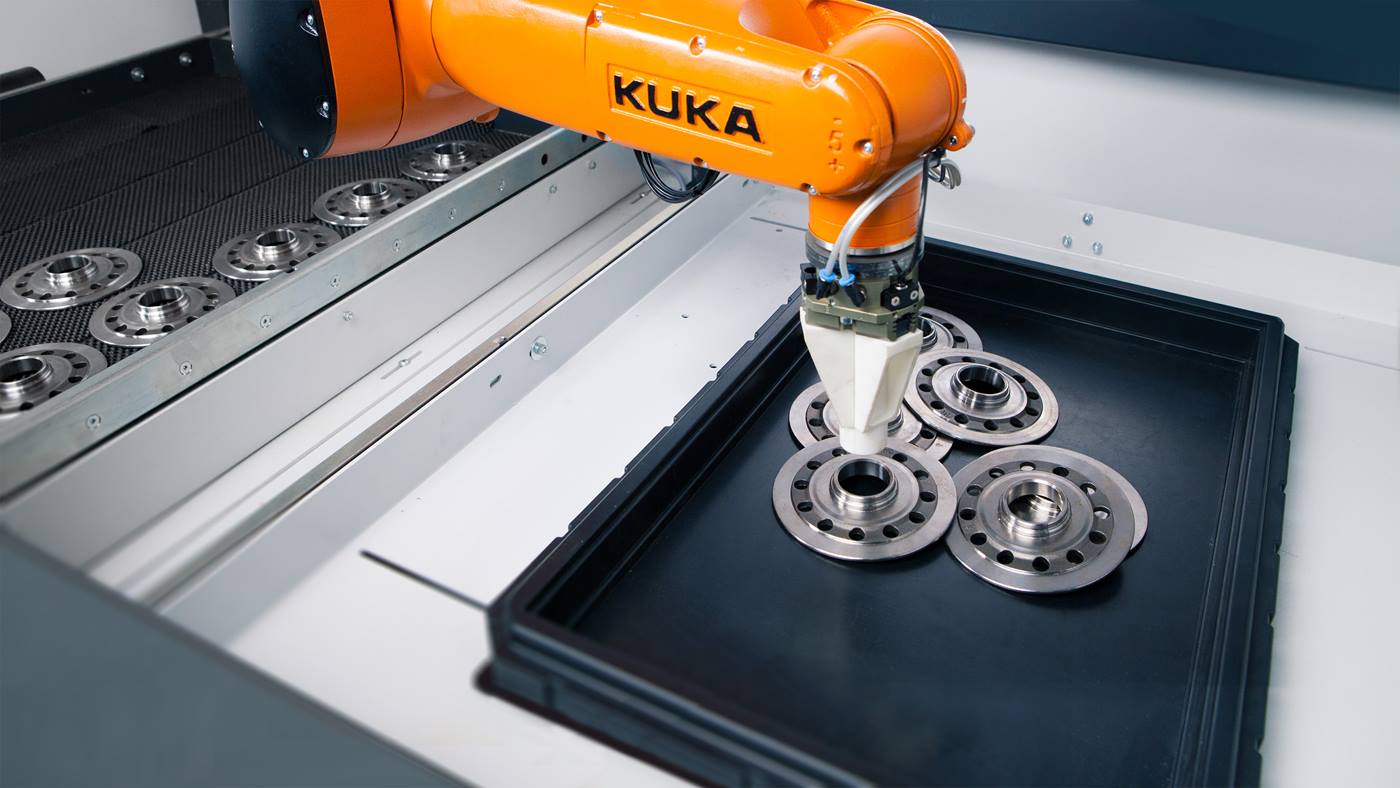
        wbt automation relies on KUKA robots for about 98% of its automation projects. “The accuracy required for this project demanded a precisely calibrated robot, not ‘off-the-shelf’ technology. We chose a KR AGILUS of the type KR10 R1100, which went to an extra training camp at KUKA before it came to us.” Now, among other things, it can check the position of the components with its laser sensor system and use a quadruple gripper, as well as a small vacuum bellows, to position each cover glass precisely.

        A well-coordinated team: the KR AGILUS as a robot for handling and the TruLaser Station 7000 from TRUMPF for 3D laser welding © Stefan Hobmaier, TRUMPF

        Step four: a promising marriage

        The robot cell docks onto the TruLaser Station 7000 and can be removed flexibly for maintenance. Its workpiece magazine contains four drawers that hold up to 960 workpieces. In each welding process, the KR AGILUS fetches components – two sleeves with cover glasses precisely placed on them – from these drawers, transfers them to laser welding and places the welded eyecups back in the workpiece magazine.

        As Joachim Burkert noted, the KUKA robot provides ideal technical capabilities: “We married the proven KUKA controller and the well-known operator panel with components from our company. The robot was mounted on a cell, the MRC flextray, which was developed specifically for it. We established a secure connection with our Siemens control system via Profibus, which gives us trouble-free communication with the TRUMPF system.”
        Pick and place with the special gripper designed by wbt automation. It uses a vacuum bellows to assure the positioning of the blanks © wbt

        Step five: convince skeptics

        Laser specialist Wolfgang Karl, who has been with KARL STORZ for 40 years, admitted to some initial skepticism. “Naturally, I had questions during development. How does the robot grip the parts? How safe is it? What if the gripper only inserts one part because of an error, but is supposed to transport two out of the cell? And how do we get this to work with 100% reliability?”

        In response, wbt automation provided “a complete simulation in advance, which we ran with the KUKA.Sim simulation software,” said Joachim Burkert. Through this digital twin, the integrator “demonstrated the entire product before the hardware was actually in place,” Burkert said. “That dispelled my doubts,” said Wolfgang Karl.

        Wolfgang Karl is the expert for all laser processes at KARL STORZ © Stefan Hobmaier, TRUMPF

        Step six: deliver lasting high quality in everyday use

        In combination with the right laser – in this case, a 500-watt fiber-based TruFiber 500 – automated production began. KARL STORZ needed to win over its employees, who no longer needed to load and unload a welding machine, but instead, had to fill the drawers, operate the robot and take over quality control, among other tasks. As Sarah Mühleck observed, “No one was laid off. Instead, we used automation to compensate for a staff member who retired. But some employees had doubts as to whether they were up to handling the new technology.” In both Tuttlingen and Widnau, wbt trained KARL STORZ employees, which helped them overcome their uncertainty.
        Flexible system for 3D laser welding: the robot can be quickly disconnected from the laser system at any time © Stefan Hobmaier, TRUMPF

        “The welds are very, very good”

        Six months after the first meeting of all the parties involved, the TruLaser Station 7000 with KR AGILUS robot cell began operation in Widnau – with measurable success. Manual loading and unloading required an average of ten seconds, but the robot accomplishes the task in only two seconds. More importantly for Sarah Mühleck, however, “The quality is right. The welds are very, very good. And the system is reliable: nothing falls out.” Her assessment after just over half a year: “Any employee can operate the robot and this station is even particularly popular in our rotating system.”
        Sarah Mühleck carrying out quality control: the eyecup can only be used if the cover glass and sleeve are welded perfectly © Stefan Hobmaier, TRUMPF

        To sum up: automation with a spotlight effect

        This automation project also impressed Dr. Axel Frey, Product Manager at TRUMPF. “Loading and unloading parts into and out of a laser welding system, and doing it with the highest process reliability – that’s something that an employee can do, but not at that speed, and not with 100% consistency. But the process must be consistent 24/7, and the quality must remain high.” The TruLaser Station 7000 in Widnau achieved that standard. And that’s not all: “The project has also received very positive feedback from medical engineers in the USA to whom I have presented it. This project spotlights the value of automation in many ways.”
        Pick – Place – Weld! The laser welding system delivers top quality for endoscopy © Stefan Hobmaier, TRUMPF

        Any employee can operate the KUKA robot and this station is even particularly popular in our rotating system.

        Sarah Mühleck, Site Manager at KARL STORZ in Widnau

        Open to new challenges

        For Joachim Burkert, the fact that the laser welding system and robot can be separated quickly at any time makes the solution particularly promising for the future. “If KARL STORZ has a different task for the robot in five years, employees can undock the cell in less than a minute and assign the KR AGILUS its new job. Or two different lasers can be assigned to one KR AGILUS, so it works with laser one during the day, and laser two at night.” Currently, however, no one wants to change a thing. Everyone at KARL STORZ in Widnau is satisfied with the way people, machines and the KUKA robot perform their tasks together. “It was a really good collaboration,” noted Site Manager Sarah Mühleck in summary. “It makes us want to do something like this again.

        Find KUKA system partners in your area

        Find the right partner for your industry or specific challenge here.

        主站蜘蛛池模板: 日韩精品国产自在欧美| 少妇性饥渴videofree| 国产精品一亚洲av日韩| 国产精品人妻一区二区高 | 成人视频XXxx| 一本色道久久加勒比综合| 国模极品一区二区三区| 国产成年码av片在线观看| 亚洲国产精品久久久天堂麻豆宅男 | 亚洲av区三区二区一| 国产精品久久久久9999| 岛国最新亚洲伦理成人| 疯狂做受xxxx高潮欧美日本| 在线观看国产成人AV天堂| 无遮挡aaaaa大片免费看| 国产区精品视频自产自拍| 精品久久久久久无码中文野结衣| 人妻AV无码系列一区二区三区| 夜夜嗨AV一区二区三区网页| 人妻影音先锋啪啪av资源| 99久久久国产精品免费无卡顿| 久久无码喷吹高潮播放不卡| 95国产精品| 亚洲一本大道在线| 国产精品无码专区在线观看| 国产精品区一区二区三在线播放-午夜福利电影免费国语-F01AV | 福利社在线播放| 欧美肥老太牲交大战| 亚洲天堂精品在线| 亚洲国产精品无码久久电影| 国产精品综合色区在线| 日本一区二区三本视频在线观看 | 日本人又色又爽的视频| 欧美极品色午夜在线视频| 国产真实乱人偷精品视频| 亚洲人成77777在线观| 91在线视频视频在线| 日韩高清国产中文字幕| 2020精品国产自在现线看| 国产精品片在线观看手机版| 中文字幕乱妇无码AV在线|