You are using Internet Explorer and will not be able to use our website properly. Please change to an up-to-date browser for ideal presentation of the website.
3D metal printing without supporting structures
In cooperation with KUKA, HS Automation developed a laser cell for metal additive manufacturing. The laser welding process with the KR IONTEC enables the cost-effective and material-saving manufacturing of complex metal parts.
KUKA Robotics is revolutionizing the metal additive manufacturing of complex structures
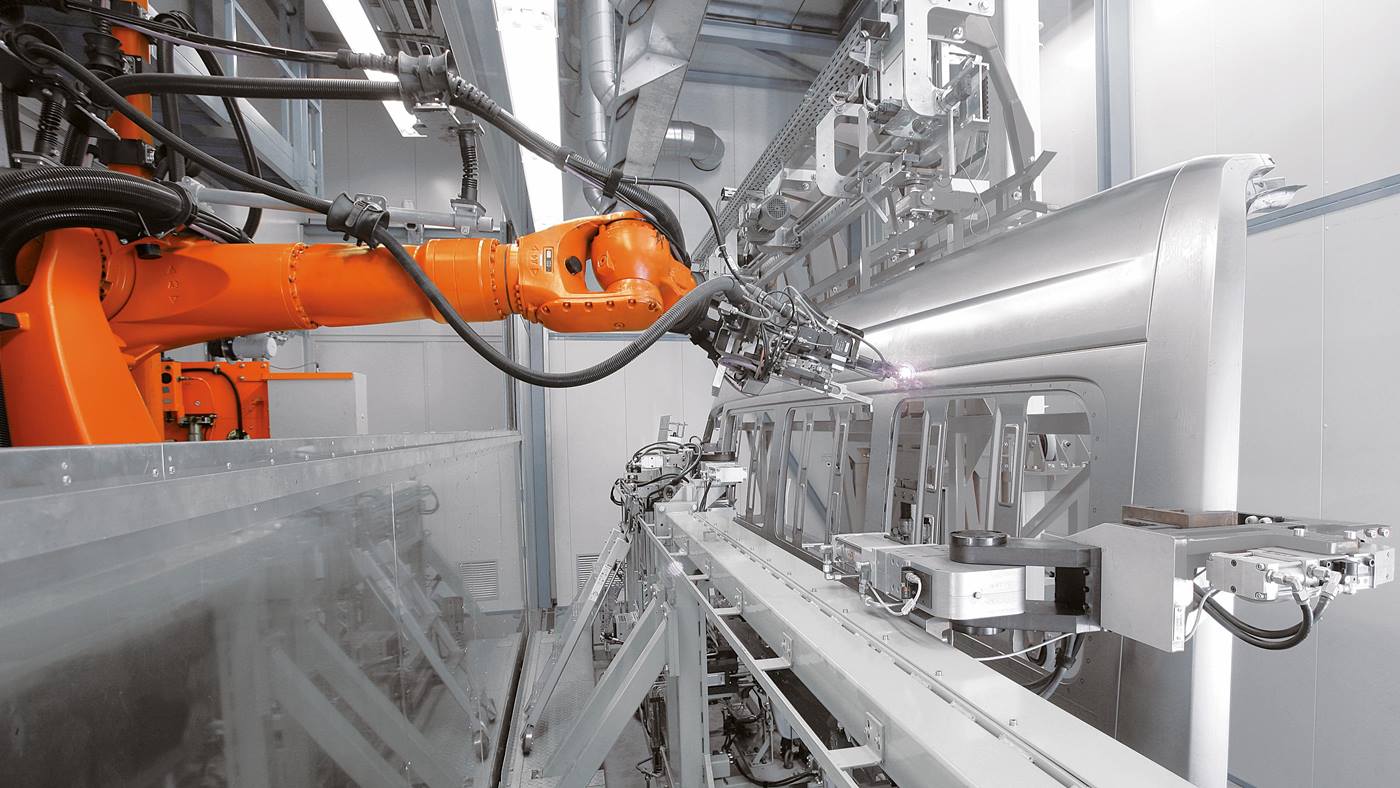
Challenges in the metal industry are growing: Thanks to a new type of 3D metal printing in a modular automation cell, HS Automation and KUKA are setting new standards. The 3D metal printer combines robots from the KR IONTEC family and a turn-tilt table that moves synchronously with the robot arm in accordance with the workpiece requirements. Six welding lasers at the end of the Meltio printer head precisely melt the wire fed onto the carrier material or the resulting workpiece. The finished component requires only minimal finishing or none at all. Because of its cooperation, the system development area achieves minimal material waste and low manufacturing costs with almost unlimited design possibilities. The technology creates tools, parts and free-forms with the material properties of stainless steel, titanium, Inconel® and structural steel. Experts report that 3D printing of copper will also be possible soon.
This also enables 3D printing of bionic designs and complex structures, such as those used in lightweight construction and prototype construction. SMEs benefit from the fast production of spare parts and savings in energy and materials. The use of innovative software solutions such as KUKA.CNC make the technology even more attractive for small and medium-sized companies. Thanks to KUKA.CNC, structures previously designed using CAD software or CAM systems can be executed directly – without the need to convert the CAD file to KUKA Robot Language (KRL).
Automation service provider HS Automation is based in Vöhringen, Baden-Württemberg, and has been working with KUKA since 2017.
3D metal printing with KR IONTEC and the KUKA turn-tilt table
Innovative 3D printing process for metal saves material and produces complex parts cost-effectively.
How does 3D printing for metal work with robots?
In the field of metal additive manufacturing, new innovations are generated every minute. The goal is not only to cost-effectively produce for batch size 1 and up and to reduce material consumption, but also to shorten finishing time. Automation expert HS Automation meets these requirements for modern manufacturing in the metal industry using the 3D laser welding cell. The 3D printer welds layer by layer onto a workpiece carrier.
The additive manufacturing technology benefits from the spatial mobility of the robot and the tilt table.
Unlike laser sintering, the carrier is not lowered, but rather the robot arm moves the laser in sync with the turn-tilt table on which the carrier is mounted. The DKP-400 V2, also developed by KUKA, positions the workpiece in such a way that the printer head can always weld new material in the right place. The previously designed 3D object grows layer by layer. Support structures that are common in conventional 3D metal printing are becoming obsolete along with powder management, which is prevalent in other 3D laser printers or metal laser sintering. Another considerable difference is the dimension of the parts being produced where conventional applications have a limited size of about 50 x 50 cm. HS Automation technology also manufactures large parts.
The laser of the 3D metal printing system applies layers with a wall thickness of 2 mm.
Opportunities and possibilities of metal 3D printing
Using the robot with absolutely accurate calibration guarantees the precision that makes the metal printing application stand out from its competition. “Thanks to this robotic solution, we are expanding manufacturing capabilities enormously,” says Rolf Steidinger, Managing Director and Commercial Director of HS Automation, when discussing the potential of the 3D metal printer. This method solves spare parts problems, among other things – since parts that are no longer available can be produced by the customers themselves.
When a part cannot be manufactured conventionally, this device becomes essential.
For parts that can be manufactured conventionally, the process stands out with its cost reduction and its productivity being four times higher. Laser cladding reduces both the material requirements and the finishing time when compared to milling or turning when using a complete block of metal. The potential for savings is up to 98% of the material. These strengths particularly become significant in toolmaking, in special systems engineering and prototype production. The production, testing and optimization of flow-optimized components, such as wind turbines, are thus accelerated immensely.
Managing Director and Commercial Director, Rolf Steidinger, sees enormous potential in the technology of metal 3D printing.
Advantages of robotic metal additive manufacturing
The innovative combination of robots, tilt tables and laser printer heads sets new standards in 3D metal printing.
Maximum design freedom
Metal additive manufacturing is particularly advantageous where complex structures or double-panel objects are required.
Optimal microstructure
The 3D metal printer builds up objects with a wall thickness of 2 mm. The device also produces solid material workpieces made of metal or alloys.
Cost-efficient and sustainable
The process impresses with four times higher productivity and 90% cost savings compared to conventional manufacturing.
Efficient use of materials
Metal waste is drastically reduced compared to milling. 3D printing works without supporting structures or metal powder.
The robot used for 3D metal printing works in a laser cell that measures 5 x 4 x 4 meters.
3D metal printing for industries of the future: e-mobility and medical technology
The precision of the robot-guided laser cladding takes the familiar application of metal printing to a new level. For example, the robot system is capable of producing double-panel objects such as components with internal cooling ducts. The printer head is equipped with six 200-watt lasers and is capable of processing two different metal materials in a single printed part in addition to single-material printing.
“Almost any material can be processed: stainless steel, titanium, tool steels or nickel alloys. Our laser partner, Meltio, is currently working on printing copper. This even makes deployment for e-mobility projects possible,” predicts Marc Steidinger, Managing Director of HS Automation.
Managing Director Marc Steidinger (left) checks the quality of the 3D metal printing with employee Lukas Nill.
The Managing Director of HS Automation, who is responsible for the technical management of the project, envisions primary areas of application such as parts production, series development and medical technology. In prototype construction, users benefit from the fully flexible adaptation of the printing parameters. Thanks to 3D metal printing, artificial knee joints made of titanium as well as other medical implants will be individually adapted to the patient in the future.
Utilizing synergies: HS Automation has been a KUKA system partner since 2017
The goal of HS Automation’s approximately 20 employees is to make automation productively usable for other small and medium-sized enterprises (SMEs) as well. Rolf Steidinger sees the company as a partner for higher-performing, more sustainable German SMEs: “We have been supporting some of our customers in automated production for 24 years. Together, we are continuously developing future-oriented, state-of-the-art solutions.”
During the KUKA system partnership, which has been in place since 2017, the two companies have leveraged each other’s strengths in a solution-oriented and profitable manner. This includes direct accessibility for practical challenges, industry-specific know-how, tools from the KUKA Robotic Republic and high application experience. The experts at HS Automation design and build complete production lines – from loading the machine and inputting of dimensions and cutouts through to automated cutting, and screwing or nailing. However, they implement individual projects such as spot welding cells as well. Before start-up, HS Automation also uses KUKA products such as KUKA.Sim to ensure project success. The experts plan the dimensions of the space, the motion radii and the safety zones of the system in advance.
With the 3D metal printer, managing directors Marc and Rolf Steidinger are opening up new manufacturing prospects, especially for the SME sector.