<sub id="for6y"><s id="for6y"><form id="for6y"></form></s></sub>

    <cite id="for6y"></cite>

        <s id="for6y"></s>
        亚洲一品道一区二区三区,国产无套粉嫩白浆在线,51妺嘿嘿午夜福利,人人妻人人澡人人爽人人精品av,欧美一区二区三区欧美日韩亚洲,欧美一本大道香蕉综合视频 ,884aa四虎影成人精品,国产精品久久久久久福利69堂

        Select your location:

        Location

        Industrial battery disassembly makes electric cars even more sustainable

        The business of electric cars is booming – but what happens to the tons of used batteries? Fraunhofer Institute for Manufacturing Engineering and Automation has successfully tested how industrial battery disassembly works using the KR QUANTEC robot. The goal: make the use of electric cars even more sustainable.


        An increasing number of electric cars – the recycling of batteries as a solution?

        In March 2023, the countries of the European Union (EU) made a momentous decision: To only newly register zero-emission passenger cars and vans starting in 2035. Since making that decision, it has been clear that the future of the automotive industry is in e-mobility. Forecasts for the industry reveal this as well. There were approximately 27.7 million electric vehicles worldwide in 2022, the International Energy Agency (IEA) anticipates this number to exceed 226 million by 2030. In Germany, almost a quarter of all cars will be electric cars – currently they account for just two percent.
        Automated Battery Disassembly for More Sustainable E-Mobility
        Technology from KUKA played a central role in the successful “DeMoBat” project for industrial battery disassembly at Fraunhofer IPA in Stuttgart.

        Industrial robot enables the recycling of valuable raw materials

        There are two problems with electric vehicles. With increased consumer demand, the mountain of used batteries grows. This is because they currently only have an average service life of about ten years. At the same time, raw materials for their production are becoming increasingly scarce and expensive. One solution for both is recycling, which is where the KUKA industrial robot – or, more specifically, the KR QUANTEC industrial robot – comes into play. With the robot’s help, the Fraunhofer Institute for Production Technology and Automation IPA in Stuttgart, Germany demonstrated how recycling can work efficiently through the “DeMoBat" an abbreviation that loosely translates to "Industrial Disassembly of Batteries and Electric Motors."  
        Fraunhofer IPA in Stuttgart and KUKA have a long-standing partnership.

        Twelve partners did research together for several years

        The research partners investigated how to recondition batteries from electric cars in both sustainable and economically viable ways. In this project, a total of eight robotic applications were set up as demonstration and testing tools that could be used for continuous industrial operation. The focus was on the disassembly of electric car batteries since the prerequisite for recycling these components is a clean separation into their component parts, which is no easy task.

        Battery disassembly: complex and life-threatening

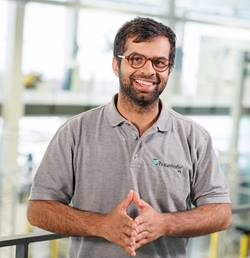
        “The disassembly of batteries presents three major challenges,” explains Anwar Al Assadi, Group Leader at the institute. “First, you need highly qualified specialists, because working with high-voltage technologies requires time-intensive training. Second, manual disassembly is associated with a health risk due to the high voltage and hazardous gases. In the worst case, spontaneous ignition may occur. And thirdly, disassembly by hand takes a very long time and is very costly. The trio of difficulties often makes recycling seem unprofitable.”

        During battery disassembly, the industrial robot moves gently.

        Automation solutions can play a decisive role in making e-mobility even more sustainable.

        Anwar Al Assadi, Group Leader at Fraunhofer IPA

        Automated disassembly of batteries solves all three

        The three challenges are ideal for a robot-based solution. A KR QUANTEC assembly robot with a payload capacity of 270 kilograms was operated entirely by means of the “pitasc” software developed at Fraunhofer and controlled by means of KUKA.RobotSensorInterface, which facilitated connection to external sensors. Researchers were able to control important disassembly steps in real time and thus automate various operations that previously had to be done manually. KUKA’s technology solved three problems at once: it reduced the shortage of skilled labor, minimized the safety risk for employees and, with efficiency, ensured that battery recycling is also economically profitable.

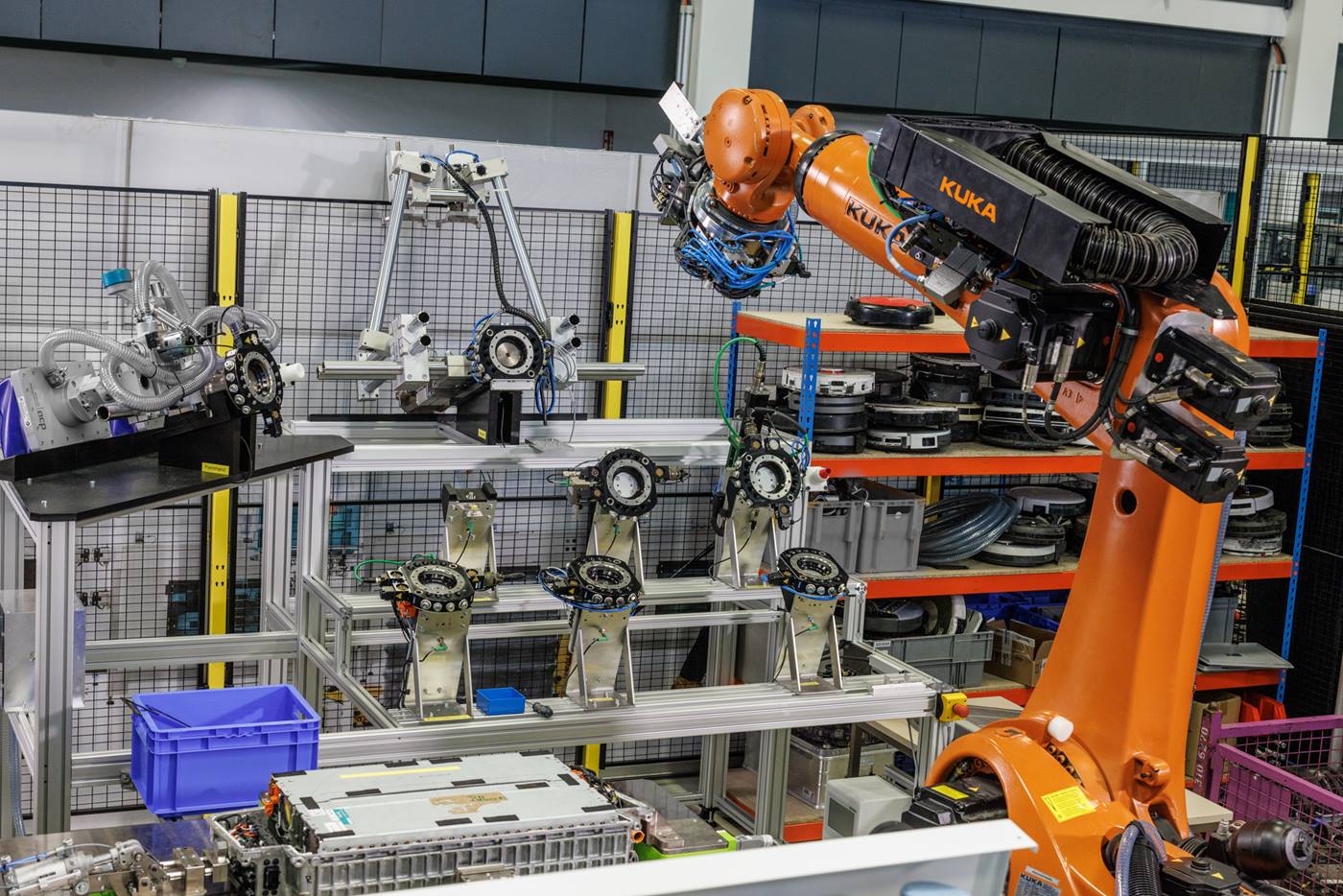
        The 6-axis jointed-arm robot detaches screws or adhesives with utmost accuracy.

        Strict EU Batteries Regulation forces action 

        In addition, manufacturers face stricter rules for battery production. Since 2023, an EU Batteries Regulation has required, among other things, that new batteries include an increased proportion of recycled materials – even if these have been imported into Europe. The successful research project in Stuttgart shows how valuable KUKA’s technical support can be.

        Automation opens up new possibilities for battery recycling.

        Here, the KR QUANTEC carried out a wide range of work steps: unscrewing screws, opening sealing joints and disconnecting cables. “The complex thing is that there are an incredible number of different battery systems on the market,” says Anwar Al Assadi, “and each one looks different inside.” He further notes that, at times, manufacturers change the structure of the battery systems within a single vehicle model.

        No matter which battery from which electric car, the KR QUANTEC knows how to handle it

        As a 6-axis robot, the KR QUANTEC leverages its six degrees of freedom. The jointed-arm robot can optimally adapt to the different dimensions and geometries of the battery system and, thanks to its payload, it can also cope with high torques. Accordingly, software such as the aforementioned “pitasc” solution is needed. In conjunction with the hardware, this software recognizes what needs to be done regardless of the battery model
        The Fraunhofer IPA project setup demonstrates the flexibility of the KUKA robot.
        Supporting image processing systems for the automatic detection of screws as well as other components made it unnecessary to manually teach the KR QUANTEC for each individual step. To prevent collisions with components, results monitoring occurred after every disassembly step via sensors and 3D camera systems. The signals were then transferred to the central process controller to ensure a safe process sequence.

        Thanks to its streamlined geometry and small footprint, the QUANTEC can be used to build a flexible and future-oriented system.

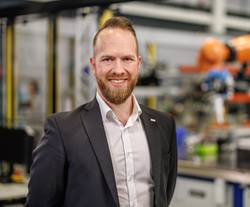
        Thomas Schmidberger, Global Business Development Manager, Electronics

        Flexible systems successfully tackle batteries with a wide range of designs

        "The complicated issue," says Al Assadi, "is that automakers must store as many components as possible in the confined spaces of the batteries." He notes that this severely limits the range of motion during disassembly. Further challenges, according to Al Assadi, include the varying position of cables or the adhesives in a battery which are much harder to detach using automation than screws. “But here, too, we have found solutions, which we now want to develop further for industrial use.” He explains that the decisive factor is to build flexible systems – not least because the fundamental design of the batteries changes around every half year or so.
        The project system from Fraunhofer IPA could be used for continuous industrial operation.

        KR QUANTEC: attractive for a wide range of applications

        Versatility is one of the great advantages of the KR QUANTEC series: “Because of its streamlined geometry and small footprint, the KR QUANTEC can be used to build a flexible and future-oriented system,” says Thomas Schmidberger, Global Business Development Manager for Electronics at KUKA. “Like all KUKA robots, it is also ESD-certified as standard to ensure safe handling of components that are sensitive to electrostatic discharges.”

        All the right moves at the flick of a “wrist” with the KR QUANTEC.

        Beyond this, the new generation of the KR QUANTEC articulated robot impresses with its distinctive energy efficiency due to its standard DC controller. Energy consumption was significantly reduced in both the motion and standby modes. In the production motion, the six-axis robots consume around 30 percent less energy than the predecessor model because of its recovered brake energy, among other things. In standby mode, the robots consume 60 percent less energy.

        An industrial robot that can do even more than automated disassembly

        This makes the 6-axis KR QUANTEC robot attractive not only for the recycling of electric car batteries, but also for a variety of applications. Its streamlined modular system also promises precision-fit technology and fast delivery times – which adds up to a low total cost of ownership (TCO). This is because maintenance requirements are minimized and the number of spare parts is reduced. 
        The KR QUANTEC is characterized by high flexibility and a low TCO.
        Capable of lifting 120 to 300 kilograms, the KR QUANTEC series models are in the high payload category and within this range have the largest payload and reach portfolio on the market. The possibility of upgrading the payload in the field as well as the motion modes for high process quality make it a sensible and safe investment in the future of any production.

        Market volume growing rapidly

        This also applies to the field of battery disassembly, particularly since the electric vehicle industry will develop rapidly in the coming years. Experts anticipate the global market volume for electric vehicles to rise from just under $420 billion USD (2022) to more than $US 770 billion by 2028. The project’s test series has now shown how this great potential could be harnessed for battery recycling by automotive OEMs (in-house EV recycling), battery producers or recycling companies. Interested companies can have the feasibility of robot-based disassembly for their products tested at Fraunhofer IPA. The institute is also working on optimizing products initially for disassembly.

        Thanks to its great flexibility, the KR QUANTEC is an essential element in the test system at Fraunhofer IPA.

        Cooperation between KUKA and scientific community has proven effective 

        It is also worth noting that the work that went into this project was not a new experience for everyone involved. In the development and testing of its technologies, KUKA has been in a trusting collaborative relationship with the research institute for decades. The first KUKA cleanroom robotwas jointly developed around 20 years ago, followed by the ESD certifications of dozens of KUKA products along with many others.

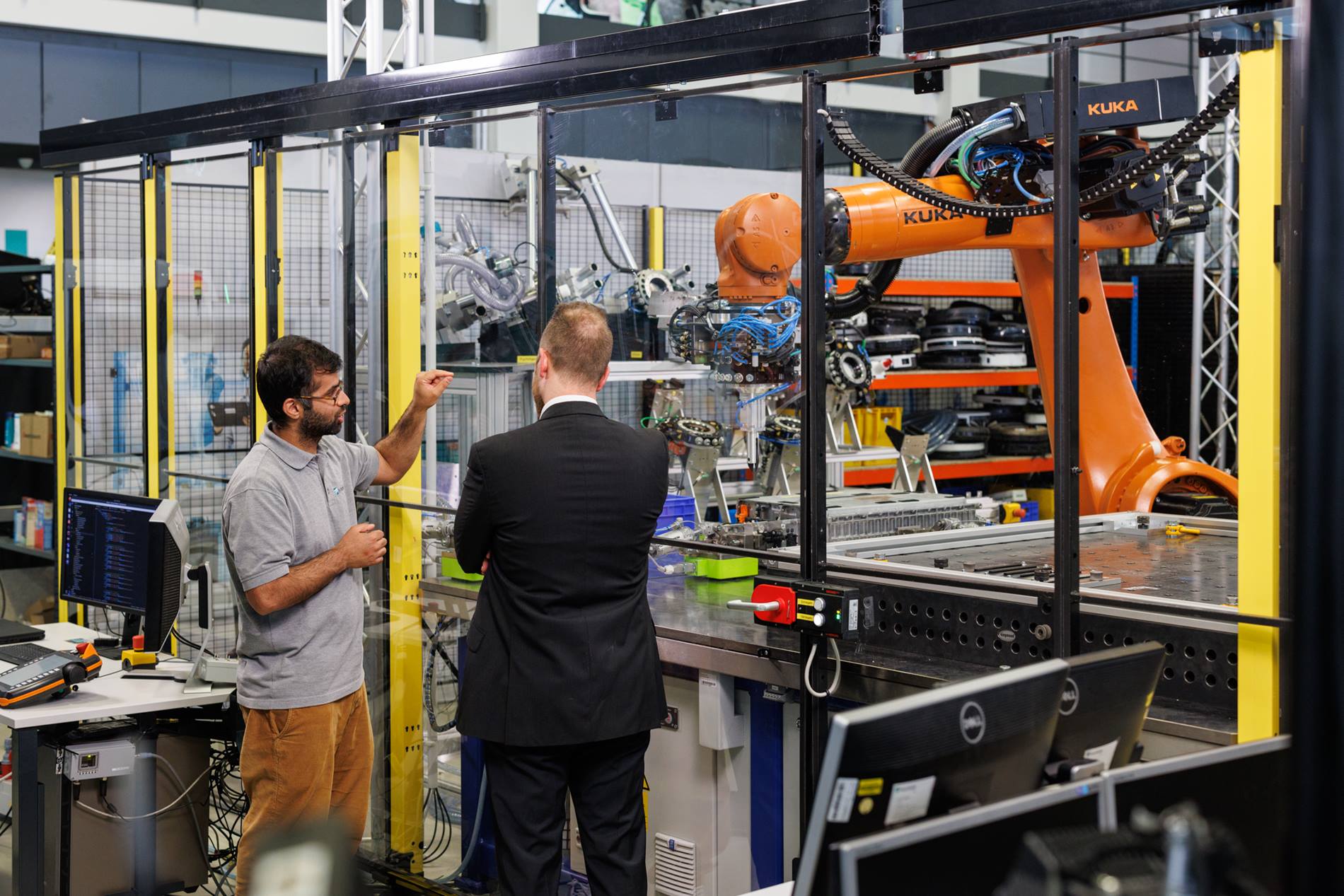
        Thomas Schmidberger from KUKA and Anwar Al Assadi, Project Manager at Fraunhofer IPA, are delighted with the successful cooperation.

        An interaction between the industry and the scientific community that has proven itself once again is the DeMoBat. “We have built Europe’s largest test facility for battery disassembly,” says Anwar Al Assadi proudly, “and we have demonstrated how automation solutions can play a definitive role in making e-mobility even more sustainable.”

        Find KUKA system partners in your area

        Find the right partner for your industry or specific challenge here.

        Learn more about automation in the field of electromobility

        主站蜘蛛池模板: 国产精品入口麻豆| 国产激情自拍| 两根大肉大捧一进一出好爽视频| 91综合网| 99自拍视频| 丁香六月婷婷| 色色午夜天| 亚洲12色吧| 亚洲无av在线中文字幕| 夜夜操夜夜| 尤物导航| 丰满人妻无码∧v区视频| 一卡二卡中文字幕| 亚洲天堂视频在线播放| 国产精品蜜臀av在线一区| 亚洲性无码一区二区三区| 亚洲区少妇熟女专区| 亚洲の无码国产の无码步美| 玩弄白嫩少妇xxxxx性| 国产欧美视频高清va在线观看| 午夜毛片不卡免费观看视频| 亚洲日本高清一区二区三区| 国产高潮流白浆视频| 内射在线播放| 97人妻精品一区二区三区| 国产成人无码aa精品一区| 国内精品偷拍| 国产一区二区一卡二卡| 男女猛烈xx00动态图高清| 精品国产午夜福利在线观看 | 国产精品麻豆成人av电影艾秋| 中文字幕A片免费观看| 人妻色综合| 国产浮力第一页草草影院| 国产黄色电影| 久久夜色午夜久久综合| 国产精品导航一区二区| 中文字幕人妻不卡精品| 国产精品Av久久| 亚洲av无码专区在线亚| 一本色道婷婷久久欧美|