You are using Internet Explorer and will not be able to use our website properly. Please change to an up-to-date browser for ideal presentation of the website.
The many faces of artificial intelligence
Artificial intelligence (AI) is already part of our everyday lives. It solves problems that would have been very difficult or impossible to solve without it. Much is still in its infancy, but it is clear that smart assistants are penetrating more and more areas - including industry.
Carolin Hort
April 9, 2025
Technology
Reading Time: 5 min.
There are tasks that cannot be solved with pure programming. Especially in chaotic environments. For example, when mobile robots autonomously take over deliveries in production. When foodstuffs such as fruit or fish of different sizes, shapes and colors are picked, sorted and deposited. Or when chocolate and fruit muesli in identical packaging are picked at the same time in a logistics center. The potential for automation in all these areas is huge - and is made possible with the help of assistance systems. One such system is artificial intelligence (AI).
How do we use AI at KUKA?
A lot is already technically possible with AI today. The question is often: What makes sense? KUKA is also looking into this. Both in the area of research with regard to products and solutions for customers as well as the supportive use of AI in its own work processes. “We have to solve our customers' problems. If this requires AI, we use it,” explains Dr. Hui Zhang, CTO of KUKA Group. The strategy internally is analogous: We use AI to optimize our processes - regardless of whether it is a development or a customer service process. AI is therefore a tool for greater efficiency and to increase customer benefits.
Artificial intelligence: a means to an end, not the goal
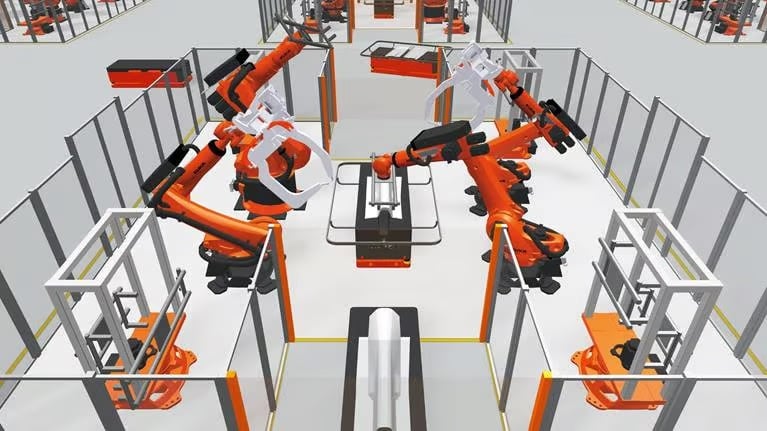
“AI applications can be divided into logical, learning and creative-generating applications. In our field of work today, we are primarily concerned with logical intelligence, as we can already cover many use cases with algorithms,” explains Reinhold Groß, CEO of KUKA Robotics, with regard to the focus of the company's own products. In the case of the autonomous mobile robots (AMR) described above, for example, this means that algorithms distribute the transport orders in such a way that the overall efficiency is at its highest. As a result, only as many AMRs are deployed as necessary. This saves acquisition and operating costs for the customer.
AI has great leverage here. This is also confirmed by Bitkom President Dr. Ralf Wintergerst in a comment on a recent survey conducted by his association: “Every company should look into the use of AI and take advantage of the opportunities ranging from greater efficiency to new products or services.”
Smart assistants for greater added value
KUKA wants to make this possible for its customers. Also with the help of generative AI. As in the example with the fish: the AI helps to categorize the fish, give them typical characteristics and thus generate the optimum gripping position. Incidentally, the neural network was trained using artificial fish. And in the case of the muesli in the logistics center? Here, too, conventional programming reaches its limits. This is because the system has to know which specific item to pick from a large number of different items. This requires intelligence and a good grip quality. Swisslog has trained an AI model with existing robot data, typical customer data and real customer data - and also equipped a robot with a camera. The result is the ItemPiQ: a robot that recognizes which muesli is in front of it, automatically switches to the corresponding gripper and thus picks mixed items independently. Niklas Goddemeier, Head of Research & Development at the Robogistic Product Center at Swisslog: “The aim is to put together a wide variety of products quickly and with as few errors as possible. That already works pretty well. The next stage is: how can we ensure that the system continues to learn? So that it doesn't forget in summer what is picked in winter?” This question of “model updates” is still on many people's minds. And it is immediately followed by another: What can AI already do today?
AI: A lot is already possible. But a lot is not.
“The advantage of AI technologies is that they can make systems more flexible and efficient,” explains Volker Schmirgel, Head of the Technology and Innovation Center at KUKA. He adds: “And it can make recommendations based on its database.” KUKA uses this in chatbots, for example when selecting KUKA simulation products. Even more traditional companies have recognized the potential: An AI tool from Heidelberger Druckmaschinen AG, for example, uses countless data to advise its customers on how to optimize processes. The goal: a boost in the automation of print shops and new business models in the market. This shows that AI is not only changing KUKA's automation sector, but the entire industry. And this creates a certain analogy: you have to react flexibly to changes in the environment in order to continue to be successful. Exactly what AI can do, it is now also demanding from companies.