What is Physical AI?
This development is often described as Physical AI.
It refers to systems that combine perception, decision-making, and action. In doing so, AI moves beyond the purely digital domain into real production environments.

You are using Internet Explorer and will not be able to use our website properly.
Please change to an up-to-date browser for ideal presentation of the website.
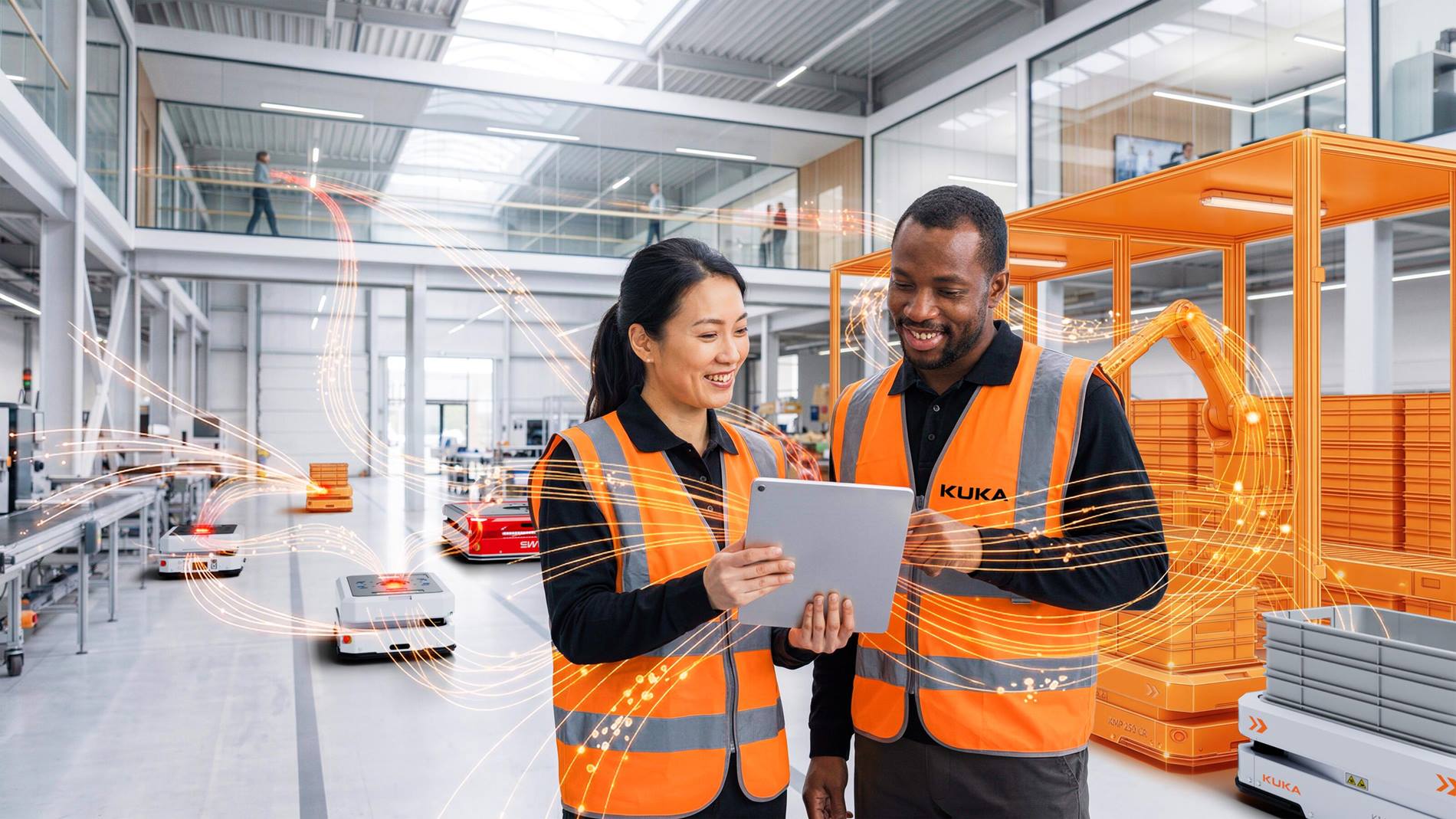
New technologies are not only transforming production, but also the way we talk about it. Terms such as Automation 2.0 or Physical AI describe key developments that companies like KUKA are already translating into concrete industrial applications. But what do these terms really mean? Below, we explain the most important concepts – and place them in the context of modern automation.
The key takeaway upfront: The future of automation does not replace existing production, logistics, or automation solutions – it extends them.
Automation 1.0, with fixed programming or isolated automated processes, remains indispensable. At the same time, Automation 2.0 introduces new ways to make systems more intelligent, flexible, and scalable.
The real strength lies in combining these worlds – enabled by software, data, and platform approaches.
Automation 1.0 describes classical industrial automation:
These systems are deterministic, meaning that under the same conditions they always produce the same result. For decades, they have been the backbone of industrial production and will remain essential – especially in standardized and safety-critical applications.

Automation 2.0 expands existing systems through software, data, and artificial intelligence.
At its core is a shift in how systems are understood: processes are no longer fully predefined but increasingly controlled and adapted based on context. Systems can:

This development is often described as Physical AI.
It refers to systems that combine perception, decision-making, and action. In doing so, AI moves beyond the purely digital domain into real production environments.
A key principle of Automation 2.0 is intent-based automation:
This approach marks a shift in perspective: from detailed programming of individual steps to goal-oriented interaction.
Outside industrial contexts, “intent” is also used to describe requirements, objectives, and constraints that systems interpret and execute autonomously.
In robotics, this is referred to as intent-based robotics: systems no longer act purely on prede-fined programming, but based on goals and context.
At the same time, the digital twin is becoming increasingly important from a strategic perspective – a digital representation of a real system that uses up-to-date data to better understand, test, and improve processes.
It enables:
As a result, automation is becoming increasingly simulation-driven – a key lever for speed and efficiency.

With Automation 2.0, the role of machines is also evolving. Robots are increasingly becoming intelligent collaborators:
This development paves the way for autonomous systems that can operate in dynamic environments – well beyond traditional production scenarios.
The growing complexity of modern automation requires new approaches to integration.
A central role is played by:
Automation is evolving from deterministic, rule-based systems to intelligent, adaptive, and connected solutions.
The key changes can be summarized as follows:

This makes one thing clear: Automation 2.0 is not a disruption, but a consistent extension of existing industrial strengths.
What matters most is how these elements work together. Only by combining software, AI, simulation, and physical automation can a new level of industrial application be achieved – scalable, flexible, and reliable.
This is exactly where the KUKA Group comes in:
With an integrated approach, the company combines robotics, intralogistics, warehouse and healthcare automation, software, data, platforms, and services into End-to-End solutions – covering the entire automation process from planning and simulation to implementation and continuous optimization in operation.
In this context, End-to-End automation means not viewing technologies in isolation, but inte-grating them into a consistent system – with the goal of reducing complexity and optimizing industrial value creation as a whole.
This turns individual technologies into an integrated overall system – and automation into a connected, learning system.

Automation 2.0 refers to the extension of classical automation through software, data, and artificial intelligence. The goal is to move from predefined systems to ones that can be con-trolled and adapted based on context.
A digital twin is a digital representation of a real system that uses current data to understand, simulate, and optimize processes.
Intent-based automation is an approach in which a human defines a goal and the system independently decides how to achieve it.
Physical AI describes systems that combine perception, decision-making, and action, bringing artificial intelligence into real production environments.
Automation 1.0 is based on fixed, deterministic rules and always produces the same result under the same conditions.
Automation 2.0 extends these systems with software, data, and AI, enabling more flexible and context-based control.
Platforms connect elements such as robotics, software, data, and services within a shared environment and enable the integration of complex automation systems.
Ecosystems enable the integration of technology partners, the inclusion of external solutions, and the scaling of innovation beyond company boundaries.