You are using Internet Explorer and will not be able to use our website properly. Please change to an up-to-date browser for ideal presentation of the website.
In the cycle of sustainability
Weeks of forest fires, heatwaves followed by storms and devastating floods: The year 2023 was characterized by environmental and climate disasters worldwide. One thing is clear: we must take countermeasures. Because as a company in particular, we have a social responsibility.
Reading Time: 5 min.
The awareness of society and the economy that sustainable values must determine our actions is summarized under the term neo-ecology. This term was coined by the Zukunftsinstitut. It is "characterized by people's growing environmental awareness and sense of responsibility. It is based on the pillars of economy, ecology and ethics." What is new is that it is not just about doing without. Rather, it is about a new type of consumption: moving away from disposable consumption towards an intelligent and sustainable use of resources.
As a globally active company in the field of future technologies, KUKA is also aware of its responsibility with regard to neo-ecology. "Acting more sustainably is certainly not always easy - especially as a company. But if we address these issues, we can achieve decisive competitive advantages," says Kerstin Heinrich, Head of Corporate Sustainability, describing the situation. "On the one hand, as a company we naturally have a huge social and environmental responsibility, which we are aware of. On the other hand, sustainable business practices are increasingly contributing to the company's success."
According to current figures from the International Federation of Robotics (IFR), almost four million industrial robots are installed worldwide. The energy consumption of these robots alone is extremely high over their lifetime. In total, they cause several billion tons of CO2 emissions. This is precisely where we have a lever to reduce our contribution to global warming and help customers achieve their climate targets on a site-specific basis.
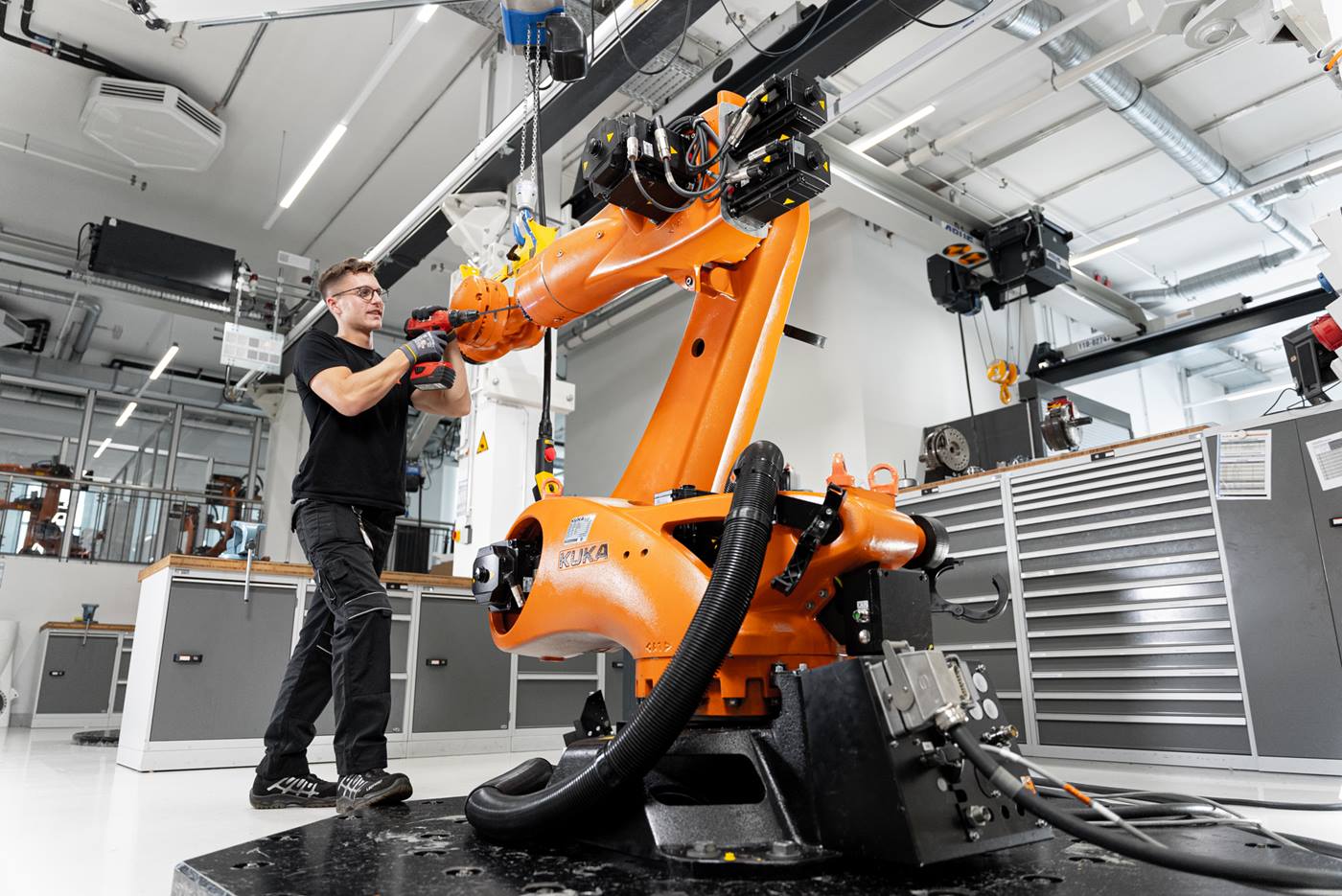
We also need to ask ourselves what happens to robots when they have reached the end of their life cycle: KUKA offers several options here. One of them is that customers return their robots and KUKA takes care of the recycling or reconditioning. Robots of newer generations are made fit for new applications in Augsburg and robots of older generations in Hungary.
This saves money and valuable resources. But it's not just pure reuse that is the trend, as Karoline Strobl, Director Parts, Repair & Used, describes: "What we are now seeing in the demand for used robots: Producers who want to make their production as sustainable as possible are happy to rely on second-hand machines with a lower CO2 footprint. Our customers are definitely becoming more sensitive when it comes to sustainability. The demand for used parts will increase and the topic of the circular economy will become ever more important."
In circulation with KUKA | CIRCLE
The circular economy is one of the most promising economic models when it comes to smart consumption. It conserves resources and avoids waste. And because the market for used robots is huge, the KUKA | Circle innovation team addressed the question: How can we build a sustainable business model based on used robots?
The solution: a platform under the KUKA umbrella where customers can buy and sell used robots. KUKA | Circle offers our customers not only a platform for buying and selling used robots, but also additional KUKA service products to support their business needs and increase the chances of a second life for used robots. Simple, fast and smart. Also in China, the largest and fastest growing robot market worldwide, there is already the possibility to buy used robots from KUKA.
In line with the topic, we are using the knowledge about the circular economy that has accumulated in the company as part of the Innovation Challenge 2022 of the same name. In collaboration with KUKA and Swisslog, a Group-wide training module has been created on our internal learning platform LMS. We will continue to live up to our corporate social responsibility (CSR) in the future by continuously developing our skills.
Saving as a key
Conserving resources is not the only hurdle for companies. The EU target of reducing greenhouse gas emissions by at least 55% by 2030 compared to 1990 also poses enormous challenges for manufacturing companies. Decarbonization is the process that should ultimately lead to us becoming CO2-neutral. But how can this be achieved? One important point is to reduce energy consumption. After all, the cleanest and cheapest energy is that which is not consumed in the first place.
The increasing use of renewable energy is also indispensable. However, this is most available when the wind is blowing or the sun is shining - and not necessarily when consumption is at its highest. The use of energy storage systems is required to balance this out. Batteries as storage systems are therefore a key technology for decarbonization. KUKA has been manufacturing and supplying automated assembly lines for batteries for many years and is also involved in related areas such as fuel cells and recycling. With this experience, KUKA Systems also accompanies and supports companies in other areas on the path to decarbonization.
Companies are paying increasing attention to reducing CO2 emissions along the entire value chain. This is primarily about the energy consumption of our products, but also increasingly about how and under what conditions our products were manufactured. Kerstin Heinrich shares this impression: "Our customers are increasingly asking about our supply chains and the carbon footprint of our products. This is already increasing and this trend will continue."
Swisslog relies on IntegrityNext, an online sustainability platform, to implement compliance with ESG (environmental, social and governance) and sustainability targets in supplier and risk management in the supply chain. The aim is also to focus more strongly on key suppliers in terms of expenditure and risk and to initiate measures in good time should the legal requirements change.
Focus on the essentials
In order to identify potential for improvement, but also risks, it is crucial to know your value chain. In a materiality analysis, KUKA has therefore identified the most important ESG issues that have a significant impact on the environment (Environmental), people (Social) and the company (Governance) across our entire value chain.
KUKA conducted the materiality analysis in accordance with the requirements of the new EU directive, the Corporate Sustainability Reporting Directive and the European Sustainability Reporting Standards (ESRS). In the analysis, the ESG topics specified in the standard were considered and evaluated from two perspectives: the inside-out perspective, which considers the impact of the company's business activities on sustainability issues, and the outside-in perspective, which describes the impact of the environment and society on the company that is relevant to business performance or business results.
The preliminary results cover the following ESG topics:
• Climate change
• Resource utilization and circular economy
• Own workforce
• Workforce in the value chain
• Corporate policy
• Customers and end users
In future, we will have to report on this comprehensively and Group-wide in accordance with the requirements of the ESRS standard. A strategy, objectives, measures and procedures will be developed for each ESG topic identified. We will also set up a reporting system to record the key figures worldwide. After all, we can only improve what is transparent and measurable. We have it in our hands.